EGT in Karting: Using Exhaust Temperature Data to Jet Right
EGT is the carburettor's thermometer. How to read kart exhaust temperature at the bottom and the top, against peak RPM, and the seize-risk drift.
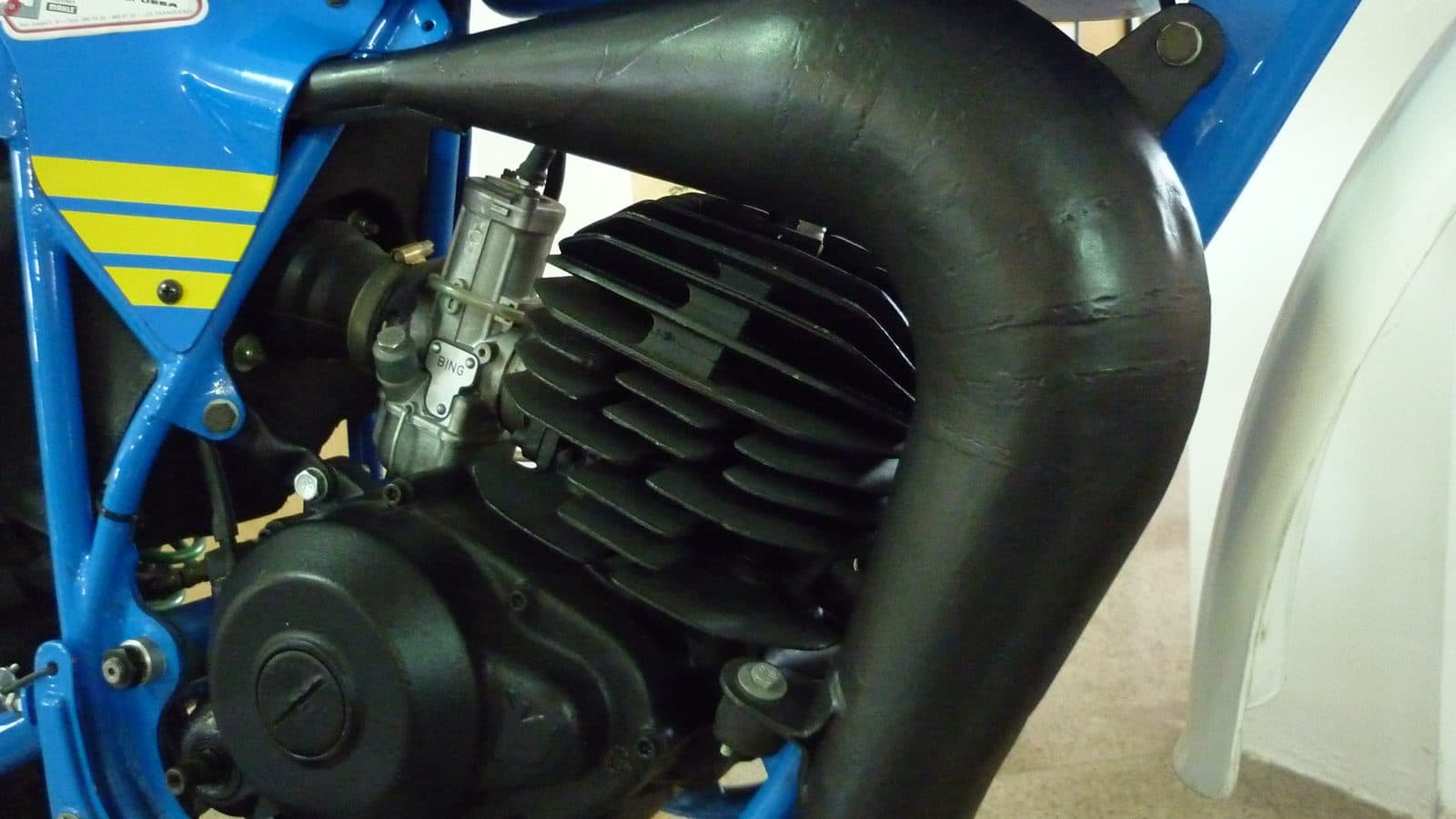

Every two-stroke karter lives between two fears. Too rich, and the engine is soft, dirty, slow. Too lean, and somewhere out there a seizure is waiting with your name on it.
The kart EGT sensor exists to manage exactly that trade. A probe in the exhaust reads the temperature of the burn, and the burn tells you where your carburetion really is, lap after lap, corner after corner.
It's the carburettor's thermometer, and at serious level it's not optional anymore. Here's how I read it, including the two traps that catch almost everyone.
What the probe actually measures
The sensor is a thermocouple sitting in the exhaust header, close to the cylinder. It reports the temperature of the gas leaving the engine, many times a second, straight into your logger.
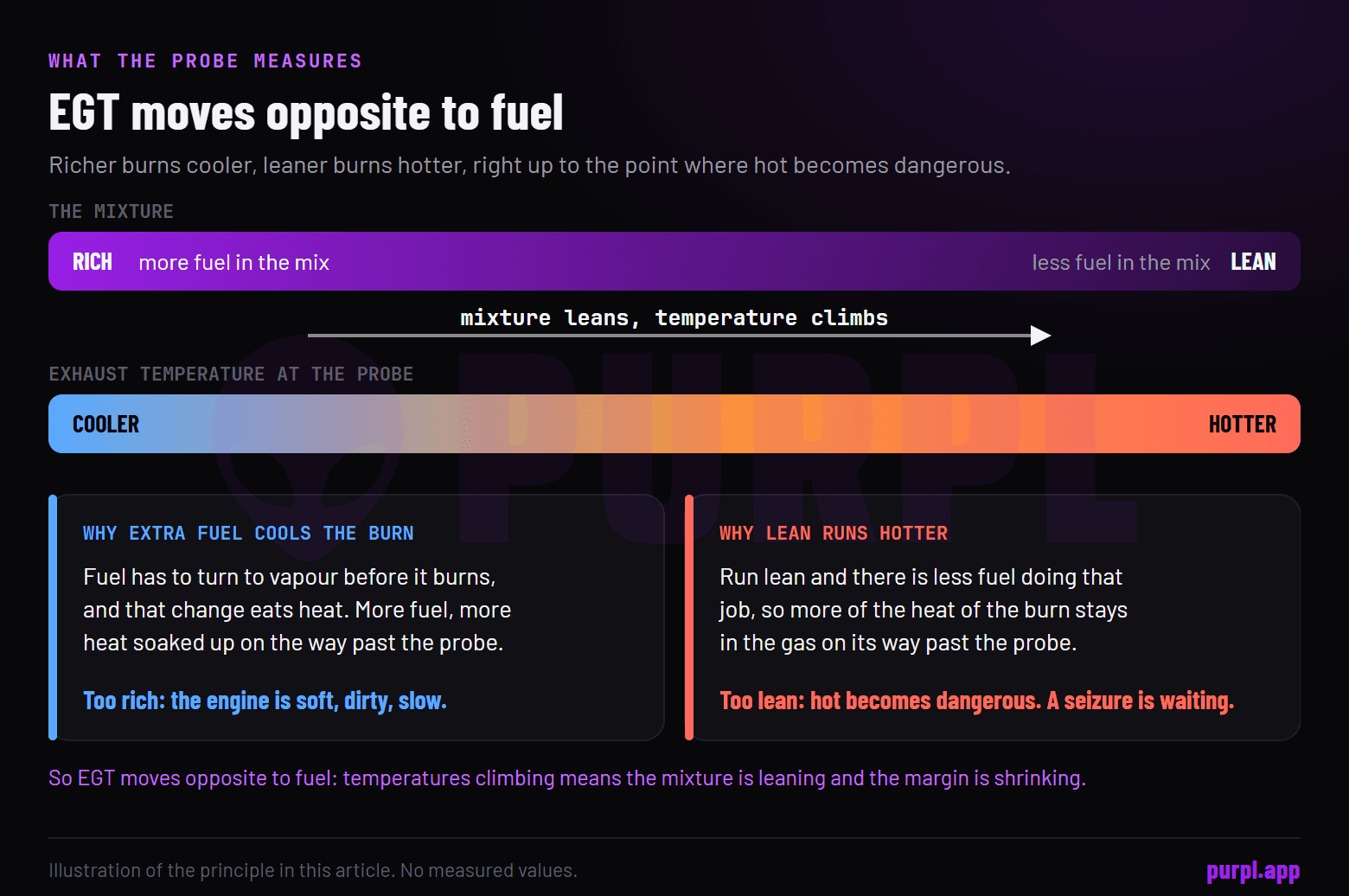
The chemistry is simple enough to trust. A richer mixture burns cooler, because the extra fuel soaks up heat. A leaner mixture burns hotter, right up to the point where hot becomes dangerous.
Why does extra fuel cool the burn? Because fuel has to turn to vapour before it burns, and that change eats heat. Run lean and there's less fuel doing that job, so more of the heat of the burn stays in the gas on its way past the probe.
So EGT moves opposite to fuel. Temperatures climbing means mixture leaning, and your margin shrinking. That's the whole principle.
The skill is in which numbers you watch, and when you're allowed to believe them.
Reading kart EGT: two numbers, not one
The biggest beginner mistake here is reading one temperature. It's two.
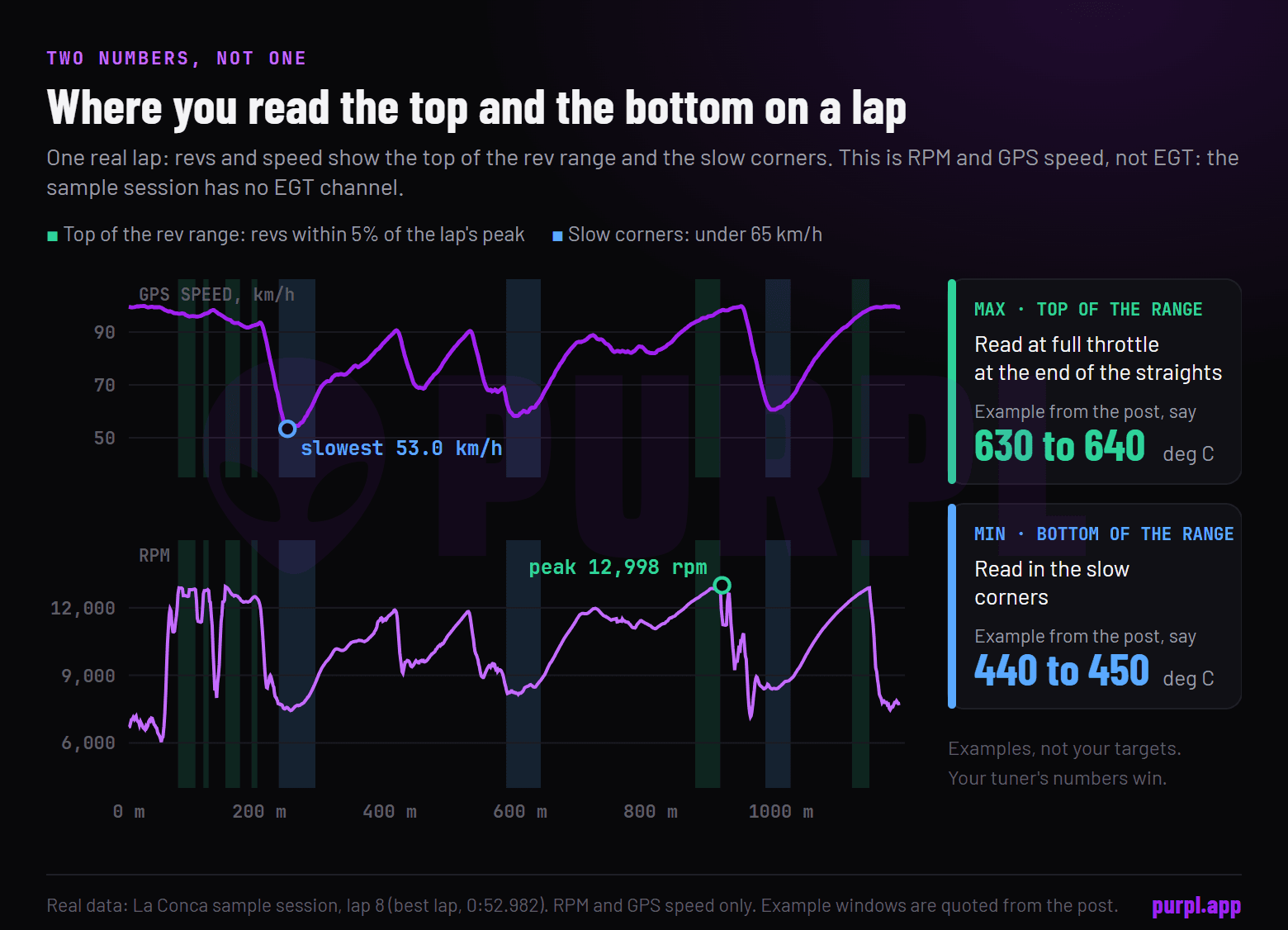
The maximum, reached at full throttle down the straights, describes your carburetion at the top of the rev range, and the minimum, in the slow corners, describes the bottom.
They answer different questions. They're tuned by different adjustments. And they need to be logged separately, never averaged.
The targets come from your engine tuner's dyno hours, and they're specific to your engine and fuel. To give you the shape of it with our numbers: a window of say 630 to 640 degrees at the top. Not so rich you lose power, not so lean you risk seizing.
And say 440 to 450 at the bottom; once the tuner names them, those values become the north star, exactly like the 50 degrees of water temperature.
Treat those as examples of the framing, not as your targets. Your tuner's numbers beat mine, every time, and the wider window idea is mapped in kart sensors explained.
Now make it practical. Say your tuner names the windows, and your straight-end maximum starts creeping above the top one. That's a lean warning at high revs, even if the bottom number is still sitting pretty.
Or say the bottom number sits low while the top is fine. That's a rich bottom end: dirty pickup off slow corners, nothing dangerous, just slow.
Two numbers. Two separate conversations with the carburettor.
The driving-style trap
Here's the trap that wastes the most carburettor adjustments in any paddock. By a distance.
EGT lines are heavily driving-style related. Two karts with identical carburetion will draw different EGT traces if the drivers pick up the throttle at different points. The burn follows the right foot as much as the fuel.
I've sat with drivers convinced their jetting was wrong because their EGT line split from their teammate's. Then I showed them. Wherever both karts went to throttle at the same moment, the temperatures matched exactly.
So the comparison rule is strict. Judge carburetion against another kart only where the throttle behaviour matches, ideally at the end of the straights where everyone is flat.
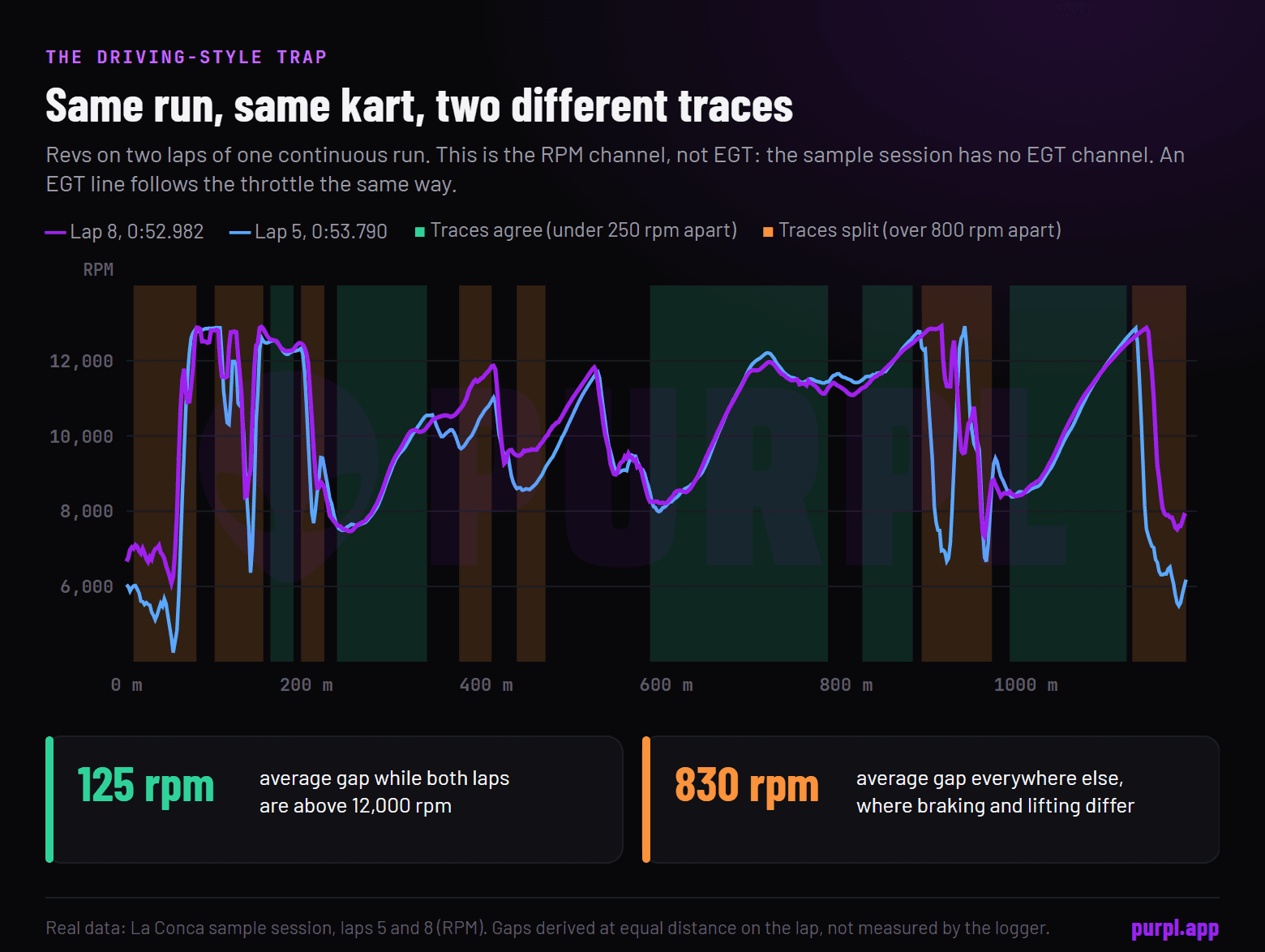
Mid-corner EGT differences are usually driving differences wearing a carburettor costume, and they're the same confusion filed under mistake seven in my list of data analysis mistakes.
The drift that seizes engines
Carburetion isn't a set-and-forget number across a race. It drifts, and the drift has a direction.
As laps go by and grip comes up, the driver naturally gets on the throttle earlier and harder. More throttle time means the mixture runs effectively leaner and leaner. In categories like OK and KZ2, that drift is exactly how engines get seized in the final third of a race.
The EGT trace shows it as a ceiling that creeps upward, lap after lap.
Which is why starting slightly rich is the classic race setup: you suffer a dirty first response early, and the engine cleans up as the race leans it. The sweet spot arrives mid-race instead of the danger zone arriving at the flag.
Start lean and the same drift works against you, with much worse failure modes. Rich is patient. Lean is not.
What does a healthy stint look like on screen? Peaks that sit inside the window and stay put, lap after lap, maybe edging up a touch as grip builds. Boring is good here.
An unhealthy stint is a staircase. Each lap's peak a little higher than the last, no flattening, and the minimum climbing with it. When the whole trace migrates upward together, blame the mixture, not the driving.
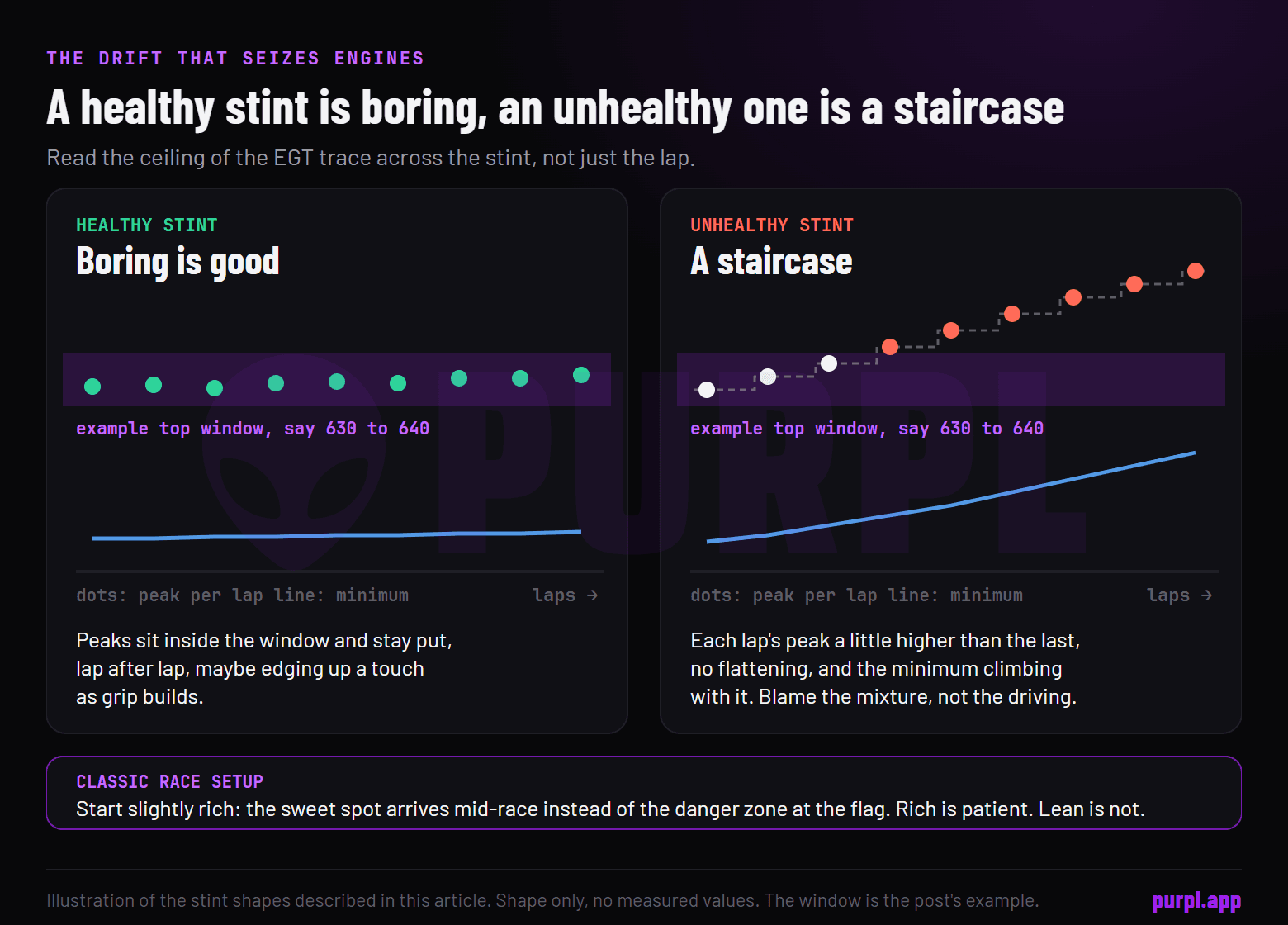
Watch the trend across the stint, not just the lap. A rising EGT ceiling is the engine telling you tomorrow's jetting, and the hardware levers live in jetting by the numbers.
The ear test still works
One old-school habit I refuse to retire, even with a perfect EGT trace on the dash.
You can hear a lean engine. The sound shifts, gets just a bit too loud and hard-edged, and that note told me more than once that the engine was struggling toward the edge of seizing.
The response is immediate and free. Richen the carburetion, or do the ancient karting move of putting a hand over the carb down the straight to force it richer for a moment.
The sensor confirms what the ear suspected, a few seconds later, in degrees. Use both. The ear is real-time and the probe is precise, and the combination is how two-stroke drivers survive hot afternoons.
Can you train the ear? Yes, and the safe way is to practice on days when you know the engine is rich. Learn the round, slightly flat note of a fat mixture on those safe days, so the hard edge of a lean one stands out the moment it appears.
Listen in the same place every lap, ideally the second half of the main straight. And use the ear in one direction only. A suspicious note earns a richer setting or a hand over the carb, never a leaner one.
Setup and comparison discipline
Three habits make the channel trustworthy.
First, mount the probe at the distance your engine builder specifies. Never compare absolute EGT numbers with a kart whose probe sits at a different distance. Placement changes the reading.
Second, log minimum and maximum separately in your session sheet, the routine from the sensors hub. Third, when something looks wrong, check the basics. A loose probe or tired connector draws drama better than any real problem, per installation discipline.
Here's my session routine for this channel. Glance at the dash max on the in-lap. Then write two numbers in the sheet before anyone touches the kart: the EGT maximum and the minimum.
That's it. Do it after every run, morning practice included. No exceptions.
The early numbers look harmless, but grip builds through the day, throttle time grows with it, and the same lean drift quietly works across the whole day too.
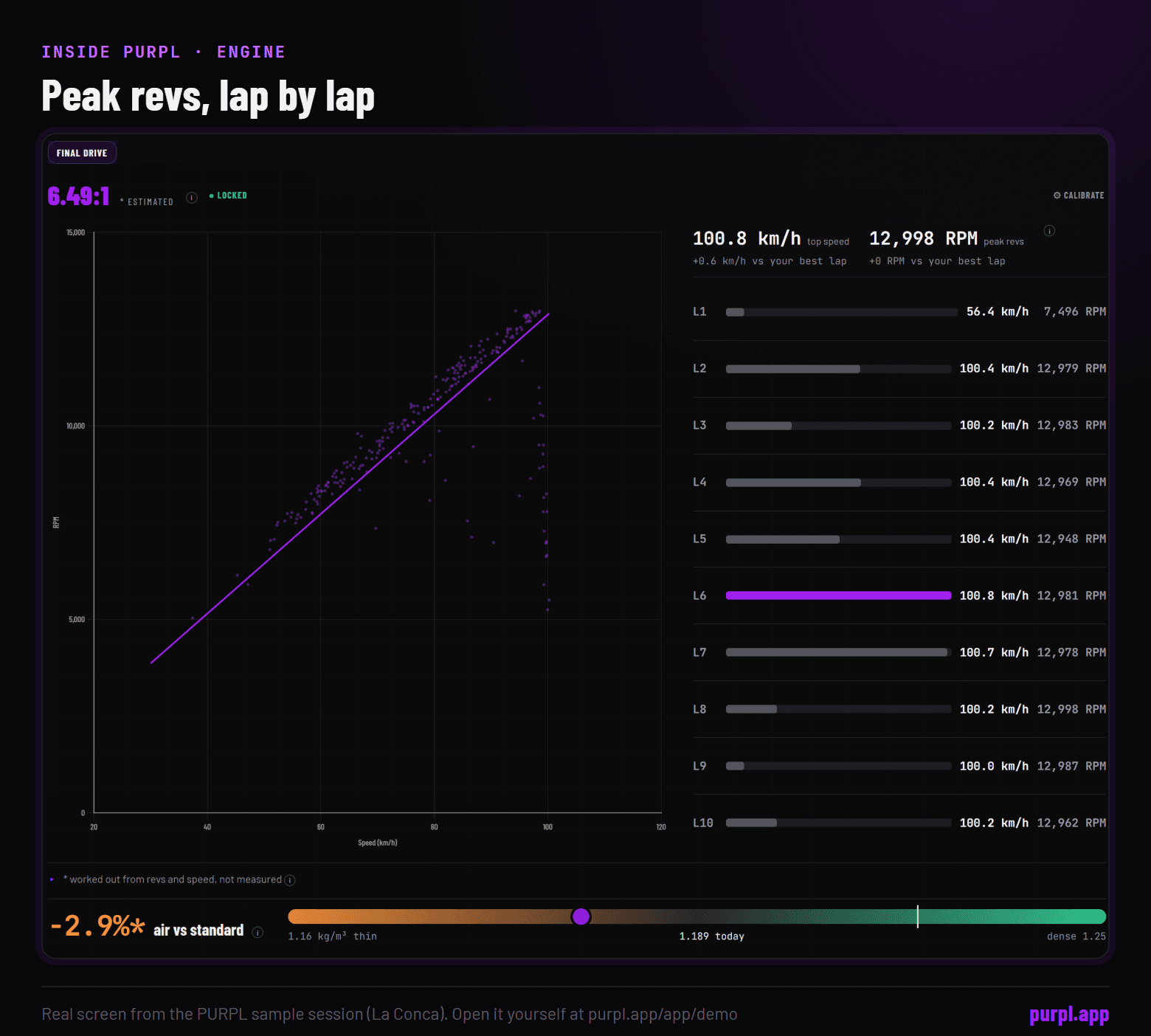
Cross-check the straight-end reading against revs while you're at it. EGT and RPM read together tell you whether the engine is healthy and pulling, the pairing I walk through in kart RPM data.
For the practical carburettor side, TKART's carburetion tools guide is solid. And the KartPulse EGT and carburetion thread shows real drivers working through real traces, useful calibration for what normal confusion looks like.
EGT against peak RPM: lean, rich, or something else?
Here's a question that came up on KartPulse on 7 October 2026. A KZ driver compared notes with another KZ driver. The driver's peak RPM was 14,400 against the other kart's 15,800, and their EGT was about 100 to 120 degrees F higher. On some straights the kart ran out of pull and had to shift early. Those are the driver's numbers, not mine, and the thread is worth reading in full.
The reasoning was the one almost everybody uses: smaller main jet, leaner top end, more RPM, more EGT, more power. Then the driver saw that their kart had the hot EGT without the RPM, so going smaller on the jet looked wrong. The driver was right to stop and ask.
So how do you read the two together? Start with the RPM, because the RPM number is the one people trust too fast.
Is the peak real?
Several people in that thread said the 15,800 was probably a downshift. The driver agreed it could be: it was the highest peak of the session on the logger. The comparison was against their own logger. Another poster said a dash max is meaningless without knowing where on track it occurs.
On a shifter, a session maximum can be a spike when you drop a gear. It tells you nothing about the carburettor. So don't use it. Open the trace and look at the end of the longest straight, flat throttle, same gear, lap after lap. That is the RPM that belongs next to your EGT, and it is the same place I told you to read EGT in the driving-style section above.
What the two numbers say together
Read both at that same point on the straight, on the same laps. Then use this as a map of what to check, not as a verdict.
| At the end of the straight | What it can mean | Check first |
|---|---|---|
| RPM reaches where it did before, EGT steady | Nothing has moved | Nothing. Log it as your baseline |
| RPM the same, EGT climbing lap after lap | Mixture leaning, the staircase from earlier | Go richer, listen, and read the plug and piston the way your tuner shows you |
| RPM flat or lower, EGT higher than your own baseline | Can be lean. Can also be late ignition, a different probe, or an exhaust that is not breathing | Probe and connector, ignition setting, a dent in the pipe. Not a smaller jet |
| RPM lower, EGT lower than your baseline | Can be rich and soft | Float, jets and needle, and whether the probe is reading at all |
The third row is the driver in the thread. And the others did not just say lean. They put other causes on the table. Firing the spark later sends more heat out of the exhaust port, so retarded ignition raises EGT. Different EGT sensors can read 100 to 150 degrees F apart, one poster said. A dent in the diffuser section of the pipe hurts the engine. And one of them corrected the driver on a timing change: going from 1.4 mm to 1.3 mm BTDC fires the plug later, so it retards the timing.
That is why I don't like to jet off one number. A hot EGT with a flat RPM trace is a question, not an instruction. The data narrows it down, and the piston crown and the plug finish the job, which is also what the driver said in the first post.
Do not tune to someone else's kart
The most useful line in the thread, from another poster: tune your own equipment from your own data, because adjustments based on someone else's equipment may not lead you the right way. Same story as the teammate question in the FAQ. Different sensor, different probe distance, different ignition advance, different fuel: the 15,800 on the other dash can't tell you what to do with your jet.
Another poster made the point that a higher peak is not automatically faster. An engine with less peak power can be quicker over a lap if it makes more usable power across the range. The RPM trace shows that too, in how fast it climbs out of the slow corners, the shape I describe in kart RPM data. And if the shortfall is at the end of the straight, gearing is part of the same conversation: kart gearing from RPM data.
The downshift side of this, where you drop the gear and how much engine brake you use, is a driving question. That one lives on senndit.com, in the shifter kart tips.
EGT or lambda?
Honest answer: I prefer lambda, because it measures the mixture directly instead of inferring it from heat, and the information is simply more accurate.
But EGT is cheaper, tougher, and everywhere, which is why it remains the standard tuning channel in most paddocks. Run EGT until your programme is serious enough to want the sharper tool, then read the lambda sensor guide before spending. Plenty of top tents run both and let them check each other.
FAQ
What should my kart EGT be?
Whatever your engine builder's dyno work says for your engine, fuel and pipe, read as separate top and bottom windows. Published numbers vary too much across classes and probe placements to borrow safely.
If you have no tuner numbers yet, log a known-good session and treat it as your baseline. Then judge every later session against that baseline. The trend is the information.
Why does my EGT differ from my teammate's with the same jetting?
Almost always driving style: different throttle pickup points produce different burns from identical carburettors. Compare only where you're both flat out.
If the numbers still differ at the end of the straight, check probe placement before touching a jet. Same engine, same fuel, same probe distance: only then do the absolute numbers earn a conversation.
Is a falling EGT at full throttle good news?
Usually the opposite of what it looks like. If peak temperatures sag while everything else is constant, don't celebrate. Suspect the reading or the engine: a tired probe, a connector, or combustion that's gone wrong.
Investigate before the next session, not after. Sensors fail far more often than engines, so start at the cheap end of the list.
Does EGT replace the water temperature channel?
No, they watch different systems. EGT guards the mixture, water temp guards the cooling, and a hot day can push both for different reasons.
The pairing, plus RPM, is the core two-stroke dashboard, as covered in the karting telemetry guide. Read them together at the end of each session, next to your lap times, and the engine has very few ways left to surprise you.
My EGT is higher than another driver's and my peak RPM is lower. Do I jet leaner or richer?
Neither, until you know the peak is real. Check that the peak RPM is on the straight at full throttle and not a downshift spike, then compare against your own baseline.
A hotter EGT with lower RPM can be a lean mixture, late ignition, a different sensor or a damaged pipe. Check those before you touch the main jet.
Is a higher peak RPM always better?
No. What counts is the width and shape of the power across the lap, not one peak. An engine with less peak power can be quicker if it makes more usable power where the track needs it.
Judge the straight and the exits together.
Alessio Lorandi started karting at six and won the 2013 CIK-FIA Karting World Championship. He raced through Formula 3, GP3 and Formula 2 before founding Purpl, an AI data coach for karting drivers.