Braking Repeatability: Why the Best Drivers Brake the Same Every Lap
Anyone can find a braking point once. Repeating it every lap, as grip and fuel load change through a stint, is the skill that actually wins races.

Everyone can brake on the limit once, but being able to brake at the limit every single lap, over a 25 lap race distance, well, that's what separates the great drivers from the good drivers. And the reality is that, uh, well, yeah, lots of drivers focus on, you know, braking late and braking hard and braking efficiently. That's all very important. But one other aspect they need to focus on, including myself, is on the braking repeatability. So the goal is that, of course, you're going to try to brake later and later, and you're going to try to, you know, get closer and closer to the limit, even going beyond the limit sometimes. But at the same time, when you get the optimal braking point, in a way, with a maximum braking pressure, with the given track conditions grip, well, then the goal turns into no longer trying to find the limit, but to be able to precisely and consistently sustain the brake point at the limit, every single lap. Yeah, that's, I mean, one of the core skills racing drivers need to have. And again, it's, it's all fair and easy to kind of get to the optimal braking point once. But the difficult part, as you may have already realized over your racing career, is that, you know, sustaining that peak performance in terms of braking, well, that requires a lot of precision, a lot of muscle memory, and a lot of consistency. And that obviously comes down to practice, as well as focus. And yeah, I, I think that ultimately, then, you need to make a distinction, because let's be honest, the grip level is not going to be the same across the session, especially if you're going for, as I said, a long 20 lap stint.
Grip changes through a stint, and the Le Mans example
Let's suppose you're starting out on new tires. You know, the first two, three laps at the beginning of the race, your tires won't be as hot, because, you know, even though you may have warmed them up as much as you could in the formation lap, they still won't be up to temperature and up to pressure as they will be on, like, lap four, five and six. And therefore, in the first laps, you just physically won't be able to brake the latest of the session and still be able to stop the car, because you probably won't have the same amount of grip level at the peak as you would have later on into the session. And also you would be full of fuel. So the kart is going to weigh three kilos more, roughly, from the end of the race, because, uh, yeah, I mean, you're gonna consume a lot of fuel during the race, so you're gonna have a heavier kart with a lower tire temperature and lower tire pressures. And therefore, it's not going to be, ultimately, the best kind of scenario for the ultimate latest braking and most efficient braking. Therefore, you'll need to know that the first two, three laps, even though you may not have the ultimate grip and braking efficiency, you'll still want to brake as late as you possibly can, so you can ideally warm up the tires, warm up the brakes, and get everything up to temperature. So that's really one thing. But yeah, you'll probably notice that by lap five, six, seven or eight, that's when you're going to have the peak grip during the session, because, again, your tires were new at the beginning, they just got up to temperature now, so you're ready to take full advantage. And you'll see that probably your braking point will be moved a bit further down the corner, so you can brake a tiny bit later, a bit more efficient, the car is going to grip up nicely. So that's when you have, pretty much, the peak braking capacity and efficiency. But then you'll notice that by the end of the race, let's say lap 17, 18, 19, you'll probably start to see that you're going to start to slide a bit on the tires, your tire temperature is going to go up, pressures are going to go up, and yeah, also the tread of the tire is going to go down. You know, you're going to start to lose really some actual tire tread, and therefore you'll have worse grip performance. So by the end of the session, you may not be able to brake as late and as hard as you were doing in the middle of the race, when you had the peak performance. So yes, of course, the goal is to ultimately try to replicate the braking points and the braking features as much as possible, but we also need to be realistic and obviously realize that it comes down also to the grip level on the track, the grip level from the tires, and so it will vary a lot.
For example, I was watching the race, uh, Le Mans, for the world championship, in KZ2 and KZ1, and I noticed that, uh, in the first four laps of the race or so, the track was super slow, and I was wondering why. Probably the tires were too cold, and yes, for sure that played a factor, even though LeCont tires normally warm up pretty quickly. But I think there was something to do with the track. So I feel like, like the first two, three laps, lots of drivers were fighting hard and going on the grass and coming back on the track, and bringing a lot of grass and dirt in the middle of the track. And so I'd feel like, by doing so, the track would get slower, because in those early laps there would be less grip, and because there would be more dirt in the track. And therefore you would be able to go slower into the corner. And so you wouldn't be able to brake as late, because if you try to brake as late as you do in qualifying, in the first two, three laps, when the tires and the track were dirty, then of course you're going to go straight. So yeah, I, I was looking at the first laps, yeah, the track was like two, three seconds slower, and it was quite crazy. And yeah, I have noticed this a lot of times in my career, that the first laps the lap time is slower, and therefore you just can't brake in the same place as you would want to, even you may be courageous enough to do it, but the grip level just won't help you in that moment to stop the car. So yeah, you really want to pay attention all the time to track conditions, conditions during the stint of a race, you probably won't be braking in the same place every time, but the goal is that when you arrive in that moment where everything stabilizes, and you have peak grip level as well as the acceleration efficiency, that's exactly the moment where you want to get super precise and consistent and replicate it. And I'll be honest with you, it's coming down to muscle memory, experience, it's not something you buy from day one.
Why karting doesn't use fixed braking references like cars do
Of course, what I've noticed is that, in karting compared to cars, as single-seaters or GT3 cars, you know, in karting you don't quite have lots of braking point reference. You brake more by feeling, and trying to really change the limits, feeling the conditions, feeling the grip level, and just braking to the limit that you have felt in the previous corner, or in the previous lap in the exact same corner that you're braking right now. So it really comes down to that. Whereas if you're in formula cars, you are arriving in Monza, for example, the first chicane, you arrive at 300 kilometers an hour, and you know you have to brake at 100 meters, because if you brake at 90 meters you're going to overshoot the corner, you won't be able to stop. So, you know, in Formula and GT cars, you really have to take advantage of their reference points, because that's the only way to be consistent, and arrive, let's say, in the only one shot you have in qualifying, and be able to brake exactly where you want to brake. Because if you're trying to brake by feeling, it's not going to work, sometimes it's going to be too late, sometimes going to be too early, and, uh, you know, sometimes it will be just fine, but you won't be able to build a consistency around that. Whereas in karting, you won't arrive at 300 kilometers an hour, I mean, we wish, but you would probably get to 130, 140 in the shifter kart at max, in a hairpin. And therefore, in that case, you know, it's so much easier to stop from 140 kilometers an hour than at 300 kilometers an hour, because obviously the speed that you travel is a lot different at those two different speeds. So, 140 kilometers an hour, 0.1 second difference in braking point, actually in braking moment in time, not really braking point, but yeah, 0.1 second difference in braking time, it's going to make a very small difference in the amount of meters that's going to travel the kart. Whereas at 300 kilometers an hour, one tenth of a second difference, well, it's crazy, because you travel a lot more distance at that 300 kilometers an hour speed versus the 140 kilometers an hour speed. So the distance that you travel is obviously proportionate to the speed that you're going. And so, of course, in karting you don't quite need braking reference points, because you arrive at much lower speeds. And I've noticed that you just don't need to use a reference point. And by the way, there are not even that many reference points in karting. And I mean, of course, if there would be, probably drivers would start to get advantage of those, it would probably make things more consistent and repeatable. But, you know, the reality is that we just don't have many of those reference points.
The Lonato exception, and why cones don't fix it
Yes, in some tracks, like, for example, at Lonato, when you go to the mechanics corner, which is basically turn number four, you arrive over there and it's quite easy to have a reference point, because you can just take the entry curb on the left hand side that you are using on the braking, in all categories, except in the shifter karts, because you don't really use the entry curb in that corner in a shifter kart. You're pointing at the apex while braking in a V-shaped style. So yeah, it's, uh, it's quite easy there, because, you know, you're gonna probably brake at the beginning of the curb, the left, or sometimes a little bit later, but it's good, I mean, you're gonna choose exactly when to brake in reference to that point. But the good thing is that you have a reference point. So, I mean, of course, if every corner had a clear and easy to use reference point like that one in Lonato turn four, well, then it would be, of course, way, way easier to deal with. But the reality is that there are not many corners and tracks that have clear braking points like that. So in all those cases you'll have to brake by feeling. But again, by the way, as a racing driver you will get used to it. Of course, for drivers that are coming from formula cars down into karting, they're going to notice a bit of a change, because they are so used to driving with reference points for their braking. But it is what it is, you can't change that so much. You can't go and put some cones here and there on the track to get your reference points. I mean, you can do that in the testing, in fact we do it a lot at the summer camps, with Babyrace, but you can't really do it in your race. And even then, you would not really, yeah, be able to take advantage of them, because for sure somebody would move them off. And if you just relied on those points during the testing, that you've put those cones here and there, then of course you'll be quite disappointed when you realize that they've moved the cones over.
Braking by sound
Then there's another way I like to kind of create reference points, in a way. Instead of just using the visual reference points, you can actually use the auditory braking points. For example, if I'm in a shifter kart, it's actually quite easy, because you're gonna kind of, like, match the gears in terms of the RPMs sound. And so it's quite, actually, easy to build a rhythm and build a pattern around that, you know, upshifting and downshifting, it's, it's actually quite easy. And it really comes down to building a rhythm, which ultimately is going to, yeah, just allow you to, you know, build the repetition, muscle memory around it. And, you know, you're arriving at fifth gear, and you're like, as soon as you arrive at the limit of the gear shift, then that's when you have to brake. When you feel like the engine has screamed and stopped screaming, and it's like not going up anymore, OK, then, you know, you have to brake. I mean, it's not really exactly like that, it's a bit of a mix between the visual cues that you have, like, you know, the speed arriving, that you have some marks on the track, you have some curbs that you can reference to, but also then it's a mix, again, as I said, visually and auditorially, because you can really quite hear the moment that you have to brake, based on the engine sound. So imagine trying to drive a car that has no sound. I mean, if you drive the electric karts, like, I've never tried it, but I would like to, just to have an idea, for sure it would be harder, because, like, you wouldn't really know exactly when to brake, because, uh, because, yeah, I think you wouldn't hear the engine screaming, and, based on how much it's screaming, you know when to brake. So I really quite feel that's something that's, uh, yeah, a bit of a pity that's not, uh, gonna be in the electric karts in the future, so we have to take advantage of, and enjoy, the combustion engine karts, so that we can actually get more confused with the brakes. I believe, though, that a driver that can predictably replicate their braking points, again, given exact grip conditions, I mean, it's a driver who's for sure going to be fighting for championships and race wins, because, again, I've seen lots of drivers that are very quick over the one lap, but they're not, you know, able to maintain a race pace, or even a season pace, in a way.
Consistency wins races, not one fast lap
But that's, of course, you know, the ultimate goal. The ultimate goal is not to have a one-shot lap. The ultimate goal is to have a consistently repeatable laps, because think about it. If you do it once and you can't replicate it, if you can brake late once and you can't replicate it, then probably you got it by luck, or by mistake, as I like to say, but a mistake that ends up doing a good lap for you. So the goal is that you're really understanding what you're doing, and remembering, in a way. And it always comes down to muscle memory. Like, I don't think you have to overthink it. It's for sure gonna be easier and easier for you to replicate that, the more laps you do, the more days you spend, but also the more focus you do.
What the data shows in PURPL
And by the way, inside of Purpl there's an actual channel that measures your braking. You find that both in the single session analysis and in the compared session analysis, you just have to go to the Braking tab, and then under it you just look for Brake Points in the sub-tab, and then you can easily and visually see the points the driver is braking across the actual stint. And you will see that, most of the time, the time that he braked the latest is the time that he managed to get the best lap time. Or maybe not the best lap time, but the best split in that specific corner where the braking is involved.
What repeatable braking looks like in the data
Take one corner and lay the braking from several laps on top of each other. If you are repeatable, the lines stack: the braking starts at the same place on every lap, so you see close to one line. If you are not there yet, the lines spread out, and the spread is your braking point moving from lap to lap.
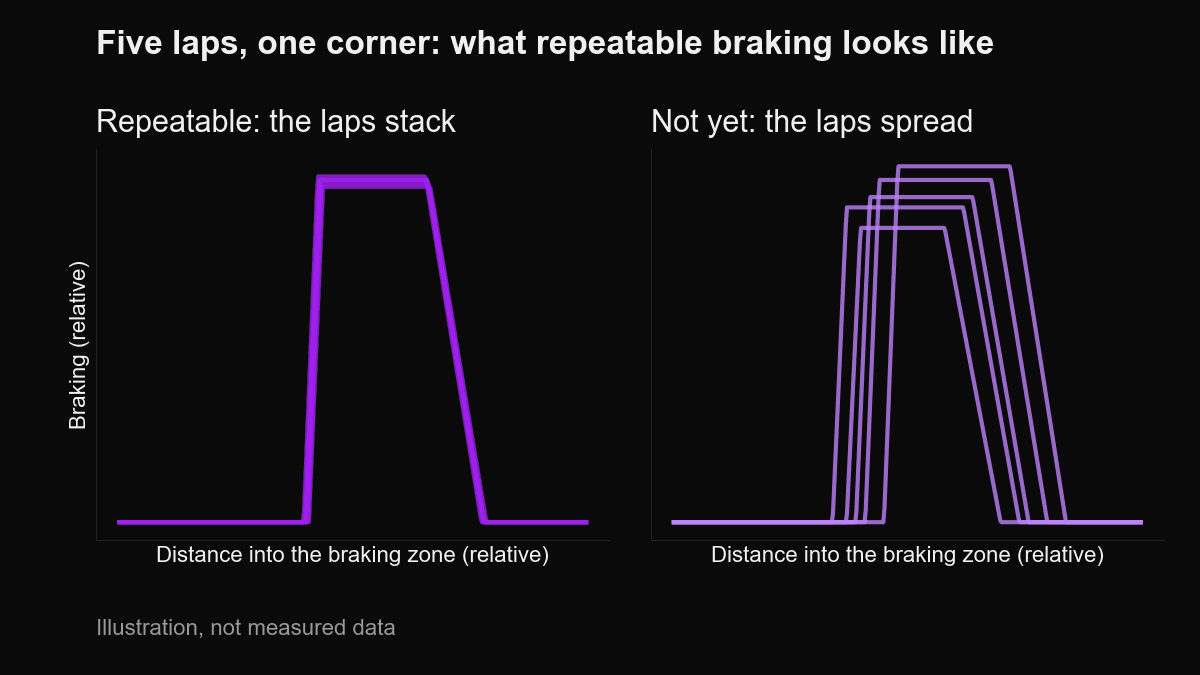
In PURPL this is the Brake Points view under Braking, and it looks at the three heaviest braking zones, corner per corner. It shows how far you are from being perfectly consistent on the brakes. Those are the corners that matter here, the ones where you arrive fast and have to stop for a tight corner like a hairpin. On a track with no real braking spot, there is not much to read.
The overlay is not supposed to be flat through the whole stint. It is normal to see the braking come earlier in the first laps, when there is less grip, and later once the grip is there. The other way around, braking later at the start and earlier at the end, only makes sense if the grip dropped a lot, and that is rare. A good session to track progress is one where you set out to brake later than in your other sessions: the data tells you if you managed it, how hard and how late you braked, and whether you still made the apex.
One limit to know about. This view shows your braking point and nothing else. It does not tell you if you got a good exit or even made the apex, so you can't rely on it alone. What it gives you is the consistency you had on the brakes. The goal is to get as close as possible to replicating your braking points, especially once you have experience at that track. When you are learning a new track it is harder, and that is fine.
Hairpins vs fast corners
If we then talk about the difference of repeatability between hairpins and fast corners, I'm going to say to you that, I mean, fast and medium speed corners is a little bit easier, I would say, because, I mean, in a fast corner, like, if you're getting too late on brakes you can still manage to get a really fast corner, unless you obviously exaggerately miss the apex. And vice versa, if you, you know, brake a tiny bit earlier, you can still release the brakes and carry a bit more exit speed. Of course you want to be as precise and as consistent as possible, also in the fast corners, but I do feel that, maybe you can relate to this, in medium and fast speed corners it's not going to hurt too much your braking point. Of course it will, but I think you can still make it up, whether you have initiated the brake a bit too early or too late. Whereas in slower corners, in hairpins specifically, when you arrive at a high speed, because that's the point, you know, if we talk about a hairpin where you arrive at low speed, because you just came back from another hairpin, so if you have, like, a back-to-back hairpin, then I don't think, again, the braking point is going to matter that much. I think the braking point and technique is going to matter more when you come at the high speed, and you have a proper hairpin, 180 degrees hairpin, and that's, yeah, I feel that's going to generate the most lap time when you are getting that one right. Whereas if you're overshooting it, or under pushing, and you're braking too early, you're gonna then end up turning in early most likely, and gonna get still a bad exit. So I just feel like the braking precision is gonna be more important in the hairpins that you're arriving at the high speed, and then you have a 180 degrees corner, versus the hairpins that you arrive at a low speed. Or even, you know, less important, are the medium and fast speed corners, where I do feel it's way more manageable, even in case you're not that precise on the initial braking point, being too early or too late. So I do feel that it's more manageable in the fast, medium speed corners, even though, of course, ultimately, if you want to become a next Max Verstappen or next Ayrton Senna, you're going to start trying to become a machine also there, in the medium and fast speed corners. There's no, there's no way around it. The more repeatable and predictable it is, the better it is.
Becoming a machine
And what I notice is that the best drivers are really the ones that, you know, you can't quite tell the difference from one lap to the other, not only when watching the driver, but also when you're reviewing the video, and also when you're reviewing the data, you're looking at the driver and you're like, wow, it's like every lap the same, it's like, it's like a autopilot. And that's what you have to ultimately aim to become. And I feel like in my golden years I've been able to accomplish that, it's like you're in a state of flow, and you're just getting faster and faster and faster, and at some point you stabilize, and you're like hammering the same lap times over and over again. And yeah, that's the ultimate dream for a driver, but also for a team manager, because, because when you have a driver that is able to be so consistent, then it's even easier to make changes on the car and feel the difference, and quite visibly see a difference, both on the chassis side and on the engine side. Because, you know, if a driver is inconsistent, it's going to be hard to tell whether the change provided an improvement or it was a loss. You know, because if a driver is inconsistent, it's going to give a lot of false positives and false negatives. Yeah. So you just want to ideally become a more consistent driver. On track, but also a lot of visualization, you're going to be able to massively improve this braking technique in terms of repetition. Remember, yes, you can do a lot of laps, but you can also progress and train yourself massively by visualizing yourself, by re-watching videos, by re-watching data, you know, by really going through that specific corner over and over again, that specific braking over and over again. And ultimately you'll become a machine. I'm aware, aware of that. It's going to take time, of course. It's not going to be happening in six months. It's going to happen, it's going to take a bit more time than that. But I'm sure that with enough practice, visualization, you know, discipline and focus, you're going to get there. It's going to take a bit. And when that's going to happen, you're going to feel like, wow, you know, it's just so enjoyable. And it just feels so good when you're at the peak of your performance, and you're able to reproduce that same lap time, that same braking, that same corner, over and over again. And that's going to get you closer and closer to those greats like Max Verstappen, Ayrton Senna. And you'll see that sky's the limit from there.
So I hope you enjoyed that. You can sign up to Purpl for free today, so you can start analyzing your lap times and finding performance in your own telemetry data, instead of having to have an engineering background analyzing yourself for complicated software. And if you want to massively grow in the next six months, you can sign up to the full six month training program on Senndit here below, with 600-plus pre-recorded lessons to take at your pace. So remember, keep sending it. I'll see you.