How to Measure (and Fix) Lap-to-Lap Consistency
Consistency over 20 laps is an index of how good a driver is. The numbers that measure it, what they predict in races, and how to tighten yours.

Ask me what separates a quick kid from a racer and I'll give you the same three words every time. Consistency, consistency, consistency.
Setting one quick lap is the easy half of the sport. The difficulty is repeating that lap over and over, and lap consistency in karting is brutally measurable, which is why so few drivers measure it. The number doesn't flatter anyone.
Here's how to compute yours, what it predicts, and how to make it better.
The standard I hold drivers to
My rule comes straight from my own career, and I'm pretty brutal about it. If you can't keep your pace within one tenth of your fastest lap, we have a problem.
I apply it to myself the same way. If I can only put three or four laps within a tenth of my best, I'm not being good enough. That's it. No drama, just "you're not doing a good job, man", and back to work.
I always like to say that the consistency of a driver over twenty laps is an index of how good the driver is. Speed impresses in qualifying. The twenty-lap index wins on Sunday.
Twenty laps, one tenth, no excuses.
How to measure lap consistency in karting
Three numbers, all computable in your analysis software or a spreadsheet in five minutes.
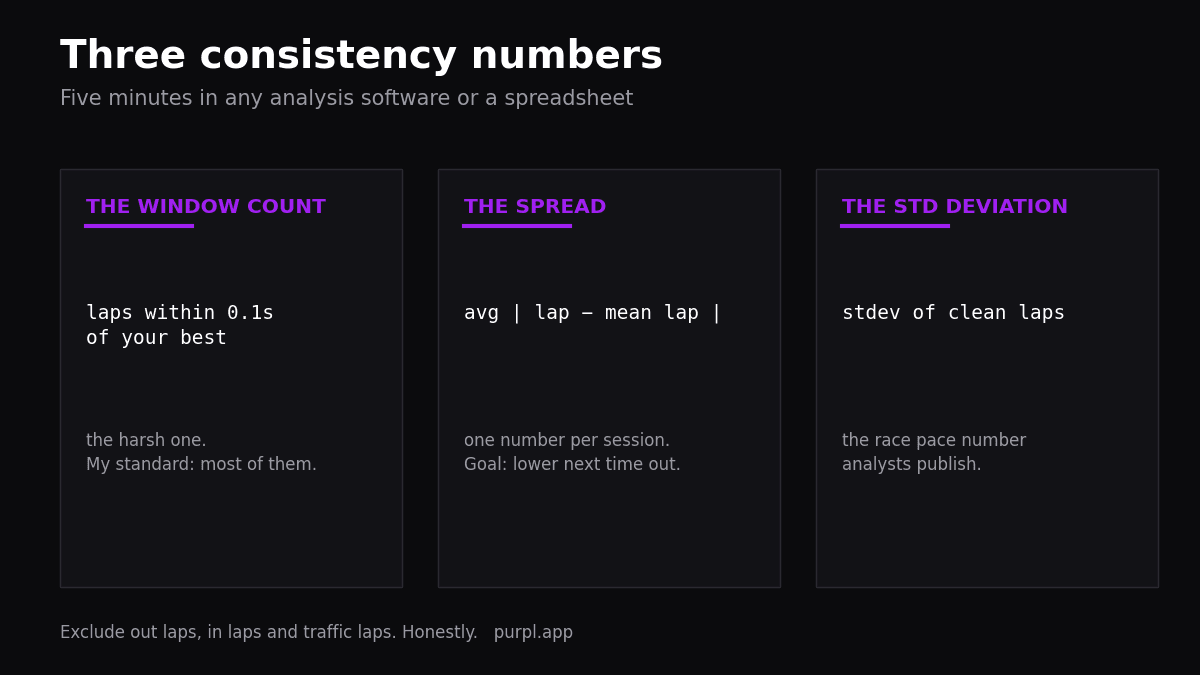
The window count. How many laps landed within one tenth of your best? Simple, harsh, and the one I check first. Out laps, in laps and traffic laps don't count, in either direction.
The spread. Average gap between each lap and your session mean. I used to compute exactly this from printed rental-kart timesheets in a spreadsheet, and the goal each visit was just to bring the number down. It's channel five in my math channels starter pack.
The standard deviation. The statistician's version of the spread, and what the data world uses for race pace. F1 analysts publish whole seasons this way, lap time distributions instead of best laps, and a site like F1 Pace shows how revealing the picture is. A tight distribution is a racer. A wide one with one heroic outlier is a qualifier with homework.
Don't overthink which metric to adopt. All three move together, so pick one, write it down every session, and stop changing the ruler. Numbers without dates are just trivia.
Count the laps that count
One refinement before you trust your numbers. Not all laps are made equal.
Twenty laps of committed, on-the-limit driving build something. Twenty laps of cruising produce a gorgeous spread and teach you nothing, because consistency at eighty percent effort is just repetition. The quality of the lap multiplies the value of the lap, in practice and in the numbers.
So pair the spread with intent. A tight spread at full commitment is the racer's number. A tight spread built on safety margins is a parked handbrake pretending to be a skill.
What consistency actually predicts
Why obsess over this number instead of outright pace? Because of what each one buys.
Pace buys you a grid slot. Consistency buys you everything after the start: defending without mistakes, attacking lap after lap, surviving the moment the tyres go off. In a 25-lap final, the driver lapping two tenths slower but every single lap beats the hero whose pace comes and goes. The arithmetic of that is in delta time, and it's merciless.
The people whose job is finding talent know this. When teams and managers scout drivers, they don't stop at results. They go through live timing and past races to check whether the good laps repeat, or whether the results were one-shots and mere luck. Enthusiast analysts do the same with race lap tables, the Clip The Apex lap analysis thread being a long-running example. Your spread is being read by people you've never met.
Where the variation comes from
Before fixing consistency, split it into its three sources, because each one has a different cure.
The track. Grip rises as rubber goes down, so some lap-to-lap drift is physics, not driving. Judge your variation against the session's trend line, not against a flat ruler. The method for separating the two is in track grip evolution.
The driver's hands. Wandering braking points, lines that change for no reason, a kerb taken on some laps and not others. This is the bucket data fixes best, one corner at a time, through sector analysis.
The driver's head and body. Focus fades, and it fades on a schedule. Compare your lap times before and after lunch some race day. A heavy plate of pasta and your afternoon laps lose the precision the morning ones had, which is why I eat small and often at the track instead. Unglamorous, measurable, real.
Split the stint in two
One more measurement habit. Compute your numbers twice: laps one to three, and everything after.
Opening laps on cold tyres, in traffic, with everyone sliding around in search of grip, will always be your widest. That part is racing, not inconsistency. The number that should be tight is everything after the tyres come in.
If the spread stays wide after lap three, now you have a real driving project. And if only the opening laps are wide, your project is warm-up and racecraft, which is different homework entirely.
Cold tyres tell their own story in the data, and it's a setup story as much as a driving one, the trade covered in kart tire pressure.
The fix: turn unforced errors into overpushing errors
Here's the reframe that did the most for my own consistency.
There are two kinds of mistakes. Unforced errors, where you miss an apex for no reason on a lap you weren't even pushing. And overpushing errors, where you asked the kart for two percent more than it had. Most drivers' inconsistency is unforced, and that's good news, because unforced errors are a focus problem, not a talent problem.
So put in the effort to translate your unforced errors into overpushing ones. Push to the limit deliberately, every lap, and you'll find the limit faster, improve your accuracy, and become both quicker and more consistent at once. Cruising doesn't protect your lap time. It just makes the mistakes boring.
Then work the loop. Find the corner with the biggest lap-to-lap variation, decide one reference to lock down, drive a session where your only job is hitting it every lap. The full version of that loop is my data analysis routine.
A session plan that builds the skill
Consistency trains like fitness: specific sessions, measurable result.
Once a test day, run a twenty-lap stint with no lap time on the dash. Just drive references. Afterwards, compute the window count and the spread, and write both in the notebook next to the conditions. Rental karts work beautifully for this too, the printed timesheet is the whole exercise, and the tight walls punish imprecision honestly.
Across a season those notebook lines become a curve. The curve is your real progress, far more than the PB list, and it's the number I'd show a team manager before any pole position. Once a season, do the full audit too: pull every race lap by lap and compute the spread for each in one evening. The trend across races tells you more about your trajectory than any championship table, because points reward circumstances while the spread rewards only you. I still run this on myself, by the way.
When the curve flattens, the next tenth is usually mental, which is a subject of its own in confidence and data.
FAQ
What's a good consistency number for a club driver?
From experience: at club level, half your clean laps inside two tenths of your best is solid, and inside one tenth is the standard I push serious drivers toward. At international level the front runners live inside a tenth for full stints. Measure against your own last month first. And log the conditions next to the number, because a tight spread on a green Monday is a different achievement from one in a rubbered final.
Should I exclude traffic laps from the calculation?
Yes, and out laps, in laps and obvious incident laps too. Consistency measures your driving, not your luck. But be honest with the cut: if "traffic" removes a third of your laps every session, your racecraft in traffic is the inconsistency.
Is consistency more important than raw pace?
They're stages, not rivals. Pace without consistency wins nothing on Sunday; consistency without pace defends midfield forever. Build repeatability at your current speed, then raise the speed and rebuild it. That ladder, repeated, is a karting career.
Which tool computes this for me?
Any analysis package will give you mean and standard deviation per session, and a spreadsheet does it from a pasted column of lap times. The exact formulas are in the consistency-spread section of math channels.
Alessio Lorandi started karting at six and won the 2013 CIK-FIA Karting World Championship. He raced through Formula 3, GP3 and Formula 2 before founding Purpl, an AI data coach for karting drivers.