Delta Time: The Most Useful Trace Most Karting Drivers Ignore
Delta time shows exactly where a lap gains or loses against a reference, metre by metre. What the line means, how to read it, and the math behind it.
Every analysis screen has one line that answers the only question that matters: where, exactly, am I losing time?
That line is delta time. In telemetry software it hides under different names, delta-t, time slip, time variance, but it's always the same idea. The running gap between two laps, drawn at every metre of the track.
Most karting drivers never open it. They stare at speed traces instead, which is like reading the witness statements before anyone has told you where the crime happened.
What the line actually is
Take two laps. At every point on track, subtract one elapsed time from the other. Plot the result against distance.
That's the whole construction. Where the line is flat, the two laps are matching each other. Where it climbs, you're losing time at that exact spot. Where it falls, you're gaining it back.
It's the only channel on the screen that's already done the comparison for you, which is exactly why it's the one to open first and the one beginners open last.
The reference lap can be your teammate's best, your own best, or your theoretical best stitched from fastest sectors. The line means something different against each one, which is why picking the reference is half the skill.
How to read delta time telemetry: three shapes
After years of doing this with drivers, I've found almost every delta line is built from three shapes.
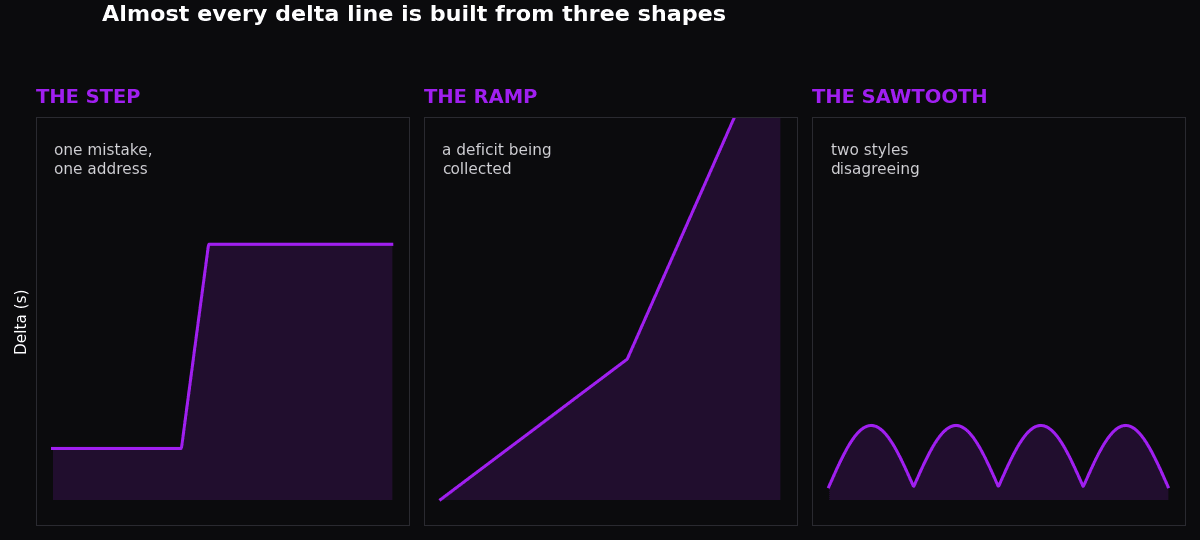
The step. Flat, then a sudden climb at one corner, then flat again. One specific mistake with an address. The step is the happiest diagnosis you can get: one corner, one fix. Go look at the speed trace right there and nowhere else.
The ramp. A slow steady climb along a straight. That's not a driving moment, that's a deficit being collected: gearing, a slipstream on the reference lap, or an exit speed gap from the corner before. The diagnosis method is in kart RPM data.
The sawtooth. You gain into every corner and give it back on every exit, or the reverse. Nothing is broken. Two driving styles are disagreeing, U against V, and the delta is scoring the argument corner by corner. The shapes themselves are covered in how to read a speed trace.
Read the delta first, always. Then open the other channels only where it moved. That reading order is the spine of my whole overlay method.
One warning about flat. A flat delta doesn't mean a perfect lap, it means a lap identical to the reference, mistakes included.
Two drivers braking forty metres early at the same corner produce a beautiful flat line between them. The delta only knows differences. Choose a reference worth differing from.
A corner read in numbers
Let me make the step shape concrete with a hypothetical that plays out at every club track.
Say the delta runs flat at +0.05 through the first sector. Then it steps to +0.21 across the hairpin and holds there to the line. That corner cost 0.16, and nothing after it added damage.
So the session has exactly one project. Open the speed trace at that hairpin only. An earlier brake point, a lower minimum and a lazier exit slope each write a different prescription, and the same step logic scales up a level in sector analysis.
Numbers first, channels second. The delta tells you the cost. The other traces tell you the cause.
The session view most people skip
Lap-against-lap is only half the channel. The other half is delta against your own average.
Build the reference from your mean race lap and the line turns into a stint report. Early laps under the line and late laps climbing over it means your pace is dying with the tyres, or with your neck. The neck part isn't a joke either: a late-stint climb with clean lines is a fitness verdict, and no sprocket fixes fitness. Random scatter around zero means the pace is fine and the repeatability isn't, which is better news, because repeatability is cheaper to fix.
I rate drivers on this view more than on any single lap. One fast lap proves potential. Twenty laps hugging the line prove a racer.
The math that should scare you
Here's a worked example I use with drivers, because the numbers are small and the consequences aren't.
Say the track record is 46.5 and we're both lapping at 99.5% of the limit, a 46.733. I'm leading by a full second with five laps to go. Comfortable, right?
Then pressure does its work. I get conservative and slip to 99.2% of the limit, a 46.875. The driver behind, with nothing to lose, pushes up to 99.8% and does a 46.593. The delta between us is now 0.282 seconds per lap.
A one-second lead divided by 0.282 is three and a half laps to zero. And in karting you don't need zero. A 0.10s gap is enough to send it down the inside, which arrives in 3.19 laps. My "comfortable" second was never comfortable. The delta knew before I did.
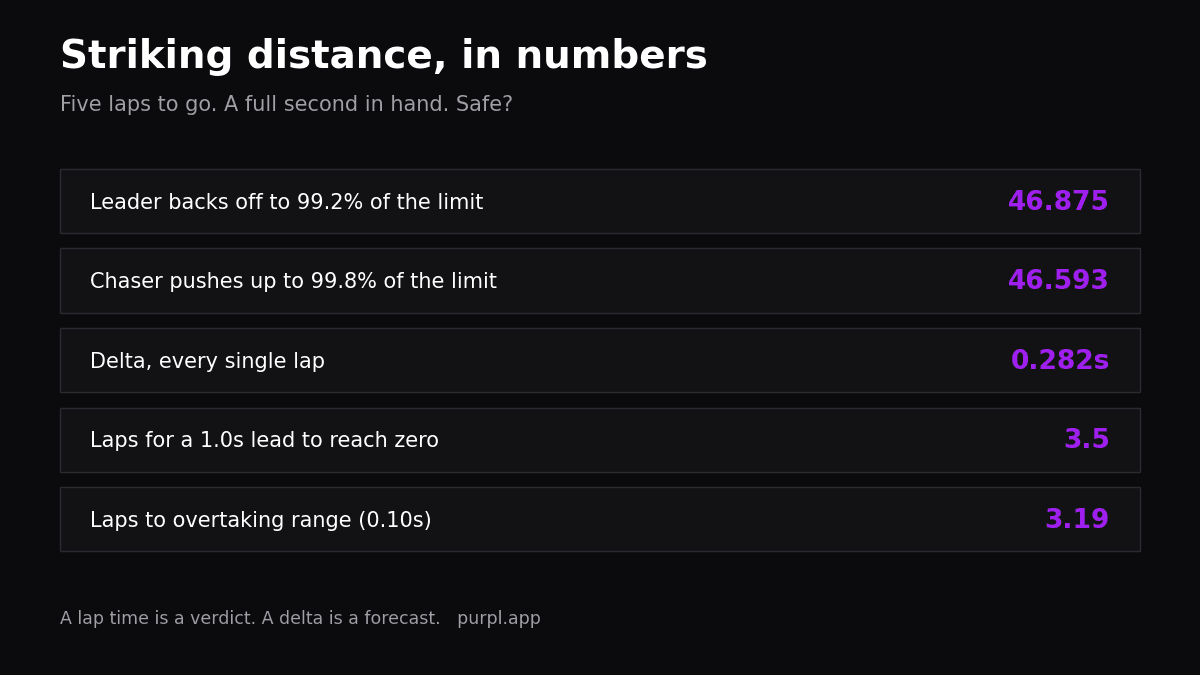
That's what delta thinking gives you that lap times don't. A lap time is a verdict. A delta is a forecast. Forecasts win races.
Run the arithmetic on yourself once mid-season. If your average lap sits three tenths off your best, that's three tenths times every lap of a 25-lap final, seven and a half seconds handed to the field. Do that math on yourself one evening. It stings, and it should.
Reference laps, and what each one teaches
Against a faster teammate from the same session, the delta is a shopping list. Each climb is a corner where his driving is purchasable, and the questions to ask there are in the lap comparison guide.
Against your own theoretical best, the delta measures consistency. The climbs show which corners you only get right sometimes, the subject of lap time analysis and lap consistency.
Against your own average lap, it shows your race pace truth. Qualifying heroes hate this reference. It's the honest one.
And honesty compounds. The driver who reads this view weekly knows his real pace to the tenth, while the one who keeps only best laps builds a museum of flattering days.
Should the delta live on your dash?
Modern dashes will happily flash a live delta at you every sector. My opinion, and I know it costs me an argument every time: leave it off while you drive.
I've watched a live delta kill laps a hundred times, including from inside my own helmet. You see the number, the brain starts doing maths instead of driving, and you brake early "just in case". The delta is a debrief tool. It earns its keep on the laptop after the session, not in your eyeline at the apex.
Where this gets interesting is what's coming. Software that reads the delta for you, between sessions, in plain language, is already arriving in sim racing and it's the direction we're taking Purpl. The discipline stays the same either way. The analysis happens after the lap, never during it. Tools that whisper the delta sensibly between sessions will change who wins club championships, and the drivers who built the habit early will be the ones it helps most.
Five minutes, every session
Download, pick the reference, read the delta left to right. Find the biggest climb. Open the speed trace at that corner only, decide one change, go drive it.
That's the entire workflow, and it's five minutes once the habit sets. The longer version, with sectors and full-session review, is in how to analyze kart racing data. If you want a second explanation of the channel itself, the data engineer Samir Abid wrote a clean introduction to delta-t.
HP Academy also keeps a worked video lesson on the time delta channel if you learn better by watching someone scrub a cursor.
FAQ
Are delta time, time slip and time variance the same thing?
Yes. Different software brands name the same channel differently. AiM calls it time variance, MoTeC users say time slip, broadcast graphics say delta. Television popularized the word, but engineers were reading this channel decades before it reached your living room. The construction underneath is identical: elapsed time difference against a reference lap, plotted by distance.
Which lap should be my reference?
For finding pace, the fastest clean lap available from the same session, yours or a teammate's. For consistency work, your theoretical best. Avoid references from other days; grip moves too much and the delta starts measuring the weather instead of you.
Why does my delta line drift even on the straights?
Usually a distance-sync issue. If the two laps' start lines or GPS tracks don't align, the whole comparison shears sideways. Check that your software is aligning by distance, and that both laps come from the same beacon or start-line definition.
Can a GPS-only logger show delta time?
Yes. Delta needs only position and time, which is exactly what GPS records. Every mainstream analysis package computes it from there, no extra sensors required.
Alessio Lorandi started karting at six and won the 2013 CIK-FIA Karting World Championship. He raced through Formula 3, GP3 and Formula 2 before founding Purpl, an AI data coach for karting drivers.