Analyzing Wet Session Data: What Changes in the Rain
Rain rewrites every number in your telemetry. Which channels still tell the truth, which references to throw away, and how I went from 2.1s off to wet wins.
Sarno, 2012, first round of the WSK Euro Series. Dry practice had me looking at pole. Then the rain came and stayed all weekend.
I qualified 49th out of 69, a whopping 2.1 seconds off P1. I didn't even make the final. The data didn't soften it, didn't excuse it, just printed the gap. And wet weather karting data has been an obsession of mine ever since, because the numbers are what turned that humiliation into a project.
What changes in the rain, channel by channel, and what to do about it.
First rule: throw away the dry reference
The most common wet-data mistake takes one second to make. Loading Friday's dry laps as the reference for Saturday's flooded session.
Everything that defines the dry lap has moved. The braking points, the minimum speeds, even the racing line itself. Because the rubber that gives grip in the dry becomes the most slippery surface on the circuit in the wet. Comparing against the dry tells you only that rain is slower, which you knew from the grid.
Wet sessions get wet references. A teammate's lap from the same session, or your own previous stint. Nothing else qualifies.
Reading wet weather karting data, channel by channel
Every channel still works in the rain. They just tell different stories, and the speed trace changes most.
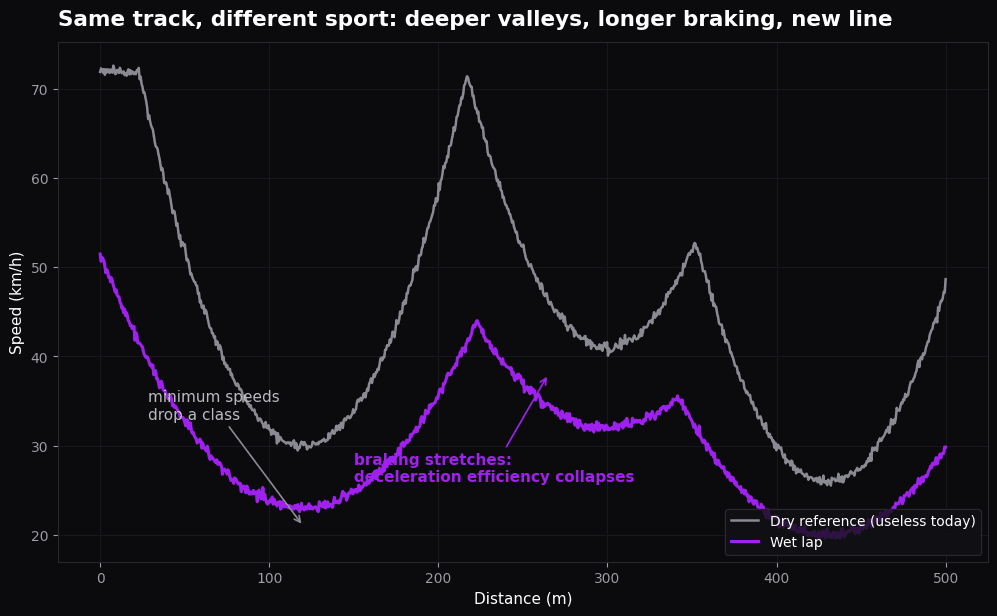
Speed. Valleys get deeper and wider. Braking zones stretch, because deceleration efficiency collapses when the track is wet; the stopping power you generate in the dry simply isn't available. Minimum speeds drop a class. Read shapes, not absolute numbers, and the shape rules from the speed trace guide still hold.
G-force. The friction circle shrinks to a fraction of its dry size, and the edge gets blurry, because wet grip varies metre by metre. A cloud that fills its smaller wet boundary is still the goal, the reading from the friction circle guide applied to a humbler circle.
RPM. Wheelspin everywhere. Rev flares without matching speed turn from an occasional diagnostic into a constant companion, and they map exactly where traction ran out. That makes the RPM trace your best wet throttle teacher on a kart with no throttle sensor.
The line itself. In the dry I barely glance at GPS track maps. In the wet they become a primary channel, because the fast line moves off the rubber, wide and strange, and two drivers' maps can differ by metres. TKART ran a good wet-versus-dry telemetry comparison showing exactly this in the traces.
The reference problem, and Val d'Argenton
After the Sarno disaster I did something that shaped how I think about wet data. I skipped a four-day school trip to Turin and spent the week testing in pouring rain, completely alone on track.
No teammate. No rival times. No reference at all, except the one the logger gave me: my own previous stint. I tested lines, pushed limits, spun when I crossed them, and measured every experiment against the run before it.
That's the wet data method in one sentence. When conditions kill external references, your last stint becomes the teammate, and progression becomes the metric.
It paid. From 2.1 seconds off at Sarno, I closed the gap enough to limit the damage at the next round in mixed conditions, then dominated the dry prefinal and final. Years later I'd won wet races in all four categories. My first two KZ2 wet races tell the arc best. Adria's WSK Final Cup in 2017 came with a ten-second lead, and the Trofeo Margutti at Lonato in 2018 by seventeen seconds in fifteen laps.
Not talent. Laps, measured honestly. The logger never cared about my feelings, which is exactly what made it the best coach I had that year. The skill that began at 2.1 seconds off was built one compared stint at a time.
What the gap number is actually for
One more thing about that 2.1 seconds, because the number did more than hurt.
It killed the excuses. I could have blamed setup, tyres, sprocket, carburation, and honestly at times I probably did. But a gap that size has only one honest owner, and the data made that impossible to negotiate with.
It also priced the project. Two seconds isn't a setup tweak or a brave lap, it's a missing skill, and missing skills respond to track time. My rival that year, Alex Palou, now an IndyCar champion, left that wet Sarno weekend with 85 points while I left with zero. He won the championship 48 points clear of me, and I didn't even hold on to second. The arithmetic of what wet weakness costs was right there on the page.
So when rain wrecks your weekend, do the unsentimental thing. Write the gap down, price the project, book the wet test days. That number is a syllabus. Mine read: wet laps, hundreds of them.
A track that won't stay still
The wet track is a moving target, and your data ages accordingly.
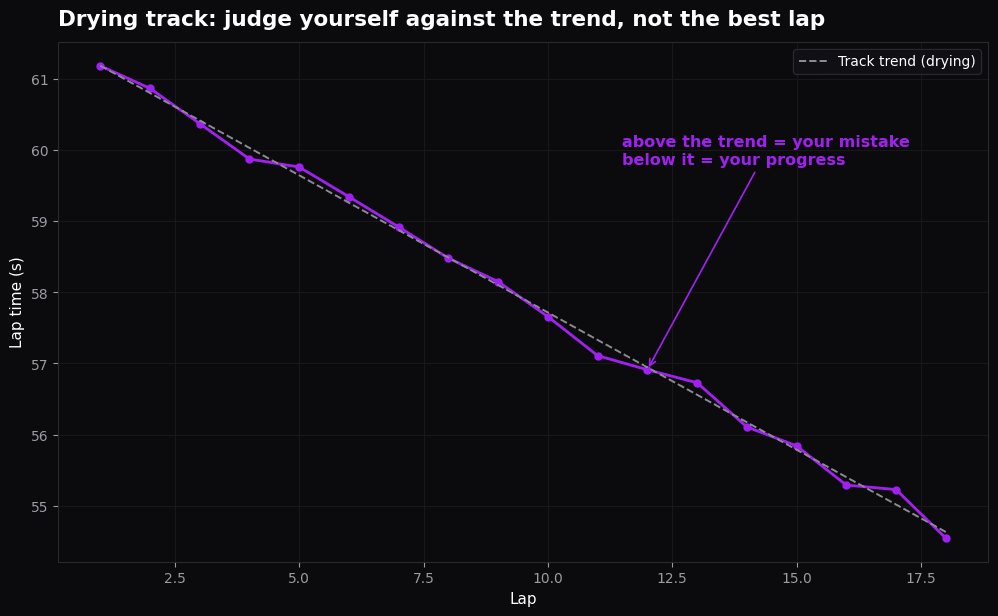
On a drying track, a lap from ten minutes ago describes a circuit that no longer exists. Corners dry unevenly too, and some hold water long after the rest has rubbered back in. At Lonato, the painted tarmac beyond the turn-eight exit kerb stays treacherous for hours after the surface looks dry. Local knowledge like that lives in data as corners that improve on a different schedule from the lap time.
My first wet win came at Castelletto di Branduzzo, the 2010 Trofeo Margutti, after exactly that kind of homework. It felt like liberation, proof the skill could be built. The point of this section is that the building material was ordinary: laps, stints, and comparisons against my own previous run.
So work with rolling references. Compare each stint against the previous one, not against the session best, and expect your consistency numbers to look terrible. In changing conditions a wide spread isn't a driving verdict, it's weather. The method for separating track movement from driver movement is in track grip evolution.
What I look for in a wet overlay
With a same-session reference, the wet overlay is the most honest coaching session in karting. Three questions, in order.
Where does the line differ? Track maps first, because in the wet the line IS the lap time, and metres of difference are normal. Then braking shape: wet rewards earlier, softer, longer braking, and the trace shows who's still braking like it's dry. Then throttle, through the RPM flares: who's straighter and smoother on the way out, especially in those first low-traction laps.
Notice none of those are about courage. Driver61's wet driving guide makes the same point from the technique side. The wet rewards the driver who adapts fastest, and adaptation is measurable, which is the whole point of running the overlay between every stint. The driving-side toolkit lives in karting in the rain.
The mindset the numbers taught me
One last thing, because wet data has a psychological edge no dry session matches.
The rain humiliated me before it taught me. I spun left and right with no clue why, the kart driving me instead of me driving it, and I could have blamed setup, tyres, carburation. With a gap that big, the only honest target was myself.
The word I used then, and still use coaching drivers now, is YET. Not good enough in the wet, yet. The data is what makes YET concrete: every stint comparison either shows progress or shows the next experiment. That's why I tell drivers to love wet sessions. Nowhere else does the gap between you and better show up this clearly, this fast.
FAQ
Should I even bother logging data in the rain?
More than ever. Wet sessions are where the biggest skill gaps live, and where data replaces the references the conditions take away. The only change is how you read it: shapes and progression instead of absolute numbers.
Why are my wet laps so inconsistent in the data?
Partly you, mostly the track. Grip in changing conditions moves lap to lap, so judge consistency against the session's trend, not a flat line. If your spread is still wide relative to a teammate in the same minutes, then it's you, and the overlay will say where.
Do braking points from a wet session transfer to the next wet race?
Loosely. Wet grip varies with how much water, which tyres, and which track, far more than dry grip does. Treat old wet data as a starting hypothesis and expect to re-find the limits within a few laps, the way you would on a new track.
Which single channel matters most in the wet?
The GPS line, which barely matters in the dry. The fast wet line moves off the rubber and keeps moving as the track changes, and finding it earlier than your rivals is worth more than any braking heroics. Speed shape second, RPM flares third.
Alessio Lorandi started karting at six and won the 2013 CIK-FIA Karting World Championship. He raced through Formula 3, GP3 and Formula 2 before founding Purpl, an AI data coach for karting drivers.