RPM Data in Karting: Reading the Trace for Gearing and Corner Speed
Your RPM trace tells you when the gearing is wrong, where the engine bogs, and which corners you're driving badly. How I read it, with examples.
Speed tells you what the kart did. RPM tells you what the engine lived through while it happened.
Most drivers treat kart RPM data as a peak number to glance at after the fastest lap, and that's maybe ten percent of what the trace knows. The other ninety percent covers your gearing, your corner speed, your clutch and even your driving mistakes, all written in one jagged line.
This article is how I read that line.
The shape of a healthy trace
Open any lap from your data logger and the RPM channel looks like a saw blade. Teeth rising along the straights, valleys cut into the corners.
On a single-gear kart, RPM and speed are locked together by the sprocket. That makes the trace beautifully honest. It can't lie. Every peak is the end of a straight, every floor is a corner minimum. The ratio between RPM and speed should barely change all lap.
When that ratio does change, something mechanical is talking. More on that below.
What kart RPM data tells you that GPS can't
GPS speed comes from satellites watching the kart. RPM comes from the engine itself, sampled off the ignition. Two different witnesses. The gaps between their stories are where the information hides.
Three things only the RPM trace will confess. First, clutch slip: revs spike off a slow corner while speed climbs lazily behind them. Second, a bogged engine: the floor of the valley drops below the power band and the whole exit suffocates. Third, chain and carburetion trouble, which show up as a ratio drift or a peak that fades lap after lap.
None of those appear in the speed trace until they've already cost you time. The revs show the cause, the speed trace shows the bill.
Gearing: the trace's main job
Here's the reading that pays for the logger. Look at peak RPM at the end of the longest straight, lap after lap.
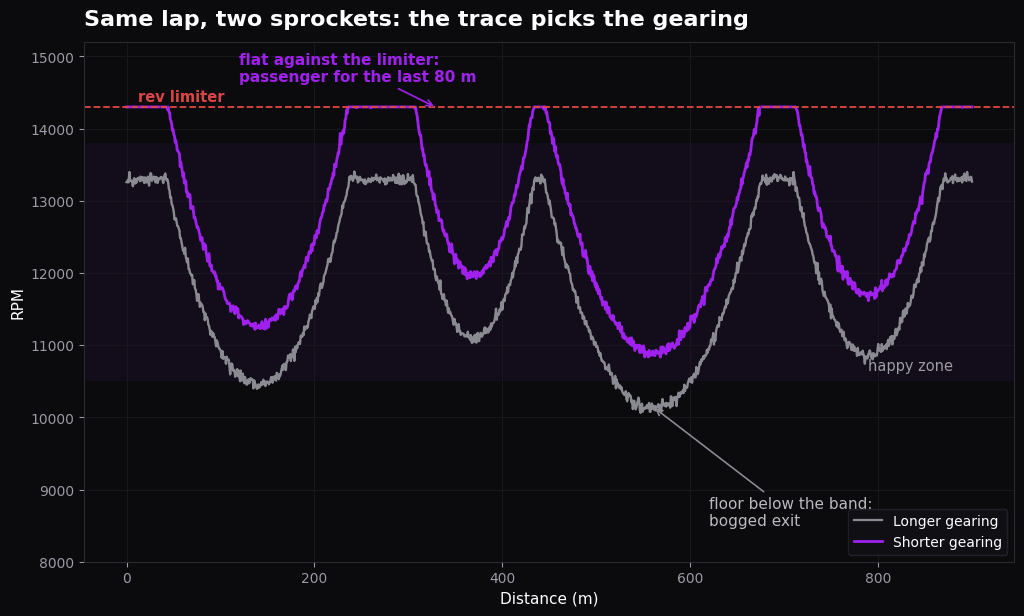
Too short a ratio and the engine reaches its ceiling with track still left, so the trace flattens against the limiter and you're a passenger for the last metres. Too long and the peak never gets near the power band's top, so the engine pulls like it's towing a trailer out of every corner.
Your engine has a happy zone, your tuner can tell you its numbers for your class, and the job of gearing is to keep the whole lap inside it. Peaks near the top of the zone, corner floors above its bottom edge. That's it.
The full sprocket-choosing method lives in the gear ratio guide. The basic mechanical trade is well explained in this gear ratio primer: more rear teeth buys acceleration, fewer buys top speed. The RPM trace is how you find out which one the track is asking for.
The corner floor: where races are lost
Now look at the bottom of each valley. That's minimum RPM, and on a low-powered kart it decides the whole exit.
Drop a couple of hundred RPM below the power band in a hairpin and the engine bogs. The kart then crawls through the first metres of the straight, and no amount of top end repays that. I learned this with my own hands as a kid, training with sprockets one or two teeth longer than optimal to force myself into higher minimum speeds.
This is also where RPM data exposes excuses. A driver once told me his sprocket was too small, so the engine had no bottom. The honest version of that sentence is different. He needed to use more track and open up the corner, carrying more minimum speed and keeping the RPMs up mid-corner, to make that smaller sprocket work.
Same trace. Two different drivers reading it. Excuse makers versus problem solvers. The racing line is an RPM tool, whether you think of it that way or not.
One corner, two traces
Here's a worked read from a club-day download. Hairpin at the end of the back straight, single-gear kart, driver convinced the engine is tired.
The speed trace shows a decent minimum. Nothing alarming there. But the RPM floor sits 300 revs below the band, and the first half of the exit slope climbs like wet cardboard.
Diagnosis? The corner is being driven too stopped for this gearing. Classic. Braked, turned, fired, and the engine never got its revs back in time to do the firing.
Two candidate fixes, in order. Drive the corner rounder and keep the floor up, which costs nothing and pays everywhere. Or accept the driving style and gear for it, the trade explained from the exit side in corner exit speed.
What you don't do is leave the mismatch in place all weekend. And drivers do, every weekend, because nobody put the two traces on the same screen.
Bottom versus top across a race
Gearing isn't only a lap-time question. It's a race-shape question. Almost nobody analyses that part.
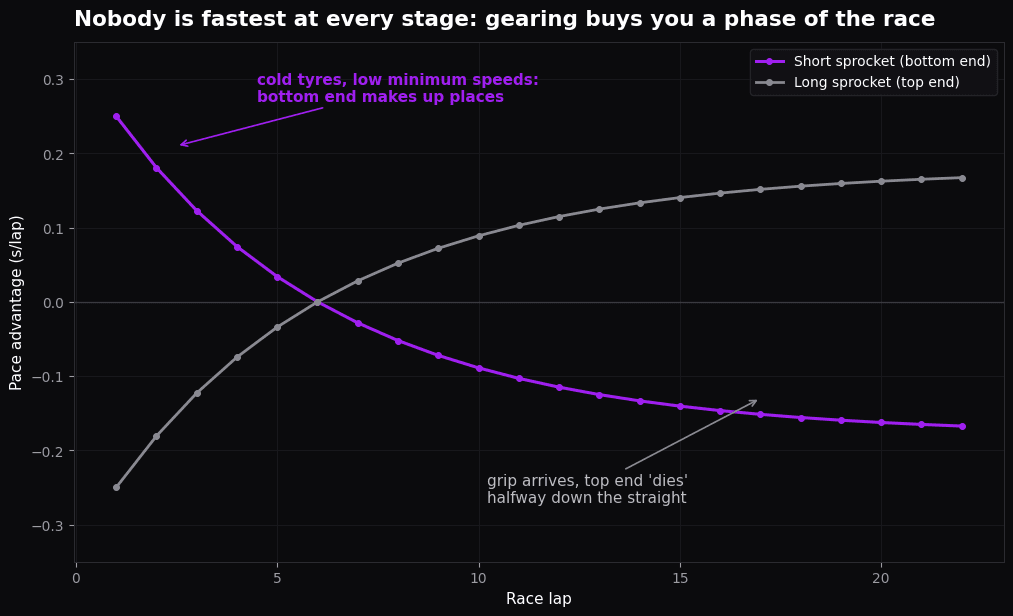
Run a short sprocket, with lots of bottom compared to top, and you'll be faster than most in the opening laps. Everyone is sliding around looking for grip, the tyres are cold, and the minimum speeds are low. You'll make up a couple of places early.
Then the grip comes, minimum speeds rise, your top end dies halfway down the straight, and the drivers who geared for the race's end arrive with a head of steam. You see where I'm going? Nobody gets to be fastest at every stage. The trace from the previous final tells you which stage you bought, and whether you'd buy it again.
Shifter karts: four extra questions
A KZ gearbox multiplies the reading. When I compare RPM against another driver in a shifter, I run a fixed list.
What gears are we using, and do we shift at the same point? Does he make a short shift where I pull the full gear? At what RPMs is he upshifting? Who's using more engine brake in the hairpins?
Each answer is worth real time, because gear choice in a KZ changes the shape of every exit. And the engine brake question changes the entries too, which connects this channel straight back to braking technique.
Comparing revs between two karts
RPM is the channel most abused by the excuses hat. A driver sees 200 RPM missing against his teammate at the end of the straight and declares the engine dead.
Hold on. Check three things before blaming the engine. Was the reference lap towed in a slipstream? Did the reference driver exit the previous corner faster, which the whole straight then inherits? And are the carburetion and jetting actually comparable that session, which is its own subject covered in jetting by the numbers?
In my experience most missing revs are missing exits. Check the exits first. It's not what drivers want to hear, because an engine problem costs money and an exit problem costs pride, and pride invoices are the ones we all avoid opening. The overlay method in comparing two laps settles it in five minutes. A broader primer on what each channel is for sits in the karting telemetry guide.
A ten-minute RPM routine
After each session, three checks. Peak RPM on the main straight across all laps: is it in the happy zone, and is it stable? Minimum RPM in the two slowest corners: above the bog line or below it? Ratio sanity: does speed divided by RPM stay constant, or is the clutch eating your exits?
Write the peak number on the setup sheet next to the sprocket you ran. Every time. Two race weekends of that habit and gearing stops being a guess. It becomes a lookup, the way 2-stroke classes running 10,000 to 15,000 RPM have always demanded, as the REV gearing guide lays out with charts.
One more habit worth stealing. When the track changes during the day, re-check the peaks before you re-check anything else, because rubber going down raises minimum speeds and drags the whole trace upward with them.
The sprocket that was right at nine in the morning is often a tooth wrong by the final. The trace knew at lunchtime.
FAQ
What RPM should my kart be pulling?
There's no universal number. Each engine class has its own band, set by the builder and the rules. The useful question is relative. Are your peaks and floors inside your engine's zone? Do they match the quick karts in your class on the same track?
Why does my RPM spike without the speed rising?
That's slip. Off slow corners it's usually the clutch; under power everywhere it can be a tired chain or wheelspin on a green track. The ratio check above catches all three, and the fix is mechanical, not driving.
Is a higher peak RPM always faster?
No. A higher peak often just means shorter gearing, bought at the cost of a weaker run through the middle of the straight. Judge gearing by lap time and exit quality, never by the biggest number on the dash.
Do I need an RPM sensor or is GPS enough?
Every mainstream kart logger reads RPM off the ignition lead as standard, so you almost certainly already have it. GPS alone leaves you blind to clutch slip, bogging and carburetion drift, which are exactly the problems RPM exists to catch.
Alessio Lorandi started karting at six and won the 2013 CIK-FIA Karting World Championship. He raced through Formula 3, GP3 and Formula 2 before founding Purpl, an AI data coach for karting drivers.