Throttle Trace Analysis: Where Karting Drivers Really Lose Time
Most karts never log the throttle, yet the throttle story is written in RPM and speed anyway. How to read application, hesitation and overlap in data.
Here's an awkward fact about the channel this article is named after. Most karts never record it.
Car drivers get a throttle position trace as standard. Karting mostly doesn't, unless you add a sensor. And yet throttle trace analysis still works on a kart, because the throttle story gets written into the channels you already log. The pedal leaves fingerprints on speed and RPM whether you sensor it or not.
This is how I read those fingerprints, and when the real sensor is worth the money. Because the pedal is where karting drivers really lose time, sensor or no sensor.
What a throttle trace shows, with or without the sensor
Three things, and they're worth more than the peak speeds everyone stares at.
Timing: where the power arrives relative to the corner. Progression: whether it arrives as one committed build or a nervous staircase. And lifts: the small mid-corner confessions where a driver breathed off the pedal and hoped nobody would notice.
Karting only hides the channel. It never hides the behaviour.
One more reason to care. Strong material hides weak throttle work. A grippy kart and a fresh engine will cover for late or messy application, right up until the day the material is equal. Data catches the habit while it's still cheap to fix.
Sim racing coaches read these all day, and the logic transfers straight to karts. Coach Dave Academy's throttle trace guide is a clean primer on the shapes. The difference in karting is just where you look for them, and KartClass's kart telemetry primer covers the same shapes from our side of the fence.
Throttle trace analysis without a throttle sensor
No TPS? You have two proxies, and together they recover most of the story.
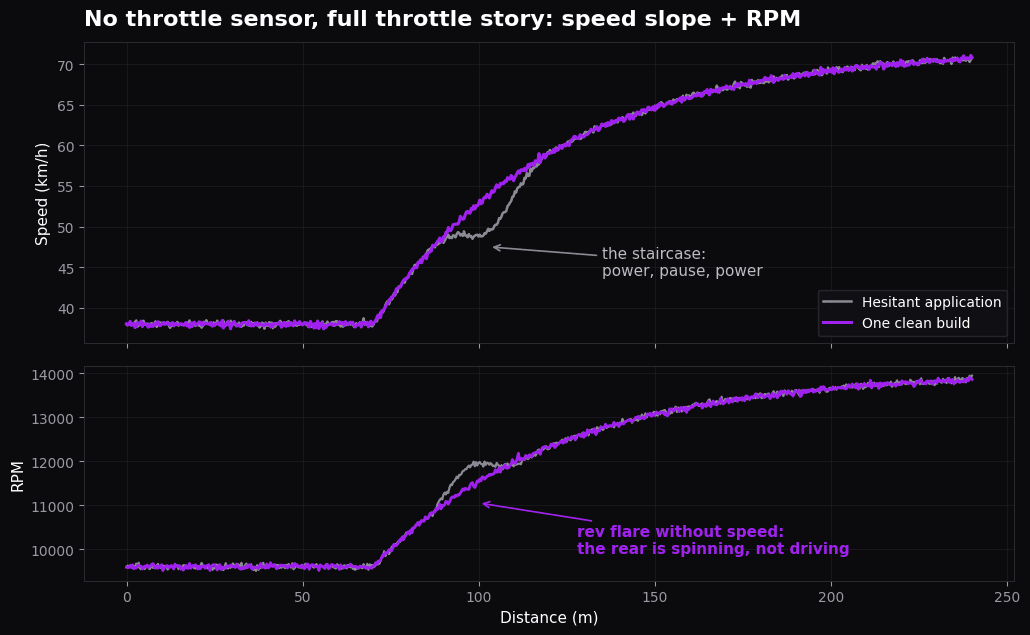
The first is the speed trace's exit slope. Where speed starts climbing and how cleanly it climbs is your effective throttle, the version the track actually received. A staircase slope is a staircase pedal.
The second is RPM. On a single-gear kart the revs respond to the pedal almost instantly, faster than speed does, so the RPM valley floor shows the exact moment of pickup. A rev flare without matching speed is wheelspin or clutch slip. The pairing method is in kart RPM data, and the slope reading in how to read a speed trace.
When is the real sensor worth it? Once you're chasing tenths at national level, or coaching seriously. A TPS turns inference into evidence, and the install options are covered in kart sensors explained. Mount it well and calibrate it twice, because a TPS that reads 80 percent at full pedal will lie to you for a whole weekend.
The earliest-throttle myth, again
If you read my exits article, you know my position: earliest pedal is not best pedal. The throttle view makes the why visible.
I've compared plenty of drivers who touch the throttle before their reference yet build speed later. The early pedal went into a sliding kart, the engine dragged against a scrubbing rear, and the trace shows power arriving long before drive does. Who gets on the throttle earliest is one of my standard comparison questions precisely because earlier is sometimes much worse.
The pedal lies. The slope doesn't. The number that settles it is where speed starts climbing, not where the foot moved. Judge the slope, then work backwards to the pedal, then fix the corner that made the early pedal useless, usually with corner exit speed thinking.
One build, not a staircase
The signature of a confident exit is a single progressive throttle build, matched to grip as the kart straightens.
Commitment has a famous payoff when the line earns it. In 2013 at Siena I found a way to take the fast turn one flat while others half-lifted. The trick was nailing the turning point and rotating the kart aggressively while staying full throttle. About a tenth a lap, from one corner.
The signature of doubt is segments. Power, pause, power again, each step a renegotiation with the rear axle. On the proxies you'll see it as a stepped exit slope and a sawing RPM line. The cure is almost never "be braver". It's an earlier, cleaner rotation so the kart is actually ready for power, which loops back to the entry work in braking technique.
Conditions move the target too. In the wet, especially the first laps before any line dries, traction is so poor that you want the kart straighter and the pedal smoother before committing. Same shape, gentler angle. The full wet toolkit is in karting in the rain.
Two corners from my own notes
To show how specific a throttle plan gets, here are two entries from my old self-briefing notes at Lonato. Real corners, written for myself at race pace.
Turn 9: don't be too early on the gas. Let the kart grip and rotate first, so the exit comes without running wide, because wide there compromises the corner after it completely.
Turn 10: open up the entry and use the engine brake early in third to settle the kart. Then pick the throttle up early, to avoid falling under torque below 9,800 RPM.
Notice that neither note treats early or late throttle as a religion. Each corner got its own answer, decided by grip, gearing and what comes next. That's the whole philosophy of this article, written in two corners.
When the engine answers the pedal late
Sometimes the hesitation in the data isn't the driver. It's carburetion.
A kart jetted rich responds to the first millimetres of pedal with a tiny delay, a "dirty" first response that cleans up as the engine leans through the race. Start lean and the opposite happens: crisp early, suffering late. Drivers get blamed for throttle hesitation that lives in the carburettor. The EGT trace tells you which story is true, the method in jetting by the numbers.
There's even a hardware lever most people never touch: throttle cable and pedal setup. Cable height trades responsiveness against modulation, and a pedal you're comfortable with is quietly worth lap time, because the better the feeling, the faster you go.
Overlap and the left foot
Karting is a left-foot-braking sport, which makes pedal overlap a permanent temptation.
A little deliberate overlap has real uses: holding the chassis settled through a fast transition, or keeping a two-stroke crisp through a long part-throttle phase. The accidental version is the expensive one. Dragging the brake into the throttle zone cooks the brake, kills the drive, and shows up in data as an exit slope that's soft despite early power.
The proxy check costs nothing: if RPM says power arrived but speed disagrees, and the kart isn't sliding, suspect your own left foot before the engine. With a shifter, add the short-shift question, since pulling a gear early to calm the rear is throttle management by other means.
A throttle session worth driving
Here's a drill I give drivers who hesitate, and it's deliberately humble.
Pick the two corners where the data shows stepped exits. For one session, your only target is one throttle application per corner. Not an early one. One. Apply when the kart is rotated, build without pausing, and accept whatever lap time comes. One application per corner sounds slow. It rarely is.
Then read the proxies. Cleaner slope, calmer revs, and usually, surprise lap time, because commitment was the missing ingredient, not courage at the brake board. Drivers fight me about this drill for exactly one session. Then they steal it for their own juniors. Fold the check into your normal data analysis routine and the staircase rarely comes back.
FAQ
Do I need a throttle position sensor on a kart?
Not to start. Speed slope plus RPM recovers most throttle behaviour on a single-gear kart. Add a TPS when you're coaching, racing at national level, or diagnosing something the proxies can't separate, like genuine pedal hesitation versus carburetion delay.
What does good throttle application look like in data?
One continuous build from the rotation point to full throttle, an exit slope without steps, and RPM rising in step with speed. The pedal may move later than you'd guess. The drive arrives sooner. On an overlay, the combination is unmistakable within two laps.
Why does my kart bog when I get on the throttle early?
Usually the corner, not the engine: a late minimum speed leaves the revs below the power band exactly when you ask for drive. Check minimum RPM and where your rotation finishes. If both are healthy and it still bogs, look at jetting and clutch before driving style.
Is throttle data racing software different for karts?
The analysis screens are the same; the difference is the channel source. Cars log TPS natively, karts usually infer or retrofit it. Every mainstream package will display and overlay whatever throttle channel you give it, alongside the proxies this article uses.
Alessio Lorandi started karting at six and won the 2013 CIK-FIA Karting World Championship. He raced through Formula 3, GP3 and Formula 2 before founding Purpl, an AI data coach for karting drivers.