Kart Understeer or Oversteer? Diagnosing Balance From Data
Front washing wide or rear snapping loose? A decision tree that reads minimum speed and steering corrections to name your kart's balance problem.

Every paddock runs on the same two complaints. "The kart's pushing." "The rear's gone."
Balance is the most discussed subject in karting and the least precisely diagnosed. A driver feels something mid-corner, names it wrong in the awning, and the mechanic spends the day fixing the wrong end of the kart.
So let's get precise. Kart understeer and oversteer leave different fingerprints in the data, and you can read them.
Understeer first. The front washes wide: you wind on more steering angle, the nose ignores you, the apex drifts away, and the minimum speed drops with every extra degree of lock.
Oversteer is the opposite end. The rear goes loose, you catch it with corrections, or you don't and it snaps.
The data tells you which one you have, where in the corner, and when in the session. That's the whole diagnosis, and this article is the map.
A decision tree for kart understeer and oversteer
Use this like a flowchart. Symptom, data check, verdict, first fix. One branch at a time.
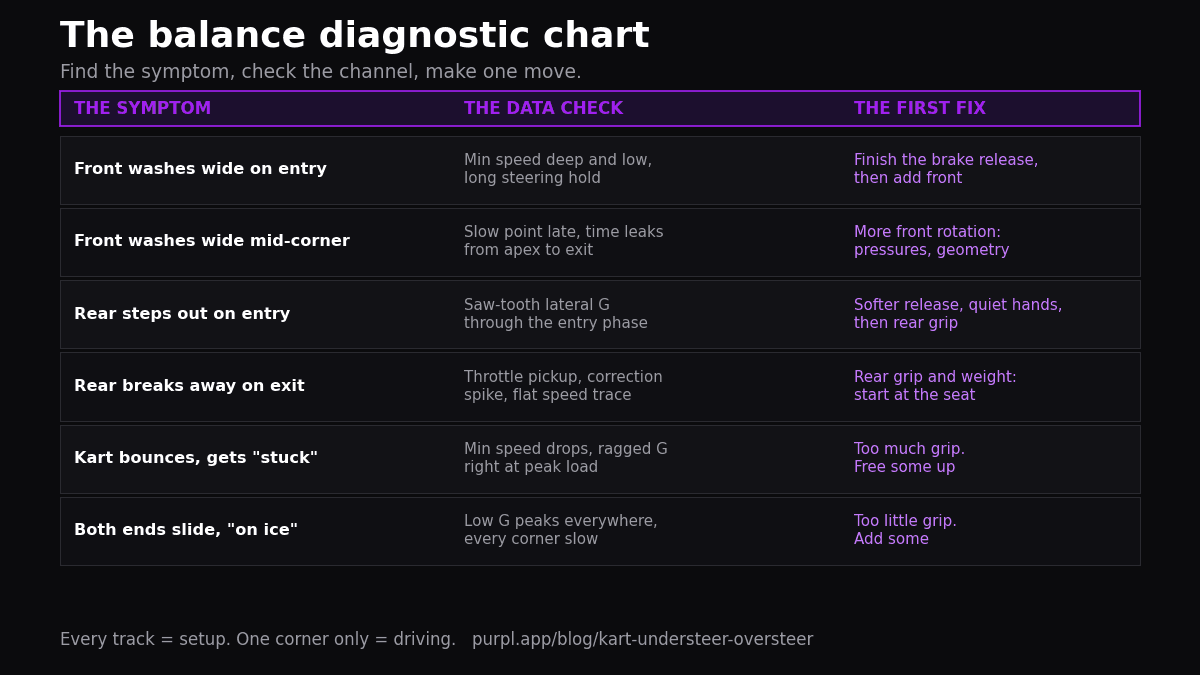
The front washes wide on entry
You turn in and the nose runs straight on. More wheel changes nothing. The apex arrives late.
Data check: the minimum speed point sits deep in the corner and low, with a long steering hold dragging the kart back to the line. The kart is being asked to brake and turn at once, the exact trade mapped by the friction circle.
Verdict: the front can't carry braking and steering together. First fix is the driving, a more finished brake release before the angle goes in. If the trace says you were already gentle, the front needs grip.
The front washes wide mid-corner
Turn-in feels fine. Then the kart drifts off the apex and you sit there waiting for the nose. And waiting.
Data check: minimum speed sits clearly below the reference, the slow point arrives late, and time leaks from apex to exit while the throttle waits for rotation that never comes.
Verdict: not enough front rotation. The fix lives at the front of the kart, and the levers run from front tyre pressures through the geometry adjustments in kart setup basics. KartClass walks the mechanical side well in its front-end setup guide.
The rear steps out on entry
You release the brake, turn, and the rear is already moving. Corrections before the apex, every lap.
Data check: lateral G through entry draws a saw-tooth instead of one clean arc. Each tooth is a catch with the hands, and a steering trace mirrors the same zigzag if you log one.
Verdict: the rear is unloading under braking. Fix the inputs first, softer release and quieter hands, the habits from steering technique. Setup comes second: more rear grip, or less load thrown forward on entry.
Hands first. Always.
The rear breaks away on exit
Power down, rear gone. The lap feels spectacular and the time is terrible.
Data check: throttle pickup followed by a correction spike in lateral G and a flat spot in the speed trace. Exit speed against the reference confirms the loss, and a small one compounds all the way down the straight into a gap you can read at the next braking point.
Verdict: the rear can't take the traction load. First fix is rear grip and where the weight sits, starting with seat position.
The kart bounces and gets "stuck"
Then there's the case nobody believes until they feel it: too much grip. The kart starts hopping mid-corner, gets "stuck", and you can't carry speed however clean the line is. Free up some grip.
Data check: minimum speed drops while the lateral G trace turns ragged at peak load. The hopping shows up as oscillation right where the arc should be smoothest.
You're driving "on ice"
The mirror image. Too little grip and both ends slide, nothing bites, and corner speed won't come no matter what you do. Add some grip.
Data check: no single-end signature. Every corner is slow, entry and exit both, and the lateral G peaks sit low across the whole lap rather than in one phase.
Is it the kart or is it you?
One last branch before anyone touches a spanner. Does the symptom appear at every track and in every corner of the same type? That's setup.
Does it live in one corner only? That's the line, the entry speed, or the technique, and the answer changes with the corner type. Drivers tend to blame the kart for their one worst corner and their own driving for nothing at all, which is exactly backwards more often than anyone admits.
What each problem looks like in the channels
Three reads carry most of the diagnosis, and none of them needs exotic sensors.
Minimum speed is the headline number. Understeer attacks it directly: less rotation means a lower, later slow point, visible the moment you put two laps together as in reading a speed trace. A kart can feel planted and still show its minimum speed bleeding away corner after corner.
Lateral G shape is the oversteer detector. A balanced corner draws one smooth arc up to peak load and back down. Corrections carve that arc into a saw-tooth, and the more teeth, the more the rear is moving.
Smooth arc, calm kart. Saw-tooth, loose.
Then there's where the time goes. Understeer loses it from apex to exit, through the low minimum speed and the delayed throttle. Oversteer loses it on exit too, but differently: every correction scrubs speed, and a sliding rear tyre gives up more as the stint runs on.
A loose kart also taxes the driver. Catching slides for ten laps erodes precision, which shows up as spread in lap consistency long before it shows up as a complaint.
Why champions run more front than feels comfortable
Now the opinion section. Although it isn't only mine.
The veterans of this sport agree on what winning world championships takes: strong braking and lots of front end. Danilo Rossi, five-time CIK-FIA world champion and the owner of DR, says you can't win a world championship without "the front", or in his Italian, "senza il davanti".
Here's the trap that pushes drivers the other way. A kart with little front grip can be genuinely fast over one lap: stable on the brakes, calm on entry, strong traction. But it loses minimum speed almost every time, because there's less rotation mid-corner.
A kart with lots of front rotation lets you put it right there. Precise at the apex, with limited steering angle. Maximum rotation arrives relatively early in the corner, mid-corner speed stays strong, and you open the steering earlier for a quick exit.
So why would anyone choose the low-front kart? Because it feels "stable" and "predictable", because it's easier to drive, and because nothing about it ever scares you on a flying lap.
And in a race fight, useless. You can't attack with it and you can't respond. You can't trust the kart to rotate when you throw a late move from two kart lengths back.
So you end up over the other driver's sidepod. Or you miss the apex and get switchbacked at the exit. Either way the position is gone.
The price of all that front is real, to be fair. Entry runs on the edge of looseness at the rear, because rear-to-front weight transfer peaks exactly there. That's the trade the quick guys accept.
Last time I checked, they didn't give any trophy for setting the fastest lap of the race. Rarely does the race winner set it anyway.
Build your balance for the fight, not for one screenshot of a timing screen.
Balance moves, so date-stamp the diagnosis
Everything above has a shelf life. A short one, too.
Track grip builds through the day as rubber goes down, and a kart that pushed on the green morning track can be loose by the time the final rolls around. Same kart, same driver, different track. The pattern, and how to plan around it, is in track grip evolution.
So write down when each complaint happened, not just what it was. Chasing Tuesday's understeer with Sunday's setup change is how weekends unravel.
And keep the driver inside the diagnosis. Even the best mechanics have blind spots, and the only person who actually feels the kart is the one sitting in it.
For the mechanical levers themselves, seat, chassis height, steering rods, TKART's setup walkthrough is a solid reference. The data's job is to tell you which lever, and in which direction.
FAQ
Why does my kart understeer?
Because the front has less grip than the rear at that moment in the corner. The cause splits two ways: setup, meaning front pressures, geometry or weight distribution, and driving, meaning entry speed too high or steering while still hard on the brake.
Find the where before the why. Entry understeer usually points at the braking-and-steering overlap, mid-corner understeer points at the setup, and the decision tree above names the first fix for each.
How do I fix oversteer in a kart?
Locate it first. Entry oversteer responds to a more progressive brake release and calmer hands. Exit oversteer wants more rear grip, and seat position is the first lever worth checking.
Then change one thing per session and reread the data. Two changes at once teach you nothing, even on the days they make the kart faster.
Is understeer or oversteer faster in karting?
Over one lap a pushy, stable kart can look quick, braking and traction stay strong, but it gives up minimum speed nearly everywhere and leaves you defenceless in a fight.
That's why the front of a world-level grid runs more front end than feels comfortable. Fastest lap is a statistic. Races go to the kart that rotates on demand.
How do I know if it's the kart or my driving?
Repetition is the test. A symptom that shows up at every track, in every corner of the same type, is setup. A symptom that lives in one corner is almost always line, entry speed or technique.
Data settles it fastest. Compare the problem corner against your best version of it from the same session, and the trace will say whether the kart ever could do what you're asking.
Alessio Lorandi started karting at six and won the 2013 CIK-FIA Karting World Championship. He raced through Formula 3, GP3 and Formula 2 before founding Purpl, an AI data coach for karting drivers.