Seat Position and Weight Distribution: What Actually Changes in the Data
The seat is the biggest setup lever most drivers never touch. Why it rules the kart's balance, what height cost me, and the before/after data experiment.

The biggest setup lever on a kart isn't an axle or a bar. It's where you sit, and most amateurs never touch it.
Kart seat position decides where the weight sits on the chassis. And on a machine with no suspension and no differential, that decides nearly everything downstream. How the inside rear lifts, how the kart rotates, how the tyres load and wear.
Here's why it rules so much, and what my own height taught me about it. Plus the before/after experiment that turns seat moves into data instead of opinions.
Why the seat rules the kart
The driver outweighs everything bolted to the chassis. That makes the seat the kart's main ballast mount.
Move it forward and the front tyres load harder: more turn-in bite, more rotation, a livelier rear. Move it back and the rear plants: traction, stability, lazier turn-in.
Raise it and weight transfers harder, the inside rear lifts easier, the kart "jacks" more in corners. Lower it and everything calms down.
None of this needs a dyno or an engineering degree, because the kart tells you on the very first out-lap and the data backs it up the same afternoon. Powerful lever, cheap test.
Every other setup change negotiates with the seat's decision. That's why it belongs early in a kart's life, not mid-weekend. Change it between race weekends, never between heats, because it resets everything else, per kart setup basics.
What height taught me the hard way
Centre of mass isn't theory to me. It's part of why my hardest season happened.
The year I fought for the World Championship, I'd grown tall. My higher centre of gravity stopped giving me the cornering speed the high-grip weekends demanded, the ones where karts ride two wheels at the kerbs. In those conditions I'd struggle to close the last tenth and a half on the very fastest drivers.
Shorter drivers had a real, physical advantage there: being twenty-odd centimetres shorter let them carry their ballast low, with the lead weights placed as low as possible on the seat. The same rule applies to everyone. Whatever weight your class makes you add, mount it low, because every centimetre of height is transfer you'll pay for in high grip.
The flipside was mine in winter: on cold, slippery tracks, my height helped load the outside tyres and build grip faster, winning me the opening races of the year. Centre of mass is a trade, not a defect, and conditions decide which end of it pays.
Mounting basics: start from the chart
Every chassis maker publishes seat-position measurements for their frames. That chart is your baseline, not your destination.
The standard references are two distances: rear axle to the seat's back edge, and the seat's front edges to the chassis tubes. A small asymmetry is built in. TKART's seat mounting guide walks the installation, and their seat-moving advice covers the direction logic by driver size and class.
And fit comes before all of it. A seat that holds your torso means the steering wheel stops being a handle, the ergonomic point from steering technique. Get the size right before debating millimetres of placement.
What does "right" mean? Seats come in fixed sizes, stepped in small increments, and the one you want holds your hips without crushing them. You should be able to brace against the sides through a corner without sliding.
Sitting between two sizes? Most drivers take the smaller seat, or take the bigger one and pad it out.
Padding is normal practice, not a cheat. Thin foam at the hips and ribs fills the gaps and spreads the load over a long day. Because a driver who slides around in the seat is moving ballast mid-corner, and no position on earth survives that.
Testing kart seat position with before/after data
Seat changes are where paddock mythology thrives. The effects are real but subtle, which is perfect mythology fuel. The experiment format kills it.
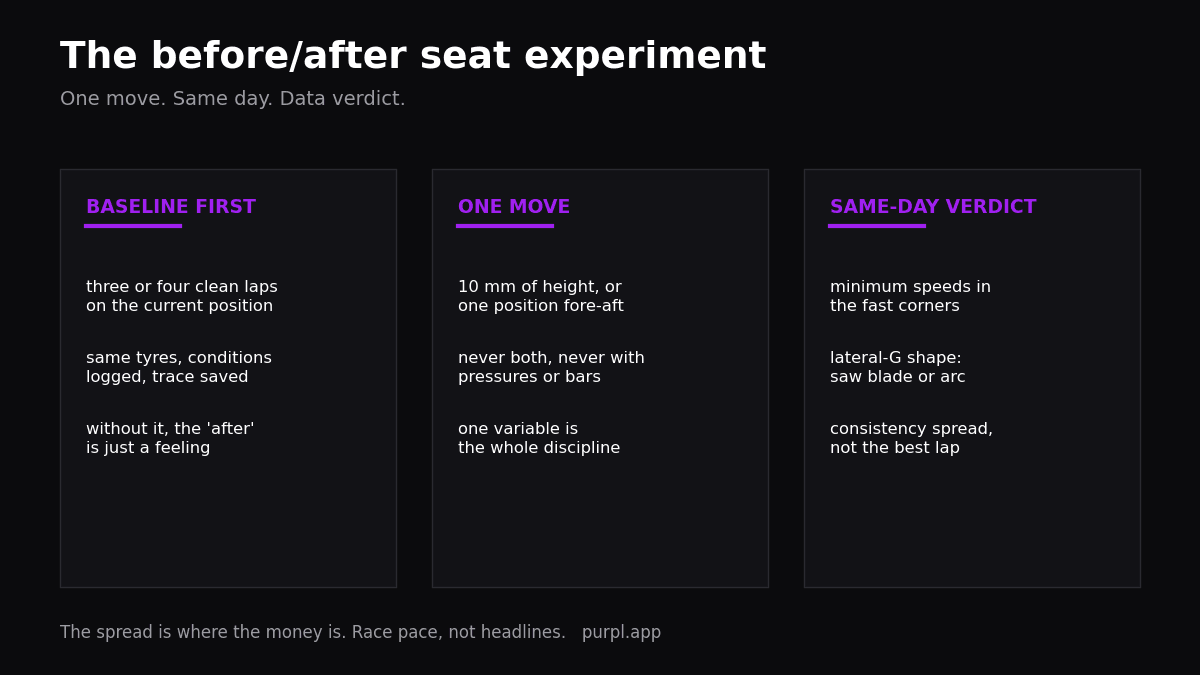
Baseline first. Three or four clean laps on the current position, same tyres, conditions logged, the trace saved. This is the "before", and without it the "after" is a feeling.
One move. One change only: ten millimetres of height, or one position fore-aft. Never both, never combined with pressures or bars.
Same-day verdict. Back-to-back, then read three things. Minimum speeds in the fast corners, where the seat's effects bite hardest.
Next, the lateral-G shape, where a kart that's jacking too hard or sliding flat shows its character, per the friction circle. And the consistency spread, because a friendlier kart repeats better even when its best lap doesn't move, the number from lap consistency.
Want it concrete? Walk through the classic case: a kart that hops through fast corners on a high-grip afternoon. The chart says the seat sits within spec, so the temptation is to chase pressures all weekend.
Run the experiment instead. Log a clean baseline, then drop the seat ten millimetres and change nothing else.
Same tyres, same fuel load, same driver. One variable. That's the whole discipline.
The "before" trace tells one story. Minimum speed in the fastest corner sags as the hopping builds. The lateral-G line through that corner looks like a saw blade: load, release, load, release.
The lap times scatter too, because the driver never gets the same kart two laps running.
The "after" trace tells another. With the weight sitting lower, the kart transfers less, so the inside rear comes up later and sets down softer. Minimum speed steadies, the G line through the same corner smooths into one clean arc, and the kart stops punishing the driver for every small mistake at the kerb.
Notice what didn't happen. The best lap barely moved. That's normal, and it's exactly why seat changes get dismissed by drivers who only watch the stopwatch.
The spread is where the money is. The slow laps move closer to the fast ones, which is race pace, the thing finals are made of and the thing a hopping kart never gives you. If reading these traces is new to you, my karting telemetry guide covers every channel mentioned here.
And if the "after" had come back worse? Equally useful. Put the seat back, write down what you saw, and you've bought certainty for the price of one session.
Write the verdict down with the measurements. Seat positions are season decisions, and a documented experiment in April saves a mythology argument in July.
Reading the symptoms backwards
The seat also explains problems that get blamed elsewhere, and the data points back to it with specific signatures.
A kart that hops mid-corner in high grip is often carrying its mass too high, transferring too hard. One that won't lift the inside rear, sliding flat through slow corners instead of rotating, may be carrying it too low or too far back. And a chronic one-sided handling difference that survives track changes can be a seat mounted off its intended asymmetry.
None of those verdicts should come from one symptom alone, the cross-check discipline from data analysis mistakes. But when the same signature survives tracks and tyre sets, stop adjusting tyre pressures and look under yourself.
FAQ
How do I know if my kart seat position is wrong?
Persistent symptoms that survive tracks and setups: mid-corner hopping in grip, a kart that won't rotate anywhere, handling that's chronically one-sided. Verify against the chassis maker's chart first, then run the before/after experiment rather than guessing.
The experiment beats opinion every time. One documented back-to-back on the same day tells you more than a season of paddock theories about where you should sit.
Should ballast weight go on the seat or the chassis?
As low as legally and safely possible, which usually means low on the seat. High-mounted weight is pure transfer with no benefit, and it costs most exactly when grip is highest. Mount it once, properly, and torque-check it as part of the weekend routine.
The tall-driver maths applies to lead too. Every centimetre higher is transfer you pay for when the grip arrives, so fight for the low mounting holes before settling for the easy ones.
Does seat height matter more for tall drivers?
It matters most for them, because their mass already sits high. A tall driver runs the lowest seat that still lets them drive properly. High-grip days will always charge a small height tax, and conditions move the bill both ways.
Shorter drivers get the same trade in reverse. On a cold, green track their kart can need help building load, so the height that hurts in summer can quietly help in winter.
How often should seat position change?
Rarely. Set it for the season with the experiment method, revisit when the driver grows or the class changes, and resist mid-weekend seat surgery. It resets every other adjustment you've learned, which is a bad trade for a Saturday.
The exceptions are a growth spurt, a class change, or a new chassis brand. Each one moves enough weight that the old answer stops meaning anything, so run the experiment again and write down the new one.
Alessio Lorandi started karting at six and won the 2013 CIK-FIA Karting World Championship. He raced through Formula 3, GP3 and Formula 2 before founding Purpl, an AI data coach for karting drivers.