Kart Setup Basics: A Data-First Primer
The perfect setup doesn't exist; the window does. What each adjustment changes, how to test one thing at a time, and how data settles setup arguments.

Let me state it right away: there's no such thing as the perfect setup. No perfect chassis, no perfect engine, no magic combination waiting in a veteran's notebook.
You may remember a race where your kart felt "on rails" and want to argue. I've had those days too, driving away from the field while everything felt effortless.
What those days really were, I understand now, is everything sitting inside the operating window at once. Not perfection. Alignment.
That distinction sounds philosophical. It's actually the most practical idea in kart setup. And it changes how you test.
The window, not the point
F1 engineers talk constantly about the working window. Red Bull's Helmut Marko was complaining about his own car at the end of 2024. He put it like this: the car needed "a wider working window, so that it doesn't immediately become unbalanced when there are slight temperature fluctuations or minor technical changes".
Karting is the same physics with smaller budgets. When tyre pressures, chassis settings and gearing are each in their range, the kart is predictable and quick. When one of them is outside, the kart turns unpredictable and no driver on earth fully compensates for it.
In a sport where 2-3 tenths is the difference between pole and the fourth row, being out of the window isn't a detail.
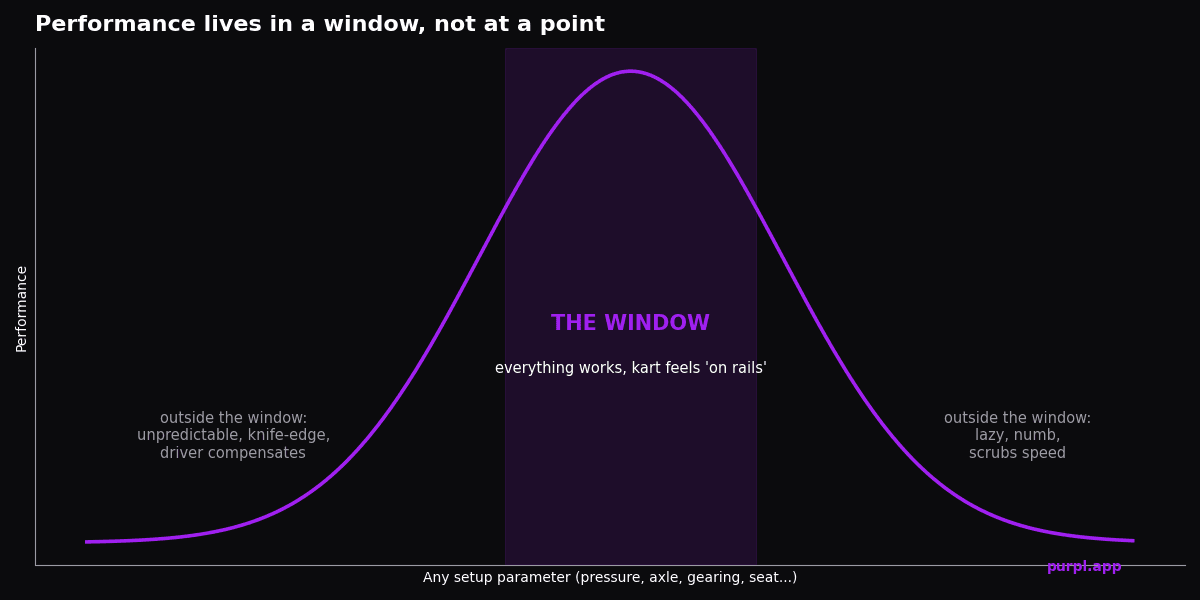
Two consequences follow. First, chasing the mythical perfect setup wastes test days that should be spent getting every parameter merely inside its window.
Second, setup work is measurement work. Because "feels better" is exactly the kind of evidence that put half the paddock outside the window in the first place.
And karting culture is honestly split on this. In some paddocks tuning is still treated as an art. Passed down by feel.
And at minor championships that romance survives contact with the stopwatch. At the top level it doesn't anymore.
Competition has squeezed out the artistry. Performance is the north star, the approach is scientific. And the teams that win treat every click on the kart as a hypothesis to be tested, not a tradition to be honoured.
What the main adjustments actually do
The short tour, each with its own deep-dive article. Tyre pressure is the adjustment you'll touch most. It sets how fast the tyre reaches working temperature and how big its contact patch is, with rules of thumb and a data method in the tyre pressure guide.
Gearing trades acceleration against top speed. And your RPM trace tells you when it's wrong, the method in choosing sprockets with RPM data.
Seat position is the biggest lever most amateurs never touch. It moves the kart's centre of mass and changes everything downstream, see seat position and weight distribution.
Track width, axle stiffness and caster shape how the kart lifts its inside rear wheel mid-corner, which is how a kart with no differential turns at all. And on two-strokes, carburation keeps the engine alive and strong, guided by temperature data as covered in jetting by the numbers.
My bias, declared: chase the front end
Every setup primer pretends to be neutral about balance. I won't be.
Ask the veterans what wins championships and they'll converge on two things: strong braking and lots of front end. Danilo Rossi, five times world champion, says it flatly, you can't win a world championship "senza il davanti", without the front.
A kart with little front grip feels stable, brakes nicely, and is comfortable to drive. It also scrubs minimum speed in every mid-corner. And in races it leaves you helpless: you can't place the kart for an overtake, can't react to a late move, can't put your tyres exactly where you decided.
A kart with lots of front rotates early in the corner, lets you open the steering sooner, and carries the mid-corner speed that wins. Yes, it's harder to drive. Who said it would be easy?
The fastest setup is usually the trickiest one, and your job is to adapt your driving to it, not to soften the kart until it matches your comfort.
How to test: the protocol
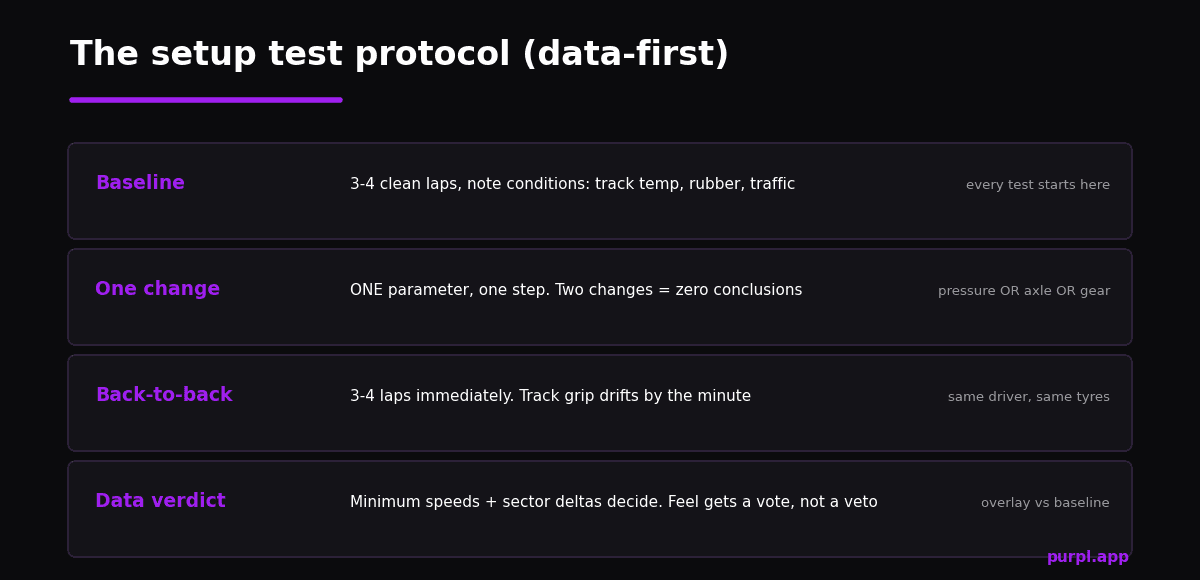
The protocol is boring and it's the entire game. Establish a baseline of three or four clean laps and write down the conditions, because track grip drifts by the minute and unlogged conditions corrupt every comparison.
That's the trap described in track grip evolution. Change one parameter, one step.
Two changes at once produce zero conclusions. This is the rule most paddock setup work breaks within an hour.
Run back-to-back immediately. Same driver, same tyres. Then let the data give the verdict.
Minimum speeds corner by corner, sector deltas, RPM at the end of the straight. Feel gets a vote, never a veto. Because drivers reliably prefer comfortable over fast, see the bias above.
The reading method for that verdict, overlays, deltas, one corner at a time, is the same one from the kart data analysis guide. And diagnosing which end of the kart is the problem has its own decision tree in understeer or oversteer.
Conditions move the window
The window isn't a place you find once. It moves. And the two biggest movers are temperature and rubber.
A pressure that was perfect at a 18°C morning session is wrong at 35°C track temperature in the afternoon final. Because the tyre now reaches its operating range earlier and overshoots it.
Rubber going down across a race weekend raises grip lap by lap, which loads the chassis differently. And it can take a kart from neutral on Friday to bound-up and sliding by Sunday's final, with no setup change at all.
This is why serious teams keep condition logs next to setup sheets: track temp, air temp, session time, rubber state. Without them you'll spend weekends chasing your own tail, fixing on Saturday what the conditions already un-fixed by Sunday.
With them, patterns emerge fast. And after a season you'll know your kart's windows by heart. What it wants in the cold morning, what it wants in the rubbered final, what it wants when clouds arrive.
When you're lost: the reset rule
Every karter eventually has the nightmare weekend. The kart is nowhere. Every change makes it different but not better.
And by Sunday morning the setup sheet looks like a ransom note. The fix is humble. And it works.
Go back to baseline, the manufacturer's recommended setup or your own last known-good sheet for that track, and re-test from there with the one-change protocol.
The kart that "nothing works on" is nearly always a kart that's three changes deep into a wrong direction, where every new adjustment is fighting the previous two. Baseline isn't defeat. Baseline is deleting the corrupted file.
This is also my argument for writing everything down. The best setup tool in any tent isn't an axle rack. It's the notebook that can answer "what exactly did we run here in April, and what did the data say about it".
Tyres outrank everything
If the window idea has a hierarchy, tyres sit at the top of it. Pressure, temperature and age move more lap time than any chassis adjustment in your toolbox, which is why experienced tents do tyre work first and axle philosophy second.
The practical minimum? Own a decent pressure gauge and trust only it. Gauges disagree with each other more than setups do. Log pressures cold and hot every session.
The difference tells you whether you're reaching the tyre's window or flying past it. And respect age.
A tyre's best laps are a finite bank account. Spend them where they count.
Full numbers and the data method are in the tyre pressure guide.
The five-minute pre-session check that prevents most fake setup problems: pressures set, chain tension and alignment eyeballed, nothing loose on the loom. Fuel enough for the run plus margin.
And one glance at the sky and the track temperature, because as the previous section says, the window already moved while you were queueing.
What I'd tell a parent buying their first setup advice
A short word for the families. Because setup is where new karting money burns fastest. You don't need the €200-an-hour chassis whisperer in year one.
You need: the manufacturer's baseline sheet, tyres in the window, a one-change discipline, and a driver consistent enough for tests to mean something. That last condition does the gatekeeping, the consistency bar from lap time analysis.
When your driver laps within a tenth of themselves and the data still shows the kart costing speed somewhere specific, then buy expertise. Bring the data to the expert. And watch how much faster the conversation goes when it starts from evidence instead of vibes.
The order I change things
When the kart misbehaves and time is short, work in this order. Pressures first, because they're fastest to change and most likely to have drifted out of the window. Then rear track width and axle for rear grip complaints, or front width and caster for rotation complaints.
Gearing whenever the RPM trace says so, independent of the rest, and seat position only between race weekends, because it resets everything else.
Notice what's last on the list at the track. Anything you can't undo in five minutes. The middle of a test day is no place for irreversible philosophy.
Setup can't fix what driving is breaking
The hardest part of coaching setup is telling a driver the kart is fine. If you miss apexes by a metre on some laps, no axle change fixes that. If your braking points wander five metres lap to lap, every setup test you run that day is noise.
Check the driver baseline first. Drive first, tune second.
The reverse trap also exists. Drivers heroically adapting to a kart far outside the window, burning seasons "building character" on a chassis that needed one pressure change.
The way out of both traps is the same discipline this whole series teaches. Measure, change one thing, measure again.
That's the whole primer: window over perfection, front end over comfort, one change at a time, and the notebook as the most underrated component on the kart. Master those four habits and you'll out-develop tents with twice your budget, because most of them are still guessing and calling it experience.
Setup culture varies by country and class, and the community archives are genuinely useful once you can read them critically. The chassis setup forum on KartPulse is the best English-language one, and TKART publishes manufacturer-grade technical explainers.
Read both with this article's filter: if a claim comes without data, it's a hypothesis, no matter how many championships the person quoting it has won.
Alessio Lorandi started karting at six and won the 2013 CIK-FIA Karting World Championship. He raced through Formula 3, GP3 and Formula 2 before founding Purpl, an AI data coach for karting drivers.