Kart Tire Pressure: Finding Your Optimum With Data
The manufacturer's pressure is a starting point, not a law. The window framing, the hot-day story that proves it, and the data method that finds your real number.

Tire pressure is the adjustment you'll touch most in karting. And the one most people set by superstition.
Here's the truth that reorganises everything: kart tire pressure is not a number you find once. It's how you steer tyre temperature into its window on a track that changes by the hour.
The number moves. The method for finding it doesn't.
This is that method, with the story that taught me to distrust every printed target.
Pressure is a thermostat, not a setting
What you're actually tuning is temperature. The tyre manufacturers name an optimal temperature range, say 80 to 85°C for a racing slick. Pressure is your main lever for how fast the tyre gets there and where it settles.
Higher pressure heats faster and peaks sooner. Lower pressure takes longer to wake up and holds on later into a stint. That single trade explains almost every pressure decision in karting, from the qualifying setup that fires immediately to the race setup that's still alive at the flag.
That's the whole game.
The community guides agree on the mechanics, KartClass's tyre pressure guide and FlowRacers' quick reference both walk it well. What they can't give you is your number for this track, today. That's the data's job.
The story that killed the printed target for me
The tyre supplier may tell you the ideal hot target is, say, 0.90 bar. And on a cold winter day, it may be exactly right.
Then comes a hot, grippy summer day, track temperature in the fifties, rubber layered down, big classes running two wheels at the kerbs. Run the printed 0.90 there and after two laps you start sliding, and your lap times get worse while everyone else's improve. The real target that day might be 0.80, even 0.75.
Same tyre, same kart, same manufacturer. Different day, different number.
Which is why the advice I give every driver is the one I follow myself. Experiment on every new track, every changed day, and let tyre data and lap-time progression name the target. The printed number is where the experiment starts, never where it ends.
Finding your kart tire pressure with data
The method needs a gauge, a logger, and honesty. Three reads per session. If the logger side is new to you, start with the karting telemetry guide and come back.
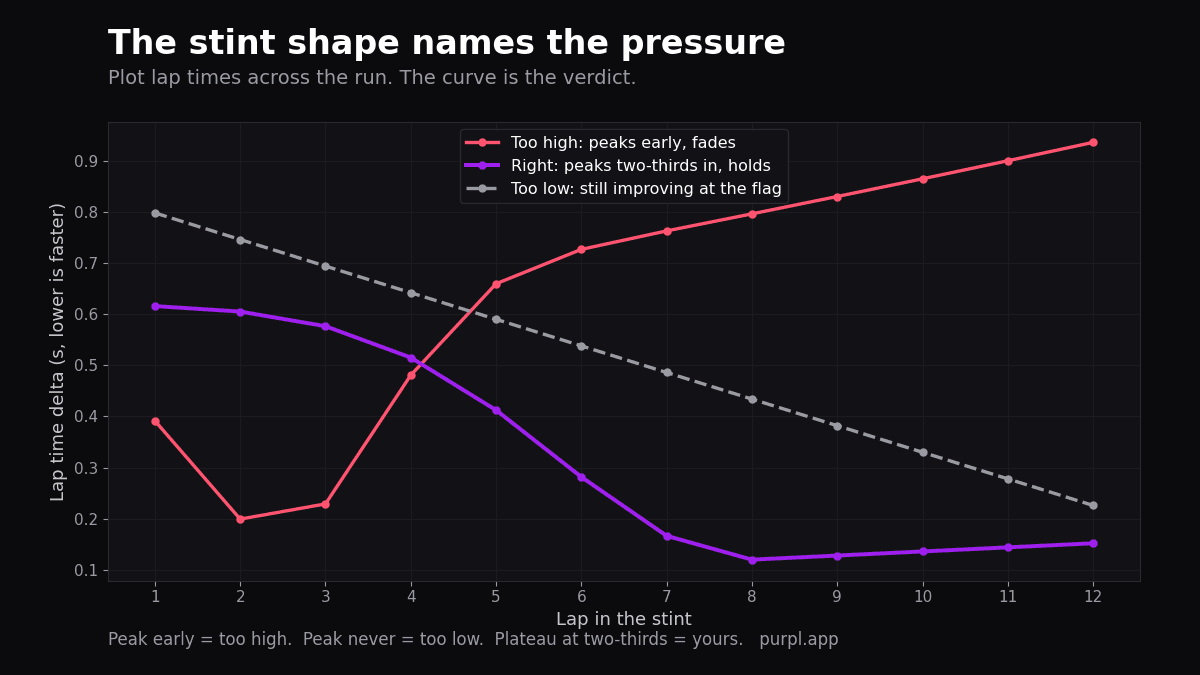
The stint shape. Plot your lap times across the run. Peak in the first three laps then fade: pressures too high, the tyre overshot its window.
Still improving on the last lap: too low, the window arrived as the session ended. Peak around two-thirds into a race run, holding a plateau: that's the shape you're hunting.
The cold-to-hot delta. Log cold pressure before the run and hot pressure the moment you're in. The difference tells you how much heat the tyre built, and a delta that swings session to session means conditions moved and your starting number should too.
The corner evidence. Minimum speeds early versus late in the stint, and the consistency spread by stint phase, per lap consistency. A kart that's quick at lap two and three tenths slower at lap ten is telling a pressure story before it's telling a driving one.
Log all of it in the session sheet, the routine from the data starter sheet. Within a few weekends you own a pressure map for your tyre, your kart, your tracks.
Here's how a pressure day actually runs. Saturday morning, green track, air still cool. You set the supplier's baseline cold, write it in the sheet, and go run the stint.
The download shows the lap times still improving when the session ended. Too low. The window arrived late for these conditions, so the next run starts a touch higher, and only the pressures change between the runs, nothing else on the kart gets touched.
By the afternoon the picture flips. Rubber has gone down, more classes have run, and the surface is grippier every session. The same starting pressures now peak early and fade, so you step back down for the next run and let the stint shape confirm the move was right.
Rinse and repeat.
Notice what never happened. No guessing. No copying the kart next door.
Every move came from a read you can repeat next weekend, the same loop as the wider data analysis routine: measure, change one thing, measure again, week after week.
Numbers for orientation, not religion
Ranges, honestly framed. Most racing slicks live somewhere around 0.55 to 0.90 bar cold, roughly 8 to 13 psi. Your class, tyre compound and supplier bulletin narrow it from there.
Rental karts run higher. Wet tyres run higher again, because standing water cools and the tyre needs help building temperature.
Your tyre supplier's recommendation and your team's baseline outrank any article's range, including this one. The data method above is how you move off the baseline with evidence instead of paddock gossip.
And condition shifts have directions worth memorising. Hotter track, more rubber: start lower. Cold morning, green track: start higher.
Long final versus short qualifying: lower still, so the window arrives mid-race instead of lap two, the same logic FlowRacers frames for race conditions.
Front and rear don't have to match, either. Plenty of drivers run the two axles at slightly different pressures, because each axle does a different job. The fronts shape turn-in and steering feel, the rears shape traction and stability under power.
So a kart that turns in lazily can respond to a small change at the front alone. A nervous rear can calm down with its own change at the back.
Some teams go further on circuits where one side of the kart works harder than the other. They trim individual corner pressures a fraction, so all four tyres build temperature evenly.
Qualitative moves, all of them. No magic. The stint shape and the gauge still decide whether they helped.
The discipline that makes pressures comparable
Pressure data is only as good as its measurement habits, and two rules carry most of it.
Own one decent gauge and trust only it, because gauges disagree with each other more than setups do. And measure at consistent moments: cold before the out lap, hot immediately on return, because five minutes of cooling rewrites the hot number and quietly corrupts your map.
One gauge, two moments. Every session.
One change at a time, as everywhere in kart setup. Pressure changes are fast and cheap, which makes them the easiest place to change two things at once and learn nothing.
When pressure isn't the problem
The honest section. Pressure gets blamed for everything because it's the adjustment everyone can reach.
A kart that slides all stint on sensible pressures has a setup or driving question, not a pressure one. Track grip moving by the hour mimics pressure problems perfectly, the trap mapped in track grip evolution.
And tyre temperature spread across the four corners of the kart, where you have temps from the sensor stack, is a separate tell. It points at setup and driving long before it points at the gauge.
The stint-shape read protects you here: pressure problems follow the heat cycle, setup problems don't care what lap it is.
Heat cycle first. Then everything else.
FAQ
What pressure should my kart tires be?
Start from your tyre supplier's recommendation for your compound and class, usually landing inside the broad 0.55-0.90 bar cold range for slicks. Then run the stint-shape method and let the data move you off the baseline. The right answer is a method, not a constant.
And write the number down with the day's conditions, every time. A baseline only becomes yours once you've tested it against a hot afternoon and a cold morning on the same tyre.
Why does my kart get slower after a few laps?
Classic too-high signature: the tyre overshot its temperature window and the grip walked away. Drop the starting pressures a step and reread the stint shape. If the fade survives sensible pressures, look at setup and driving inputs instead.
Check the boring things too, before blaming the tyre. A gauge that disagrees with last week's, or a hot reading taken late, can fake the same signature and send you chasing a problem you don't have.
Should pressures differ between qualifying and the race?
Usually yes. Qualifying wants the window in the first flying laps, so start higher. Races want it arriving mid-stint and staying, so start lower.
The exact split is your kart and tyre's answer, found in two back-to-back tests. Run them on the same day with everything else frozen, and the stint shapes will name the split better than any rule of thumb, this article's included.
Do I really need to log pressures every session?
It's thirty seconds, and it's the difference between a pressure map and a pressure mythology. Cold, hot, conditions, stint shape. A month of rows answers questions that years of paddock opinions never will.
The habit pays off fastest on the weekends that go wrong. When the kart suddenly feels strange, the sheet tells you whether the pressures moved or the track did. That one answer saves an afternoon of guessing.
Alessio Lorandi started karting at six and won the 2013 CIK-FIA Karting World Championship. He raced through Formula 3, GP3 and Formula 2 before founding Purpl, an AI data coach for karting drivers.