Karting Telemetry: The Complete Beginner's Guide
I won a karting world title reading data most drivers ignore. What telemetry records, which trace to learn first, and how to turn numbers into lap time.
I got my first data logger when I was eight years old. Nobody explained it to me.
There was a small screen on the steering wheel showing RPM and lap times, and my dad nodding at it after every session. Then there was a cable going to a laptop, where the real information lived. It took me years to understand what that information was actually saying.
This guide is the explanation I wish someone had given me then. Karting telemetry is not complicated, but almost everyone learns it backwards. They buy the hardware, stare at the screen, and never get to the part that actually makes them faster.
By the end of this article you'll know what a telemetry system records, which numbers matter and which ones don't. And what to do after your next session instead of just scrolling through laps.
What karting telemetry actually is
Telemetry is just measurement. A small logger on your kart samples what the kart and the engine are doing, many times per second, and stamps every sample with a GPS position. After the session you download it and look at the lap as a graph instead of a memory.
That last word is the whole point. Memory is a terrible engineer.
You come into the pits convinced you braked later into turn one on the fast lap. The data shows you braked two metres earlier but carried four km/h more minimum speed. I have seen this gap between feeling and fact at every level I've raced, from karts through Formula 3 and Formula 2.
Drivers feel speed. Data measures it. The two disagree more often than anyone likes to admit.
In karting the measurement layer is thin compared to cars. No suspension sensors, no brake pressure on most setups, no throttle position unless you add it.
What you get is GPS, engine RPM, one or two temperatures, and lap timing. It sounds basic. It's enough to find seconds.
What a kart data logger records
Nearly every kart data logger on the market records the same core channels. That includes the units you see from AiM, Alfano, Unipro and a few others.
The brands argue about screens and software. The data underneath is almost identical.
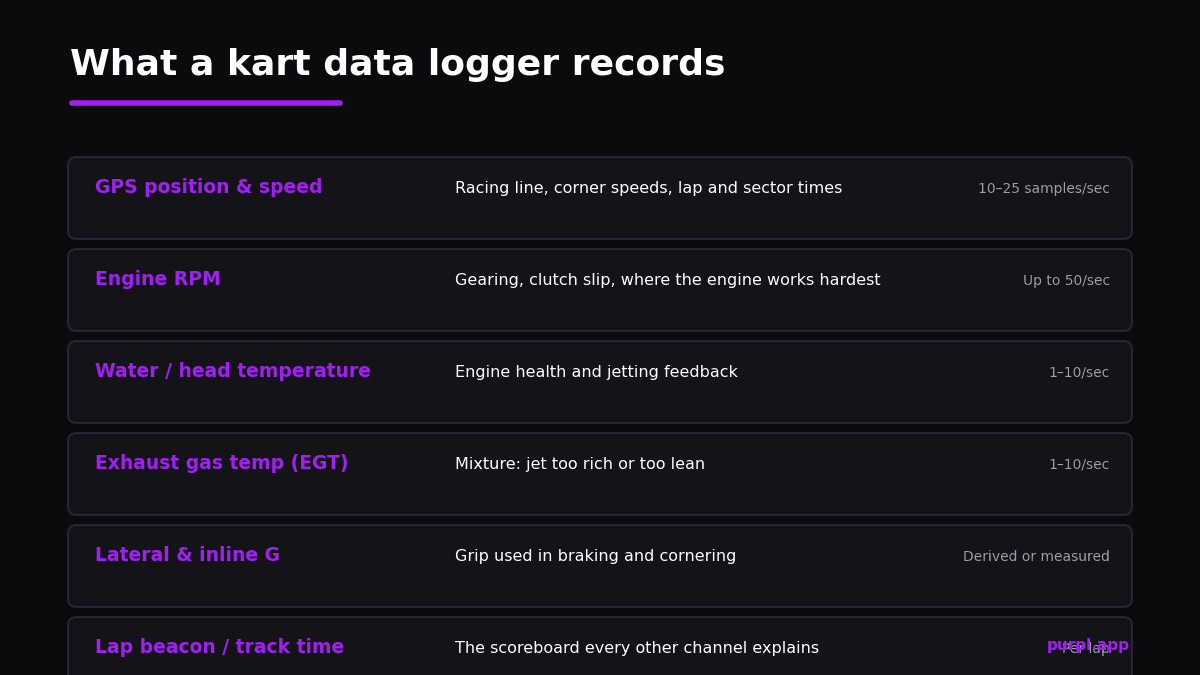
Two of these do most of the work. GPS speed tells you how the lap happened: where you braked, how much speed you kept through the corner, how early you got back to full throttle. RPM tells you how the engine lived through it: gearing, clutch behaviour, whether you're using the power band or falling out of it.
Temperatures are health and jetting monitors rather than lap-time tools, though they'll save your engine more than once. I've covered each sensor in detail in a separate piece on how kart sensors work.
Sampling rates matter less than the marketing suggests. A 10 Hz GPS trace, meaning ten positions per second, already shows you braking points within a couple of metres.
Higher rates draw smoother lines. They don't change the conclusions. If you want the technical detail, I've written about how accurate GPS lap timers really are.
The screen is not the system
Here is the mistake I see most at club level. A driver spends a few hundred euros on a logger, mounts it on the wheel, and uses it as an expensive lap timer.
Glance at the lap time on the straight, feel good or bad about it, go home. The logger could be replaced by a stopwatch and nothing would change.
The value is in the download. Telemetry pays you back the evening you first put two laps on top of each other and see, in one picture, exactly where a faster lap was faster.
Not roughly where. Exactly where, to the metre, with a number attached.
So the real question for a beginner isn't which hardware to buy. It's whether you're willing to spend twenty minutes after each session looking at the data with intent.
If the answer is yes, even the cheapest second-hand unit will make you faster. If it's no, the most expensive one won't. My full method is in how to analyze kart racing data step by step, but the short version follows.
Think of it in cost per tenth. A club driver might spend a thousand euros chasing engine tune for two tenths a lap.
The same two tenths are usually sitting in one badly-driven corner, visible in a free download from hardware you already own. Cheapest lap time in motorsport, and most people leave it on the laptop.
The first trace to learn: speed against distance
Open any analysis software and you'll see a dozen possible graphs. Ignore almost all of them.
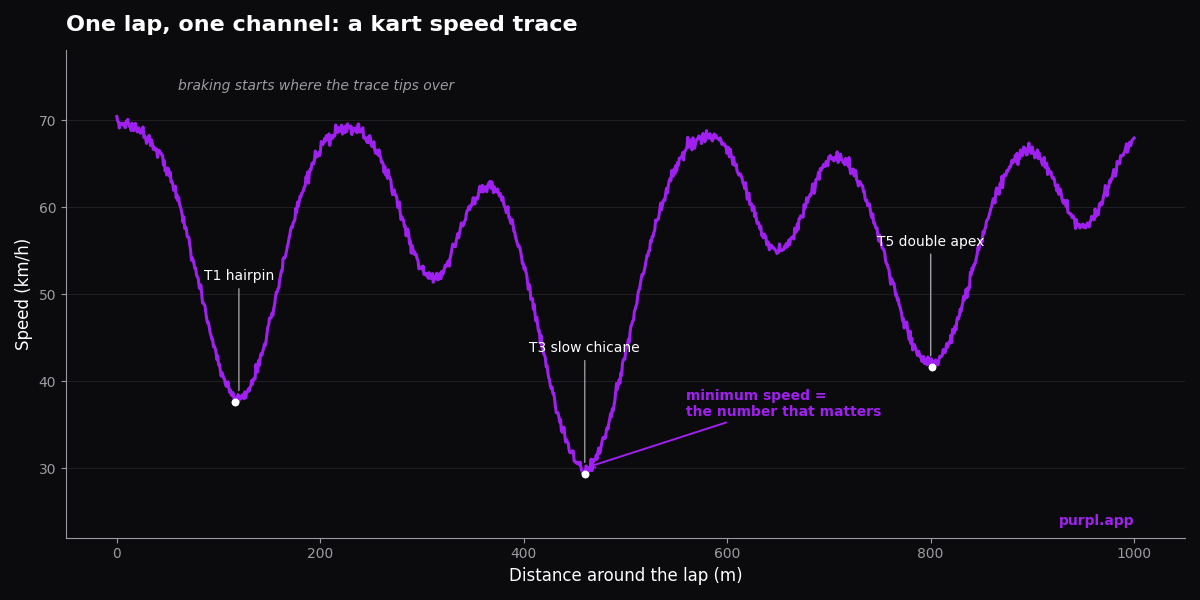
The one that matters is speed on the vertical axis, distance around the lap on the horizontal. Every corner becomes a valley. Every straight becomes a plateau.
Three things to read in every valley:
- Where the trace tips over. That's your braking point, in metres, no opinion involved.
- The bottom of the valley. Minimum corner speed. In karting this single number explains most of the gap between two drivers in the same equipment.
- The slope climbing out. How early and how cleanly you got back to accelerating. A lazy slope usually means a compromised exit line or a bog off the corner.
When you compare your best lap against a quicker driver's lap, you're comparing valleys. Almost every tenth lives at the bottom of one. I go deeper on this in how to read a speed trace, and the overlay technique itself has its own guide on comparing two laps properly.
One warning from experience: minimum speed is king in karting, and for a specific reason. Karts have no suspension travel to mask mid-corner speed, and very little straight-line braking stability to reward hero braking.
Carrying 2 km/h more through a 180-degree hairpin is worth far more than braking three metres later into it. Drivers raised on racing games usually have this exactly backwards.
And braking-point errors cost more in a kart than your instinct says. Take the mechanics' hairpin at Lonato, turn 4, arriving at about 97 km/h in a 60 Mini. Brake seven metres too early there and you give away up to two tenths in that one corner.
Make the same seven-metre error at 300 km/h into Variante 1 at Monza in a Formula 2 car and it costs roughly half a tenth. Same distance, four times the damage, because at low speed those metres take so much longer to cross.
Slow corners punish lazy braking points hardest, and the speed trace is where you catch them.
A simple workflow that actually gets used
Forget the engineer-grade routines you see in car racing. In karting, you need a loop you'll actually repeat on a cold Tuesday at the track with twenty minutes between sessions. Mine looks like this.
Before the session, pick one question. Not five. One.
"Am I losing time in the chicane entry or exit?" A session driven to answer a question produces data worth reading. A session of random laps produces a diary.
After the session, find your best lap and your theoretical best. Most software stitches your fastest sectors into an ideal lap.
The gap between your best real lap and that ideal lap is your consistency problem, and it's usually bigger than your outright pace problem. I wrote about measuring this in lap time analysis: finding where you lose time.
Overlay, pick the worst corner, decide one change. The discipline is stopping at one.
Change your braking reference into a single corner, go drive it, download again, check whether the valley changed shape. That loop of question, data, one change, data again is the entire sport of getting faster, repeated for years.
Write down what you learned. One line per session is enough.
Paper notebook, phone note, whatever survives. Six months of one-line entries will teach you more about your driving than any single afternoon of graphs.
What telemetry won't do
It won't tell you why. Data shows you the chicane exit is 3 km/h down on your benchmark lap. It doesn't know whether the cause was your line, a sliding rear, falling tyre pressure or traffic.
Interpretation is still a human job. Or lately, partly a machine one, which I'll get to.
It also won't fix a setup by itself. The data can tell you the kart is slow out of slow corners, and then knowledge has to take over: gearing, tyre pressures, chassis adjustments.
Telemetry narrows the search. It doesn't do the searching.
And it will absolutely lie to you if the install is sloppy. A GPS unit mounted next to an ignition coil, a temp sensor with a loose connector: garbage in, confident-looking garbage out. Check the basics before trusting any conclusion.
One more limit, and this is the opinion in this article that some coaches will argue with me about. Telemetry is backward-looking. It describes the session that already happened, on grip that no longer exists.
I coach young drivers at WSK weekends, and the pattern I see most is data dependence. Kids who can't find a braking point on their own, because they've learned to wait for a teammate's reference lap and copy it in the overlay.
The data should sharpen your own internal simulator, the one running predictions in your head at the apex. The day it replaces that simulator, it has made you slower.
Do you need telemetry as a beginner?
My honest answer is earlier than most coaches say, with a caveat.
The common advice is "learn to drive first, add data later." I half agree. In your first months, seat time beats everything and a screen on the wheel is a distraction.
But the moment you can lap within a consistent window of a few tenths, data stops being a luxury, because at that point your own perception becomes the bottleneck. You cannot feel two tenths. You can see them.
The caveat: keep the screen boring. Lap time and water temperature, nothing else.
I'll go further, and I know not everyone agrees with this one: don't watch your lap time at all while driving. I've seen it a hundred times in qualifying, including from inside my own helmet.
You see a sector delta flash up, your brain starts doing maths instead of driving, you brake early "just in case", and the lap you were protecting dies right there. The screen reports. It must never coach mid-lap.
The interesting stuff belongs on a laptop after the session, not in your eyeline at the apex. Chasing the dash is one of the classic beginner mistakes I see at every club track.
Where the sport is heading
For thirty years, karting data analysis has meant a human squinting at overlaid lines. That's changing fast.
The same approach behind modern AI tools, pattern recognition over thousands of laps, turns out to be very good at exactly the job described above. Finding which valley is costing you, and saying so in plain language.
It's the problem we're building Purpl around, and I've written separately about how AI coaching in motorsport works if you're curious where this is going.
The fundamentals in this guide don't change, though. Whatever reads your data (your eyes, a coach, a model) it's still speed against distance, still minimum corner speed, still one change at a time.
FAQ
What does a karting telemetry system cost?
Second-hand colour-screen loggers from the major brands trade for roughly €200–€400; new flagship units run €600–€900 before sensors. A used previous-generation unit is the sensible first buy, since the core channels haven't changed in a decade. Budget another €50–€100 for a spare temperature sensor and a proper mount, because those fail first.
Is telemetry allowed in karting competition?
Data logging is broadly permitted; live transmission of data and two-way communication generally are not, and homologation rules vary by series. Check your championship's technical regulations. The international framework sits with FIA Karting, and national bodies adapt it locally.
Which is the most important channel for a beginner?
GPS speed, without question. RPM second. Temperatures matter for engine health rather than lap time.
Master the speed trace before you open anything else, and keep a telemetry glossary open beside you the first few evenings.
Can I learn data analysis without a coach?
Yes. The community has solid free material: the technical magazine TKART publishes detailed data walkthroughs, and the KartPulse forums are full of drivers comparing real traces. Start there, bring questions, and be suspicious of anyone with a strong opinion who never posts data.
Alessio Lorandi started karting at six and won the 2013 CIK-FIA Karting World Championship. He raced through Formula 3, GP3 and Formula 2 before founding Purpl, an AI data coach for karting drivers.