How to Compare Two Laps: Overlay Analysis for Karting Drivers
Overlay analysis is the fastest way to find lap time in karting. How I pick a reference lap, read the delta, and steal tenths from faster teammates.
At the 2018 Winter Cup I compared my data against my teammate's every evening. He was half a tenth to a tenth faster than me in almost every session, and he knew it, which is why he never bothered opening my laps.
I opened his every single time.
When you compare laps in telemetry, you stop guessing where the time is and start reading it off a graph, corner by corner, with a number attached. By qualifying I knew exactly which corners were mine and which were his.
He took pole out of 94 KZ2 drivers. I was second, 0.042 behind. Then I won the first three heats, including the one against him.
That teammate, by the way, was my brother Leo. Which tells you something about how seriously I take a data comparison.
This article is the method behind that week. It assumes you know what a kart data logger records and that you've read a basic lap before. If not, start with my karting telemetry guide and come back.
Why the overlay beats every other view
A single lap of data tells you what happened. Two laps on top of each other tell you what's possible.
That difference is everything. Your braking point into turn three means nothing in isolation. But put it against a reference lap that goes four metres deeper and still makes the apex, and it becomes a measured, provable gap.
You can go and close that gap in the very next session.
Before telemetry existed, drivers relied on split times on the dash and their mechanic's opinions. A mechanic watches you miss one apex and tells you to brake earlier, while the data shows you were braking too early on every other lap of the session.
The overlay settles arguments like that in seconds. And it doesn't care about anyone's feelings.
I've called this the closest thing to a legal shortcut that exists in karting. Your teammate spends thirty laps finding the limit somewhere. You download his file and "steal" the answer for free.
Pick the reference lap first, and pick it carefully
Every overlay is a comparison against something. And the something matters more than people think. A lot more.
The default choice is the fastest lap available in your team from the same session. Same session matters. Grip in karting moves by whole tenths between a morning run and an afternoon run as rubber goes down.
Compare across sessions and you mix driver differences with track differences until you can't tell them apart. Telemetry is backward looking. It describes grip that no longer exists, which is exactly why you compare laps that lived on the same grip.
Two traps to check before you trust a reference lap:
- Was it done in a slipstream? A lap towed along a straight shows speed your engine cannot reproduce. I've watched drivers blame their engine for a 1.5 km/h straight-line deficit. Then they go quiet when I show them the reference driver was glued to someone's rear bumper that lap.
- Was it one hero lap or repeatable pace? A lap with one banzai corner teaches you less than a lap the driver can do ten times. Check his other laps before you copy anything.
No teammate? Compare your best lap against your own theoretical best, the one your software stitches together from your fastest sectors. I wrote about that exercise in lap time analysis, and it's the same overlay skill pointed at yourself.
Set the axis to distance, not time
One setting ruins more overlays than any other. Plot the laps against time and the slower lap takes longer to complete each section. The traces slide out of sync.
By mid-lap you're comparing your turn five with his turn six. Useless.
Plot against distance instead. Every package does it, from Race Studio to Alfano's software, usually in one dropdown, and then both laps sit on the same metre of track at every point.
A vertical line through the chart means one physical place. Plain and simple. That's the whole trick that makes overlays readable.
The reading order when you compare laps in telemetry
Opening every channel at once is how beginners drown. Three channels, read in a fixed order, find almost everything.
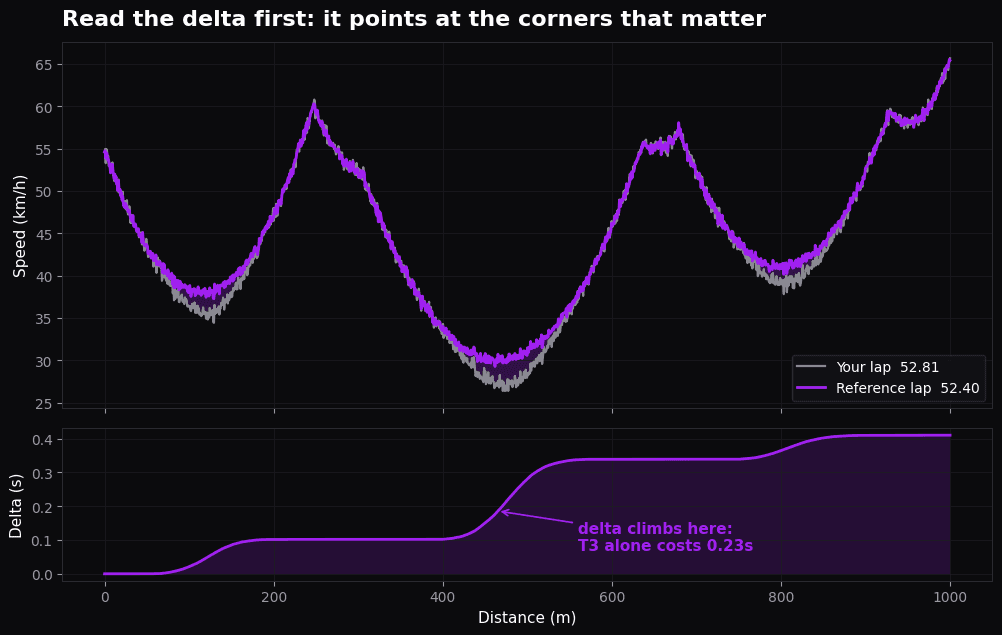
First: delta time. This is the line showing the running gap between the two laps. Where it's flat, nothing is happening.
Where it climbs, you're losing time at that exact spot, so don't read anything else until you've found the two or three places where the delta moves most. They are the lap.
Everything else is detail, and I've covered the channel itself in delta time telemetry.
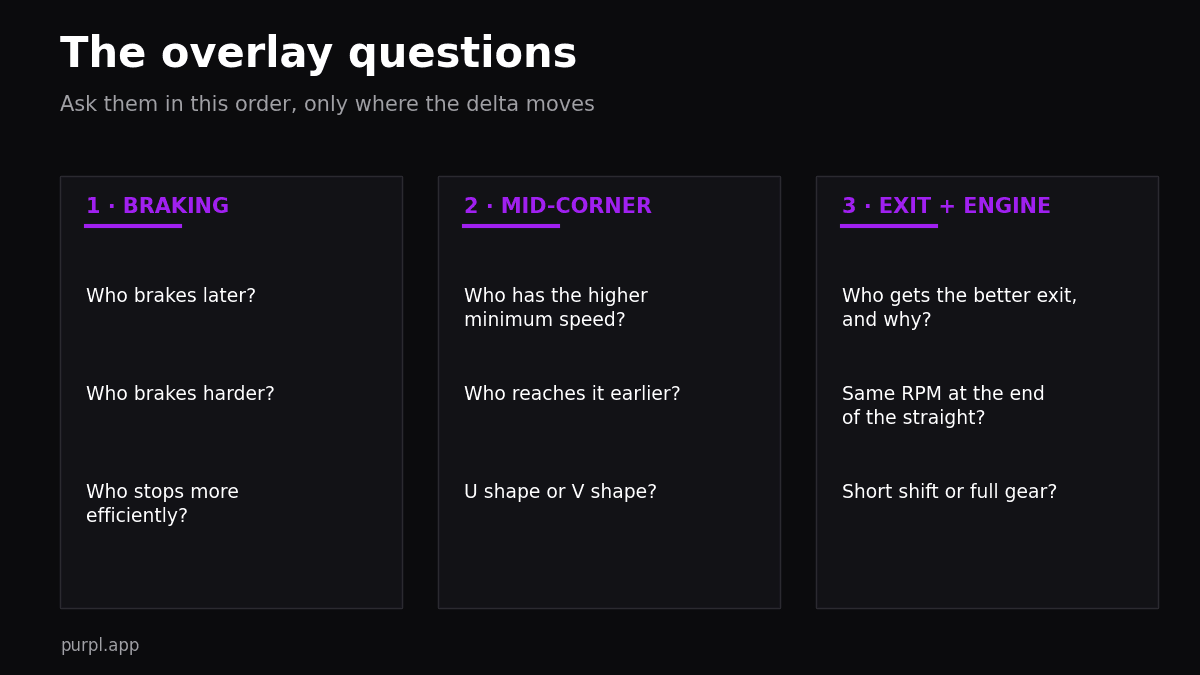
Second: the speed trace, only at those spots. Now you ask the questions I run through every time I open a teammate's file.
Who brakes later? Who brakes harder? Who carries a higher minimum speed, and who reaches their minimum earlier?
Who picks up a better exit, and why? If he's faster through a corner, is his valley U-shaped (rolling speed) or V-shaped (stop and go)?
Each answer points at a specific change in your driving. The full skill of reading that graph is its own article: how to read a speed trace.
Third: RPM. Gearing and engine questions. Are you both pulling the same revs at the end of the straight?
Does he short-shift where you hold the gear? In a hairpin, RPM also betrays how much speed each kart kept once GPS gets noisy at low speed. Only after these three do the temperature channels earn a look, and usually they just confirm what the driving channels already said.
How precise does this get? Precise enough that TKART, the karting technical magazine, put the loss in a single first corner at about 0.15 seconds while walking through a two-driver overlay. One driver covered 43 metres between throttle release and full throttle; the other needed 78.
That's the resolution you're working with. Metres and hundredths, not impressions. Their full walkthrough is worth your time once you've done a few overlays of your own.
One corner at a time, detective hat on
When I go through a comparison I feel like Sherlock Holmes. That's the right energy for it. You're not browsing, you're investigating a specific loss.
And the investigation ends with a verdict you can act on. Brake three metres later into turn four. Or stop pinching the exit of the last corner.
Take the worst corner from the delta, work through the speed questions, decide one change. Then stop.
The discipline of changing one thing per session is what separates drivers who improve from drivers who just collect data. It's the backbone of my whole data analysis routine.
There's an opposite character to the detective, and I meet him at every race weekend. He opens the overlay wearing what I call the "excuses hat". He finds the 100 RPM his engine gives up in the mid-range and ignores the four metres of braking he leaves on the table into the hairpin.
He reads an EGT difference as proof his carburetion is wrong. But the lines split purely because he and the reference driver pick up the throttle at different points.
Data is a mirror. Open it looking for reasons the kart is at fault and you'll always find one, and you won't get faster. If you're not humble enough to look in that mirror properly, don't bother downloading.
What the overlay can't do
I owe you a warning along with my enthusiasm, because I'm a genuine evangelist for this tool and I've still seen it make drivers worse.
Lean on the overlay too hard and it makes you "lazy". I see it coaching young drivers at WSK weekends: kids who won't commit to finding a braking point with their own feel. They've learned to wait for a teammate to find it first, then copy it off the screen.
The comparison should calibrate your internal references, not replace them. The day the grip changes mid-session, and it always does, the file from an hour ago is history and your own judgement is all that's left.
That balance between data and feel starts long before the laptop opens, back at braking technique you can trust.
And remember the comparison only describes the session that already happened. It won't tell you how to drive the next one on a greener or rubbered-in track.
It hands you hypotheses. The track grades them.
The loop that actually builds speed
Here's the rhythm I push on every driver I work with. It's the one I lived by the week I nearly beat my brother to that Winter Cup pole.
Drive. Download. Compare. Repeat.
Every session, no exceptions. Twenty minutes with the overlay before anyone discusses setup. Corner verdict, one change, back out.
Across a race weekend that loop runs eight or ten times, and each pass is worth somewhere between nothing and two tenths. Most of my data-driven gains came exactly this way, in small certain bites rather than big revelations.
Once the two-lap overlay feels natural, the same habit extends across the whole weekend. Start with sector analysis.
FAQ
Which lap should I compare against if I have no teammate?
Your own theoretical best lap, built from your fastest sectors of the session. The gap between it and your best real lap is consistency. Closing it is usually worth more than chasing outright pace.
Failing that, compare your best lap against your second-best. The differences between them show you which corners you don't yet control.
Should I overlay laps from different days?
Only to study yourself, never to judge pace. Grip, temperature and engine condition move too much between days for the absolute numbers to mean anything.
Shapes survive better than numbers. A braking shape or a line choice can still teach you something across days, but treat any speed difference with suspicion.
How many laps should go into one overlay?
Two. Three at the absolute most. Every analysis screen lets you stack more, and every extra trace makes the picture harder to read.
The comparison you act on is always your lap against one reference, in one corner at a time.
Does overlay analysis work with a basic GPS-only logger?
Yes. Speed against distance plus a computed delta time channel covers most of the method in this article, though you give up the RPM questions and some braking detail.
But braking points, minimum speeds and exit shapes are all in the GPS trace, and that's where most of the lap time hides. The most common errors are the ones I cover in data analysis mistakes, and hardware is rarely one of them.
Alessio Lorandi started karting at six and won the 2013 CIK-FIA Karting World Championship. He raced through Formula 3, GP3 and Formula 2 before founding Purpl, an AI data coach for karting drivers.