Braking Technique in Karting: A Data-Driven Guide
Why entries win races, what deceleration efficiency means, and how to read your braking in the data. A world champion's guide to kart braking.
The trait Michael Schumacher's engineers and rivals kept describing was simple: more speed than anyone into the entry of corners.
Not the middle. Not the exits. The entries.
Meanwhile, at every club track in the world, coaches and parents are telling kids the opposite: brake early, get it slowed down, prioritise the exit. I think that's nonsense.
Or at least, it's not how you become a genuinely fast driver. And in this article I'll explain why. I'll show you what "deceleration efficiency" means, and how your data shows whether you're actually braking well or just braking safely.
Why entries win races
Braking early and throttling early is the easy thing to do. And if it's easy, where exactly is your advantage supposed to come from? Everyone in the field can do easy.
The lap time that separates phenomenal drivers from good ones lives in the hard thing. Arriving at the corner closer to the physical limit than anyone else, still making the apex, still getting the exit.
In my best karting years I built my speed on exactly this. There was a fast corner at Lonato, the old "Chiocciola" turn two. I would take it with no brakes at all in KF3 and KF2 while others were braking for it.
And at times drivers went off the track just trying to stay with me.
I'm not telling you this to brag; I'm telling you because nobody taught me that corner with a rule about braking early.
It came from years of creeping the entry limit forward. Metre by metre. And checking the result.
To be precise about what I'm preaching: win the entry. But the deal has three parts.
Maximum entry speed. Still stopping the kart by the apex. Still keeping a workable exit.
Entry speed that destroys your exit speed isn't bravery, it's a donation to the drivers behind you.
Deceleration efficiency: the cyclist test
Here's how I explain the core skill to young drivers. You're driving your road car at 50 km/h, relaxed, braking gently and early for roundabouts like a good citizen.
Then a cyclist falls thirty metres in front of you. Oncoming lane full. No escape to the side.
Do you brake like you did for the roundabout?
You slam everything the car has, as hard and late as the physics allow, because now braking distance actually matters.
That emergency stop is closer to correct racing braking than the polite roundabout squeeze most drivers do on track.
Deceleration efficiency means shedding the speed you need to shed in the shortest possible distance.
Brake later. Brake harder at the start. Release progressively as grip demand shifts from slowing to turning.
The kart spends fewer metres slow. The lap time follows.
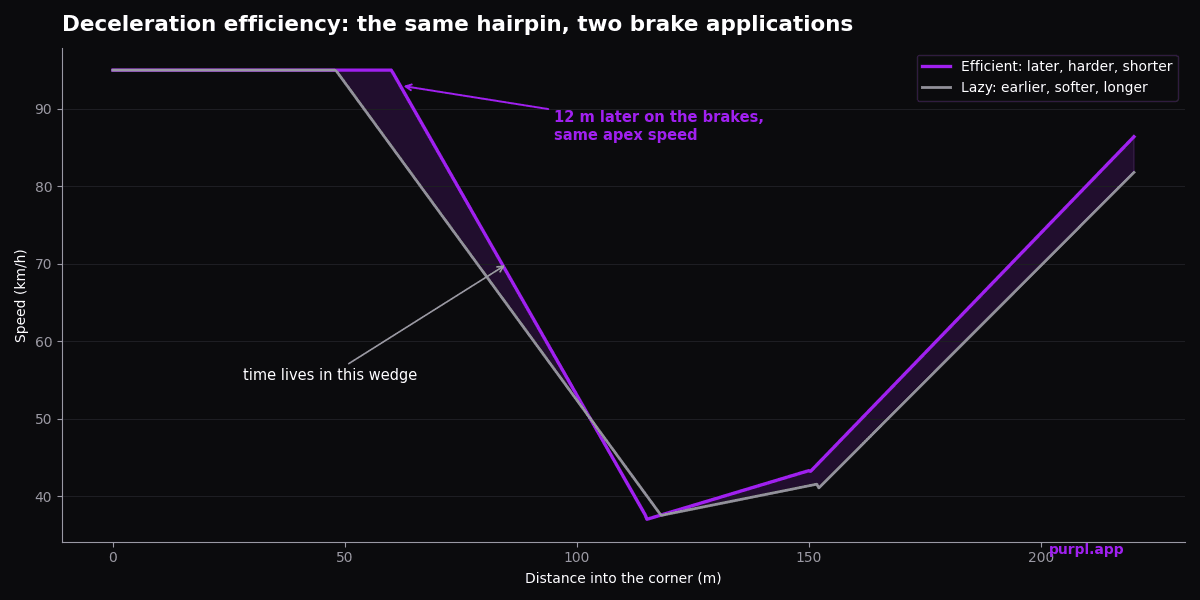
On the speed trace the two styles are unmistakable. Efficient braking is a steep cliff: late tip-over, hard initial drop, clean arc to the minimum. Lazy braking is a long ramp that starts early and bleeds speed gently.
Both reach the same apex speed. One of them spent twelve extra metres getting there, and that wedge between the two lines is where the time went. Reading these shapes is a core skill from the speed trace guide.
What braking errors cost, by the numbers
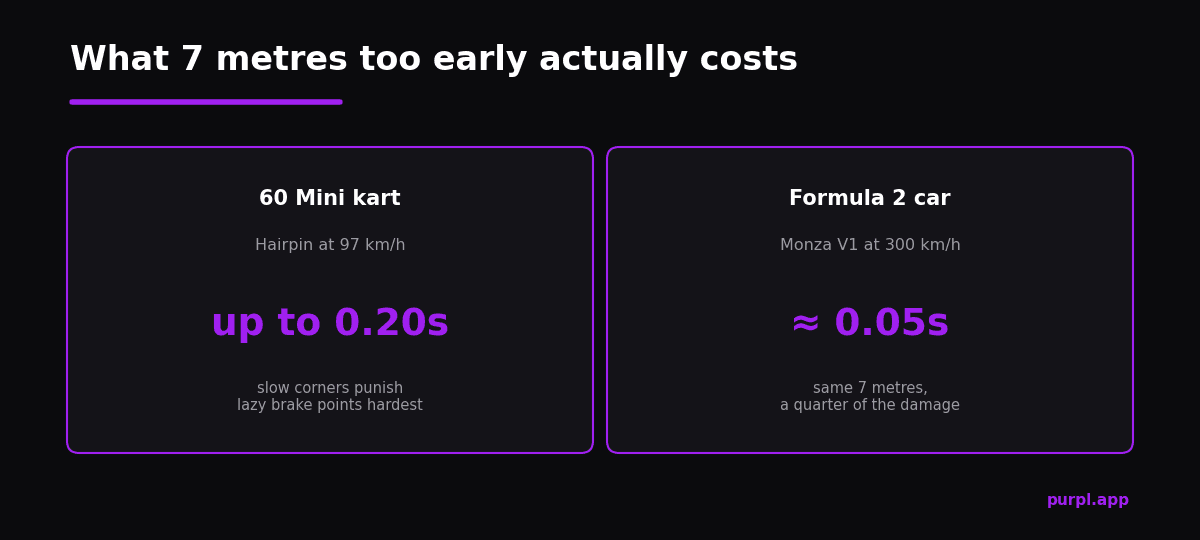
This comparison changed how some of my drivers think about braking.
Be seven metres early into a hairpin you approach at 97 km/h in a 60 Mini, like the mechanics' hairpin at Lonato. And you give away up to two tenths.
Make the same seven-metre error at 300 km/h into the first chicane at Monza in a Formula 2 car and it costs about half a tenth. Same metres, four times the price in the kart, because at low speed you cross those metres so slowly.
Karting is the discipline where braking precision is worth the most. The kids who tell me "it's only a couple of metres" have it exactly backwards.
The technique itself
Karts brake with the rear axle only, no front brakes in direct-drive and most junior classes, which makes the skill unique.
The pedal stroke: a firm, fast initial application just below locking, then a progressive release as you approach the turn-in point and start asking the tyres for cornering grip instead.
The release is the talent. Anyone can stamp. Modulating out of the stop while the kart is still straight enough, that's the part that takes years.
Locking the rear briefly isn't a catastrophe, you'll hear and feel the skip, but a long lock flat-spots tyres and kills your entry stability.
If you're consistently locking, you're stamping too hard for the grip available, braking too late for your current release skill, or carrying a chassis setup issue into the corner. That's the kind of diagnosis covered in understeer or oversteer.
As you advance, braking stops being a straight-line event. Carrying brake pressure past turn-in, trail braking, rotates the kart into the corner and is the natural next chapter: trail braking in karting covers it with the data evidence.
Reading your braking in the data
Without a brake pressure sensor, the speed trace is your braking sensor, and it tells you everything in three numbers per corner.
Where the trace tips over: your braking point, compare it lap to lap to see if you actually do what you think you do. How steep the first third of the drop is: your initial application courage. Where the minimum sits and how long it lasts: a long flat valley floor means you over-slowed and parked mid-corner.
Run the overlay against a quicker reference and check one corner at a time, the method from the data analysis guide. And a warning from coaching experience.
When the data shows you braking earlier than your reference, move your point in small steps. A metre or two per session. Not all seven at once.
The limit you can repeat is the only limit that counts, which is the entire argument of lap time analysis.
Three drills that build it
Deceleration efficiency isn't installed by reading about it. So here's the progression I use with drivers, one drill per test day.
Drill one, the reference creep. Pick one slow corner.
Choose a physical braking marker. A kerb joint, a crack, a paint edge. Never "about there".
Each run, move the marker one metre later, no more, until you can't make the apex cleanly twice in a row. Back up one metre.
That's your current limit. And you found it in single steps you can repeat, instead of one heroic lunge you can't.
Drill two, the pressure split. Same corner, hold the braking point fixed.
Now work only on the shape: first half of the braking distance at maximum pressure, second half tapering. Most drivers discover their "maximum" has another twenty percent in it. And the trace shows the cliff getting steeper run by run even with the point unchanged.
Drill three, the no-brake corner. Find the fastest corner you currently brake for. And work on entering with a lift only.
This one rebuilds your speed tolerance, the skill that made the Chiocciola story possible. And it teaches the difference between corners that need braking and corners where braking is just a habit of comfort.
Run each drill with the data open between sessions, checking the tip-over point and the steepness. Then verify the minimum speed didn't collapse, the full reading routine from the analysis method.
Wet braking, briefly
Everything above survives the rain with two amendments: the limits move massively earlier and softer, and they move lap by lap as the track changes. Initial application becomes gentler, because the rear locks instantly on a wet surface, and the release becomes even more of the skill.
The drivers who win wet races are almost never the bravest. They're the ones who recalibrate fastest. And the data work for that, comparing your braking shapes across a drying session, is covered in analyzing wet session data.
Which mistake to prefer
You will make braking mistakes. The question is which kind.
Underpushing, braking too early and safe, feels tidy and costs you silently. Every lap. Forever.
Overpushing, occasionally arriving too hot and running wide, costs you loudly and occasionally.
Drivers and parents treat the loud mistake as the bad one. I'd rather see a young driver overpush: it means they're searching for the limit from the right side. And the limit is the only teacher that never lies.
Style yourself on the drivers whose rare mistakes are too much speed, not the ones who never make a visible mistake and never set a fastest lap either.
One practical note before the class differences: braking skill has an ergonomic floor.
If you sit too far from the pedals you brake with your toes and lose modulation; too close and your leg can't deliver a fast, hard initial hit. Check that your heel stays planted while the ball of your foot covers the pedal, and that full pressure is reachable with a slightly bent leg.
I've watched drivers gain a metre of braking confidence from a seat spacer, which is the cheapest braking upgrade in the sport. And the wider ergonomics topic is covered in seat position and weight distribution.
Braking across the classes
One technique article has to serve drivers in very different machinery, so here's how the fundamentals translate.
Cadet and Mini karts have modest power and grip, which makes them the perfect braking school.
Errors are cheap. And the rear-only brake teaches weight management honestly. And a kid who masters deceleration efficiency at 95 km/h inherits it for life.
Junior and Senior direct-drive classes raise corner speeds until braking zones compress. The technique stays identical while the margins shrink.
Which is why the drill progression above stays in metres. Not feelings.
Shifter karts, KZ, change the deal twice: front brakes arrive, and so does engine braking through the gearbox. Front brakes reward a later, harder initial hit because the kart stays straighter under load, and downshifts become part of the deceleration plan. If you graduate to KZ, expect your braking points to move later and your release skill to matter even more, not less.
And rental karts, where many readers live: heavy chassis, weak brakes, often cold tyres, meaning everything happens earlier and softer. But the shape of good braking, hard early, progressive release, is exactly the same. And indoor rental tracks punish lazy shapes brutally.
For the broader fundamentals around this, braking is one piece of the corner puzzle alongside line and steering. Start with the racing line explained with telemetry.
For the physiology of braking markers and reference points, the technique articles at Driver61 are solid for car racing and translate well. And the karting-specific community wisdom on KartPulse is worth your evenings.
Alessio Lorandi started karting at six and won the 2013 CIK-FIA Karting World Championship. He raced through Formula 3, GP3 and Formula 2 before founding Purpl, an AI data coach for karting drivers.