Overtaking in Karting: Setting Up Passes That Stick
The inside means the corner is yours. Where passes really happen, the around-the-outside odds nobody calculates, and the one group move worth its risk.
A pass that sticks is built corners before it happens. A pass that doesn't is usually built on hope.
Overtaking in karting runs on a few hard laws, a little arithmetic, and more patience than highlight reels suggest. The good news: the laws are learnable, the arithmetic is simple, and the patience pays in positions.
Here they are, including the one law half the paddock refuses to accept.
The first law: the inside means the corner is yours
Everything else in this article hangs off one rule. Whoever owns the inside owns the corner. Plain and simple.
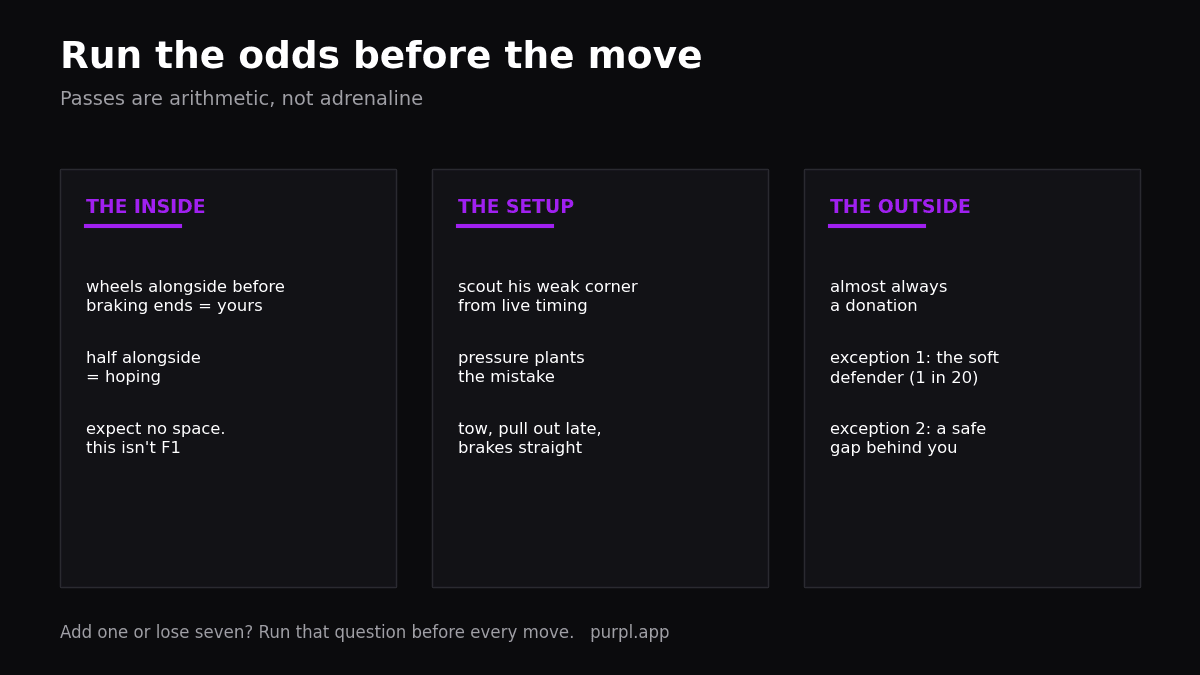
Get your front wheels genuinely alongside on the inside before the braking is done, and the corner belongs to you. The other kart's only options are yielding or contact that's on them.
Half alongside, hoping for generosity, owns nothing. Karting is not Formula 1, and the space you'd get on television mostly doesn't exist here.
That law cuts both ways, and the defensive version comes later. First, where passes actually come from.
Passes are found in data before they're made on track
The setup starts in the scouting.
Which corners is the kart ahead weak in? Where does he defend early? Where does his exit sag?
Live timing and your own laps answer all three before the race does. Studying rivals corner by corner, who's strong where, who overtakes where, is old-fashioned homework that wins modern races, the habit from sector analysis.
Then pressure does the digging. Sit close, fill his mirrors at his weak corner lap after lap, and mistakes arrive on schedule: a missed apex, a wide exit, a defensive line that wrecks his drive. The pass usually harvests an error that pressure planted.
Where the pass actually happens
Karting passes live at the end of straights and into heavy braking zones, with the slipstream doing the approach work.
The tow is worth real time, up to a couple of tenths down a straight, more in cold air. Use it to arrive with momentum, pull out late, and own the inside line into the brake zone, brakes applied straight, kart slowed enough to make the apex.
Make the corner, and the rule above does the rest.
The exit matters as much as the lunge. A pass that ruins your own drive invites the re-pass down the next straight. That's why the strongest overtakers brake a touch earlier than the maximum and keep their exit speed intact.
Pass and gap. Never pass and parade.
Here's how a planned pass looks in practice. Picture a final with plenty of laps left, and you've just caught the kart ahead.
First lap of the chase: follow, don't lunge. Watch where his kart slides, where he brakes early, where his exit sags. You're scouting, and the scouting costs nothing.
Second lap: position. Take your strongest corner cleanly so you exit closer than usual, close enough to catch the tow down the straight. But don't show the move yet, because a defender who's seen your nose twice starts covering the inside on instinct.
Third lap: execute. Tow, pull out late, inside line, brakes straight, apex made. And if the door closes, bail out early and reset, because the plan survives a failed attempt and a crash doesn't.
Three laps, one move.
The outside: the statistics nobody runs
Now the law half the paddock refuses to accept. Going around the outside in karting is, almost always, a donation.
We can't help ourselves. We've watched too much Formula 1, and somewhere inside we believe that if they can do it, we can.
But the famous outside moves you're picturing could only happen in Formula 1, with its rules about leaving space. In karting, expect no space, because the inside kart owns the corner and knows it.
Fail the move and the bill is bigger than one position. You're wide, off line, often in the dirt, and the karts behind collect you at the exit.
Risk one position to gain, several to lose. That's the arithmetic, and it's why the move stays foolish even when it feels brave.
Opening-lap traffic deserves the same arithmetic, multiplied. Everyone arrives at the first corners on cold tyres with warm optimism, and half the field is pricing moves on hope instead of odds. Survive first, race second.
So stay patient on lap one and keep your nose out of other people's accidents. The positions you protect there tend to be worth more than the ones you grab. And if the track is wet, double the caution, because karting in the rain rewrites every braking reference you trusted.
The two exceptions, calculated
Honest coaching includes the exceptions, because they exist. Two situations turn the outside from donation into gamble worth taking.
First: the rare driver ahead who's fast but yields under pressure, the one who gets moved around all race. Maybe one in twenty. If he's glued to the inside and it's the last laps, the outside can work, because he'll concede the space others wouldn't.
Second: you have a safe gap behind, a second or more; then the worst case is keeping your position after running wide, and the gamble costs nothing but the attempt.
No gap behind, no attempt. Ever.
The one group move worth learning
There's a single around-the-outside play I rate, and it only works when every condition is met.
The setting: a wide-entry 180-degree hairpin at the end of a quick section, the kind ten metres wide. The situation: you're last in a train of karts, with a second of clear air behind you. The mechanism: everyone in the train brakes early because the leader brakes early, stacking them up tight and slow on the inside.
The move: brake later than all of them, out wide, late enough that nobody sees you coming to squeeze you. Aim to draw alongside the second or third kart from the back. Then commit to the full outside on the power, all the exit kerb if needed.
Done right it's two positions. Done without the gap behind, it's a famous crash.
Treat it like the gamble it is: only with the odds stacked, never on feel, and the corner-reading that finds these spots is in karting corner types.
Defending without wrecking your race
Defence is the same laws, mirrored.
Cover the inside early enough to be legal and obvious, accept the slower line, and protect the exit above all. Against the optimist trying the outside, you don't need contact: power early and open the steering.
Physics walks him to the edge of the track, and he'll lift or mow the lawn. His choice, your corner.
And budget defence like attack: every defensive lap costs pace, so defend where you're weak and run free where you're strong. A defending driver burning two tenths a lap is just delivering himself to the next attacker, the race-pace truth from lap consistency.
Build the skill where it's cheap
Racecraft is trainable. And the cheapest classroom is rental karting, where the field is close, the races are constant, and the karts forgive experiments.
Reading moves, anticipating lines, taking the right bets with the right caution, all of it sharpens in low-stakes traffic. Which is exactly why serious teams have used rental sessions for racecraft training. The wider getting-started path is in getting into karting.
The community guides cover the basics well, K1 Speed's overtaking tips for the rental world and KartClass's overtaking guide for owner karting. What this article adds is the arithmetic. Run the odds before every move, and the moves you make start sticking.
FAQ
Where is the easiest place to overtake in karting?
The heaviest braking zone at the end of the longest straight, arriving with a slipstream; it's where the speed difference is largest and the inside line is clearest. Plan for it laps in advance rather than improvising when a gap half-appears.
And if that zone is covered every lap, attack the corner that feeds it: win the exit before the straight and the slipstream does the rest for you.
How do I overtake someone defending every lap?
Make the defence expensive. A driver covering the inside surrenders exit speed every time, so sit close, stay clean, and collect him with the better drive onto the straight. Pressure plus patience beats lunging at a closed door.
Remember that his defending costs more than your following: every covered inside is a slow exit, and slow exits compound lap after lap. The door opens eventually.
Is going around the outside ever right in a kart?
Two cases: a famously soft defender in the final laps, or a safe gap behind that makes the failure free. Otherwise it donates positions. If neither condition holds, the answer is no, however strong the instinct feels.
Run that check honestly, not hopefully. The voice saying "this time it'll work" is exactly the one the arithmetic exists to overrule.
What makes a pass "stick"?
Owning the inside before the corner starts, and keeping enough exit to hold the position down the next straight. Most failed passes die at one of those two points: half-alongside at turn-in, or fully ahead with a ruined drive.
Commitment decides the rest. A half-committed move leaves you nowhere, so make the decision before the braking zone, not inside it. That decisiveness grows the same way confidence built on data grows: through evidence, one clean rep at a time.
Alessio Lorandi started karting at six and won the 2013 CIK-FIA Karting World Championship. He raced through Formula 3, GP3 and Formula 2 before founding Purpl, an AI data coach for karting drivers.