Karting Corner Types: How to Attack Hairpins, Sweepers and Chicanes
Every corner type wants a different attack. Hairpins, sweepers, chicanes, combinations and the cash-out corner, each with its data signature and priority.

Drivers practise corners. The fast ones practise corner types.
Because karting cornering isn't one skill, it's a small family of them, and each corner type pays a different technique. The hairpin that rewards rotation punishes the sweeper's commitment. The chicane that loves kerbs would destroy the fast corner's line.
Here's the taxonomy, the attack for each type, and the data signature that tells you whether you got it right.
Three questions that sort every corner
Before technique, classification. Three questions sort any corner on any track.
What follows it? A corner feeding a long straight outranks an identical corner feeding another corner. How long is it?
Time spent mid-corner decides how much minimum speed matters. And is it alone? Combination corners change the rules completely, because only the last one's exit really counts.
Driver61's corner-technique guide builds a similar sorting from the car side. Karting sharpens it, because with no gearbox to repair mistakes, the wrong attack costs the whole next straight.
Hairpins: rotation is the corner
The slowest corners on the track, and on a kart, the most expensive to get wrong.
The attack depends on your engine. Low-powered single-gear karts want the corner driven round. Use all the track, keep the minimum speed up, keep the revs alive, because a bogged engine pays for the whole straight.
A KZ with six gears can afford the V-shaped version, stopped and fired, when the exit direction matters more than carried speed.
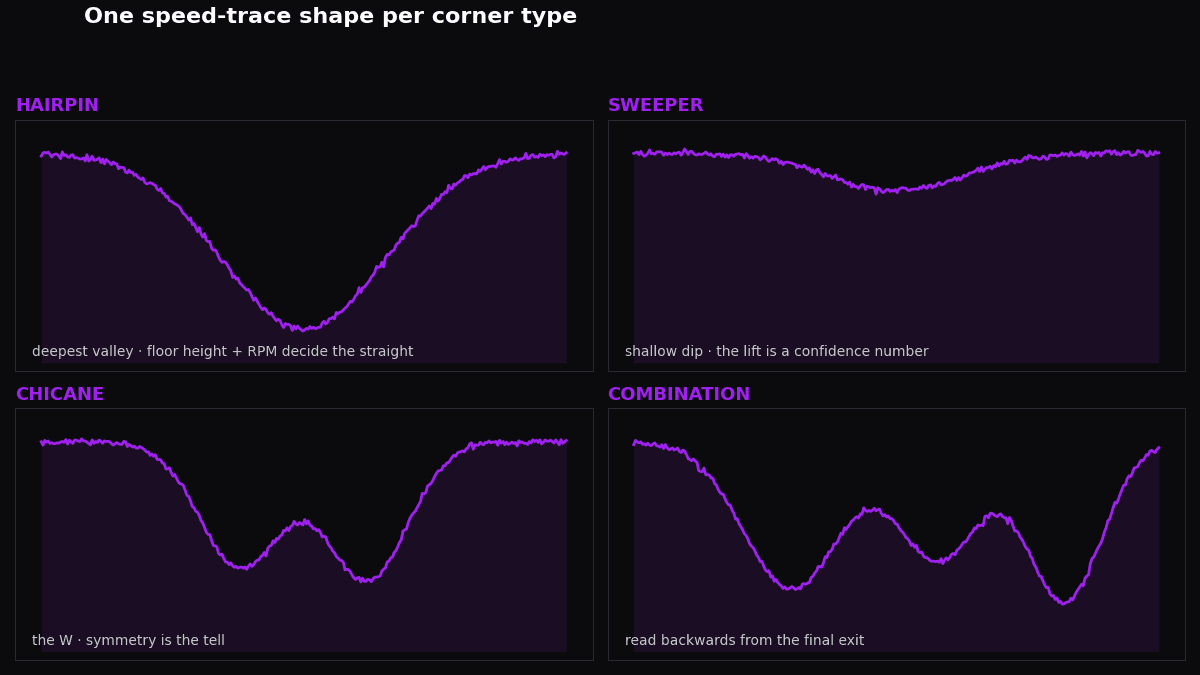
Data signature: the deepest valley on the speed trace, and the corner where minimum RPM lives or dies. If the floor scrapes below the power band, the hairpin is being driven against the gearing, the diagnosis from kart RPM data.
On the trace, a healthy hairpin shows one clean dip, a short floor, and revs that climb the moment the kart points straight. A struggling one shows a long flat floor and a lazy climb. That second shape is the engine telling you the straight is already lost.
Sweepers: commitment, measured
Fast corners flip every priority. Entry speed is the corner, and the steering does the braking.
The reference story I tell drivers comes from Siena's turn one, a fast ninety-degree right at the end of the straight. In 2013 I found a way to take it flat while others half-lifted. How?
By nailing the turning point and rotating the kart aggressively while staying full throttle, inch-perfect at the apex kerb. About a tenth a lap, from one corner, and a teammate who tried to copy it without the turning point ended up in the fences.
That's the sweeper in one story. The corner pays commitment plus precision, and it pays nothing for either one alone. Smooth, minimal steering is the enabling skill, covered in steering technique.
Data signature: a shallow valley, or none, and a lateral-G plateau. Progress shows as the lift shrinking lap over lap, visible in the speed trace long before the lap time moves.
In practice the read is simple. Overlay two of your own laps through the same fast corner; the smaller dip nearly always comes with the calmer steering. The lift is a confidence number, and the trace shows exactly where it lives.
Chicanes: the direction-change tax
Chicanes charge you twice, once per direction, and the second change is always the expensive one.
The attack is about the second apex. Sacrifice the first entry, arrive slightly tighter than feels natural, and prioritise a straight kart for the exit element.
Kerbs are tools here, as much as the class and the kart allow, but the exit kerb only pays if the kart lands pointing where the power goes. A kerb that straightens the chicane is free time; a kerb that bounces the rear axle hands it all back.
The test is simple. Take the kerb, then read the exit slope on the trace. Steeper slope, keep it; flatter, the kerb is lying to you.
Data signature: the W-shaped double valley, and the tell is asymmetry. A first element taken too fast shows as a second element taken slow, every lap, and the overlay against a reference makes the trade obvious, per the overlay method.
The W reads in one glance. A balanced W means the trade is working. A shallow first valley with a deep second means the first element stole speed the second had to repay.
Combination corners: only the last exit counts
Linked corners are where corner-by-corner thinking breaks down, deliberately.
The rule of thumb: drive backwards from the final exit. The last corner of the sequence gets the proper line and the proper exit, and every earlier corner gets whatever entry position serves that.
Using all the track for a rounder corner is the default everywhere else. In combinations it can be exactly wrong. The wide exit of corner one is the broken entry of corner two.
Data signature: green-then-red sector traps. A heroic first element that poisons the second shows as adjacent sectors trading places, the reading from sector analysis.
Backwards works on the trace too. Check the final exit speed first; if it's down, step back one corner and check the entry, because the error usually lives upstream of where the loss shows. Walk back until you find it.
The cash-out corner: priority overrides type
One corner on every track outranks its own type: the one feeding the longest straight.
Whatever shape it is, hairpin, sweeper, chicane exit, its exit speed gets multiplied by more metres than any other corner's. This is the one place the trade-entry-for-exit advice genuinely earns its keep, the full argument in corner exit speed.
So sort your track once: find the cash-out corner, mark it, and give it the exit-first attack even if its twin elsewhere on the lap gets driven for rotation. Same corner type, different priority, and the difference is worth real time.
Allen Berg's school teaches the same corner-priority sorting to its students.
Reading your corner-type report card
Here's the session habit that makes the taxonomy useful instead of academic.
After a session, group your corners by type and read each group together. All the hairpins as one question: are the floors high and early? All the fast stuff: how much lift is left?
The chicanes: symmetric or lopsided? Grouped reading finds technique patterns that corner-by-corner reading misses, because a weakness in one corner type repeats at every track you'll ever visit.
Corners are local. Types travel.
And read each group across laps, not just across corners. A type you've truly fixed stays fixed all session, the thread picked up in lap consistency.
Now the homework. Sketch a map of your home track tonight, twenty minutes with a pen. Label every corner with its type, and circle the one feeding the longest straight.
Then rank the types by where you think your time goes, and let the next session's data grade your guesses. Don't be surprised when it disagrees. That disagreement is the exercise doing its job, and if reading the traces is new to you, start with the karting telemetry guide.
Fix a type and you've fixed it everywhere. That's the quiet payoff, and it's why the fast drivers practise types, not corners, with the entries built in trail braking and the lines in the racing line guide.
FAQ
What's the most important corner type to master in karting?
Hairpins, for most drivers, because karting tracks are dense with them and the engine punishes errors there hardest. But audit your own data first: the corner type costing you time at every track is your most important one, and the grouped reading above finds it in one evening.
Then work the type, not the one corner. A single hairpin fixed is one corner at one track; the hairpin habit fixed travels with you to every circuit you race.
Should I attack a corner differently in qualifying versus the race?
Mostly no for technique, yes for risk. The attack per type stays; the margin you leave at the limit shrinks in qualifying and grows in lap-one traffic. Combination corners change most in racing, since defending position can force lines the taxonomy would never choose.
One more thing for qualifying. The cash-out corner keeps its priority even on a single flying lap, because the straight after it is where the time actually arrives.
How do kerbs change the corner-type rules?
Kerbs are corner-specific, not type-specific: some chicane kerbs are free lap time, some hairpin kerbs unsettle the rear axle for the whole exit. Test each kerb deliberately, one change at a time, and let the exit slope in the data deliver the verdict.
And borrow kerb lines with care. A heavier kart on a soft setup takes a kerb differently from a light one on stiff settings, so a teammate's kerb isn't automatically yours.
Does corner type change with the kart class?
The taxonomy stays, the attacks shift. More power makes V-shapes affordable in slow corners; more grip turns lifts into flats in fast ones. Re-sort the track when you change class, because last season's flat corner might be this season's commitment test.
The re-sort costs you one evening with the map and one session with the data. Cheap, compared to learning it the slow way across a whole season.
Alessio Lorandi started karting at six and won the 2013 CIK-FIA Karting World Championship. He raced through Formula 3, GP3 and Formula 2 before founding Purpl, an AI data coach for karting drivers.