Karting in the Rain: Technique Changes the Data Demands
Everyone sucks in the wet at first. The lines off the rubber, the upright braking, the patient throttle, and the deliberate practice that turns rain into an edge.
Let me start with the confession that makes this article trustworthy. The first times I drove in the wet, I didn't just suck a bit. I sucked big time.
I spun left and right with no clue what was causing it, the kart driving me instead of me driving it. Karting in the rain is a separate skill from dry speed, learned separately, and almost everyone starts terrible at it. That's normal, and it's fixable.
Here's the technique, system by system, and the deliberate practice that turns rain from a fear into an edge.
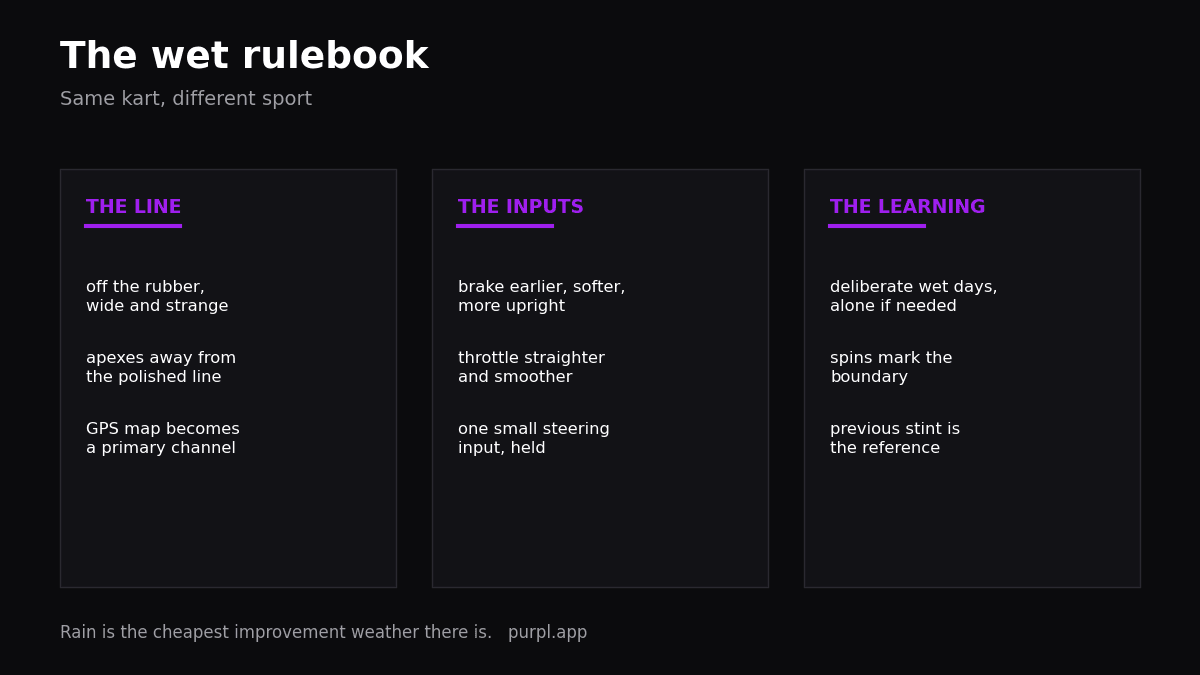
The line: drive where the grip went
The first wet rule rewrites the racing line entirely. The rubber that grips in the dry becomes the most slippery surface on the circuit in the wet, so the fast line moves off it.
Run wide. Avoid the rubber. Those were the first coaching words I got about rain, and they're still the spine of it.
Entries wider than feel natural. Apexes off the polished line. Exits using tarmac the dry line never touches.
The wet line looks wrong from the outside, and that's how you know it's right.
Cross the dry line where you must, but do your braking and turning off it. The full line theory, dry and wet, lives in the racing line guide. Your GPS track map becomes the proof.
Reading that proof is exactly what wet weather karting data covers.
Braking: earlier, softer, more upright
Wet braking changes all three dimensions at once.
Earlier, because stopping distances stretch when deceleration efficiency collapses. Softer at the first touch, because a locked rear on a wet surface is a spin with paperwork.
And more upright, finishing the braking before the kart leans in, because brake and steering share one wet tyre and that budget is far smaller than a dry one.
The dry-day trail braking habits get dialled far back. The technique stack from karting braking technique still applies, just resized to the grip available.
Throttle: straighter and smoother
Next, the throttle.
The wet throttle rule is one sentence from my own notes: in low traction, be a bit straighter and smoother when going on throttle.
Straighter means waiting until the kart points more toward the exit before asking for power.
Smoother means one patient build instead of the dry-day commitment, especially in the first laps of a wet session, when traction is at its worst and every kart is tiptoeing.
The proxies in throttle trace analysis show the wet version clearly: longer, gentler exit slopes, and rev flares wherever impatience won.
Hands and body: calm everything down
Steering inputs get the same resizing. The wet punishes big angles and sudden corrections even harder than the dry, because the front tyres hold so much less.
One input, smaller than usual, held longer. The smooth-hands discipline from steering technique goes from advice to law in the rain.
Busy hands are usually the spin's real cause, dressed up as bad luck. Slow them down.
Setup helps too, because wet settings exist to claw back grip. TKART's rain setup guide covers the standard moves. Tyre pressures do the biggest single job, per kart tire pressure.
Learn it on purpose
Here's the real separator. Deliberate wet practice.
Drivers who get good in the rain build the skill on purpose. Drivers who stay scared of it just hope the forecast changes.
After a wet weekend humiliated me early in my career, I found every rainy test day I could. Often alone on track, just working. Testing lines, pushing limits, spinning when I crossed them.
The spins were part of the syllabus. Each one marked the boundary more precisely than any coaching could.
That work converted rain from my weakness into a weapon, all the way to wet wins in every category I raced. Not talent. Wet laps, banked deliberately, while everyone else stayed in the tent waiting for sun.
Sort the basic kit before you copy any of that, because a miserable driver learns nothing. Prep the visor so it sheds water and doesn't fog at the first slow corner, and pack dry gloves somewhere they'll still be dry for the second stint.
Comfort matters more than usual too. Check the rib protector still sits right over the extra layers you wear against the cold. A driver who's soaked, frozen and pinched drives with tense shoulders, and tension is exactly what the wet punishes.
Then picture how a first deliberate wet session could run. Out lap: gentle, wide, learning where the water sits. Nobody is timing you.
For the first laps, drive the wide line on purpose, even where it feels absurd, and let the kart move underneath you while you listen to it. The slides are the track talking.
Then probe one corner at a time. Brake a touch later each lap into the same corner until the kart says enough. A spin at that point isn't failure, it's the boundary you came to find.
If the rain eases mid-session, stay out. The wet line erodes and a dry line is reborn lap by lap, the same process described in track grip evolution, just compressed into minutes.
End the session with notes before numbers. Which corners felt solid, which ones felt like guessing. Then let the data argue with the notes.
A few sessions like that and the fear goes. Not the respect, the fear. The respect you keep.
The progression method is the same one from the wet data article: your previous stint is the reference, and improvement is measured against yourself, stint by stint.
Racing in the rain: the skill gap is the opportunity
Wet races spread the field like nothing else. The gap between the best and worst wet drivers is measured in seconds, not tenths, which makes rain the biggest overtaking opportunity in karting.
The racecraft adjusts with the grip. Passes happen where the wet line and dry line cross, mistakes ahead multiply, and patience pays double because half the field will hand you positions if you stay on track.
The general passing toolbox is in overtaking in karting. Rain just serves more chances to use it.
And visibility becomes a skill of its own. Spray off a pack of karts erases braking references, which is one more reason the references you banked in practice matter. You'll be braking on memory when you can't brake on sight.
The spray itself changes with track position. At the front it's a nuisance. Mid-pack it can be a grey wall, swallowing the kart ahead, the kerbs and your braking marker all at once.
So treat clean air as a prize. Half a kart of offset, or a slightly longer gap on the opening lap, often buys back more vision than it costs in distance. Expect the worst of the spray early, before the field strings out.
The mindset that survives the first spins
One last tool, because wet technique fails without it.
The word is YET. Not good in the rain, yet.
Every driver who's now quick in the wet was once spinning with no clue, me very much included, and the difference was never talent. It was laps, taken deliberately, with the gap measured honestly after each one.
So when the rain comes and the tent groans, smile. It's the cheapest improvement weather there is, and most of your rivals are about to waste it.
FAQ
What's the most important change for karting in the rain?
The line. Get off the rubber and most of the other changes follow naturally, because you're finally driving on surface that grips.
A driver on the wet line with average technique beats a driver on the dry line with great technique, every wet session. The dark, glossy sheen on the rubbered line is the warning sign. If a stretch of track shines, the grip has left it.
Should I brake with the same force in the wet?
Same eventual force, gentler arrival at it. The first touch of the pedal is where wet spins are born.
Squeeze in, finish the braking earlier and more upright, and leave a margin for the first laps until the references are rebuilt. And do as much of the slowing as possible with the kart pointed straight.
How do I stop spinning in wet corners?
Audit the three usual causes in order. Throttle applied while the kart is still turning. Braking carried too deep with steering load.
Steering corrections stacking up mid-corner. One of those three is almost always the author, and the data shows which. Fix them in that order too, because the early mistakes tend to cause the later corrections.
Is wet practice worth the cleaning and the hassle?
It's the best-value track time in karting. Skill gaps are biggest in the wet, sessions are cheap because nobody else wants them, and the references you bank keep paying off at every wet race for years.
Yes. Emphatically.
Alessio Lorandi started karting at six and won the 2013 CIK-FIA Karting World Championship. He raced through Formula 3, GP3 and Formula 2 before founding Purpl, an AI data coach for karting drivers.