The Racing Line in Karting, Explained With Telemetry
Out wide, apex, out wide is where the racing line starts, not where it ends. GPS lines, minimum speeds and when to break the geometric rule.
Ask anyone in a paddock to explain the racing line and you'll get the same speech. Enter wide, clip the apex, exit wide. It's correct, as far as it goes.
But it's also the explanation drivers receive at eight years old and then never upgrade, which is why so many of them argue about lines using feelings. Their own GPS data could settle the question in thirty seconds.
So let's do the upgraded version: the geometry, what the data actually shows, and the cases where the textbook line is the wrong line.
The geometry: radius buys speed
A kart's cornering speed is limited by grip. And for a given grip level, speed rises with the radius of the arc you're driving.
That's the entire physics of the racing line. Use the full width of the track to drive the largest radius the corner allows, and you carry the highest minimum speed through it.
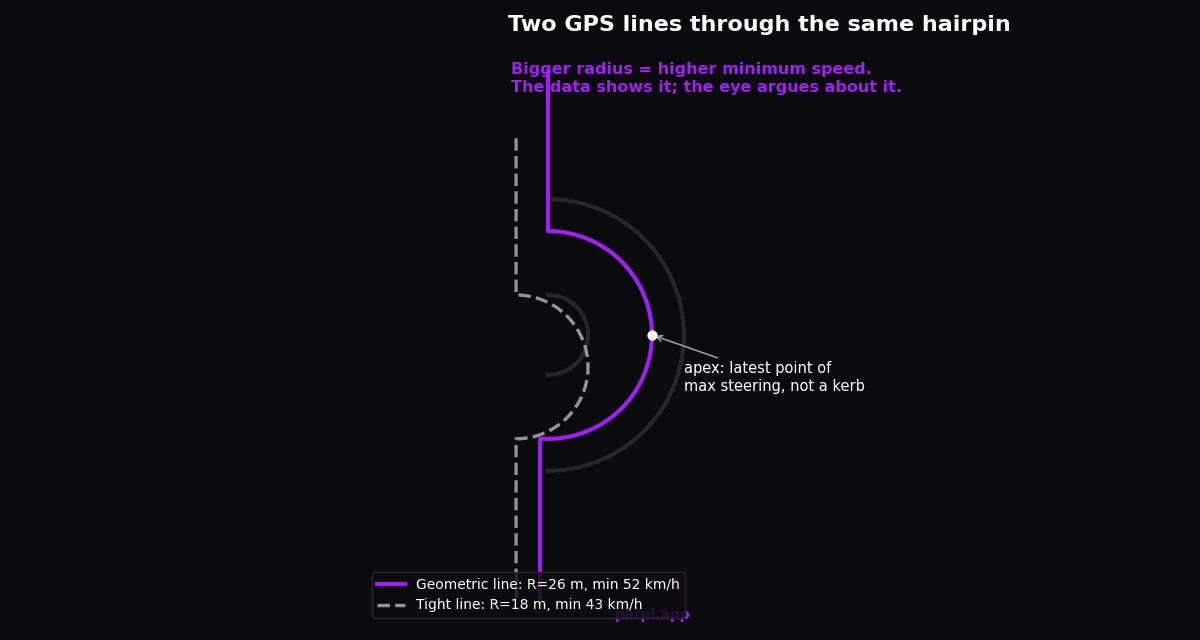
In the GPS overlay above, the wide geometric line is worth 9 km/h of minimum speed over the tight line through the same hairpin. Nine.
That dwarfs almost anything you can do with braking heroics. And it's why minimum corner speed is the first number I check in any driver's data, a habit explained in the speed trace guide.
The apex, by the way, is not a kerb. It's the point where your steering is at maximum and the corner starts opening. And its position is a choice.
Late apex: slower in, faster out, the corner exits onto a straight. Early apex: more entry speed, compromised exit, sometimes correct before a short gap to the next corner; corner-by-corner logic for that choice is in karting corner types.
What the data adds to the theory
Here's why I insist on the telemetry version of this topic. The eye is a terrible judge of lines.
Two laps can look identical from trackside while the GPS shows half a metre of difference at the apex and 3 km/h of minimum speed between them. Drivers will swear they used the full exit width; the data shows a metre of unused track, every lap, for a whole session.
A metre of track is radius. Radius is speed.
So the workflow: overlay your line against a faster reference in the corner where you're losing time. Then look at three places.
Entry width, are you actually starting from the outside edge? Apex position, earlier or later than the reference? And tighter or freer?
Exit width, did you use everything?
Then cross-check against the speed channels, because the line is only a means. The verdict is always minimum speed and exit speed. The full overlay method is in comparing two laps.
The five reference points of every corner
To work on lines systematically you need vocabulary, because "I took it better" isn't analysable. Every corner has five points worth naming. And your GPS line shows all of them.
The braking point, covered fully in the braking guide, sets up everything after it. A wandering braking point makes the other four points wander with it.
The turn-in point is where your line commits, and it's the most underrated of the five: turning in two metres early is the most common single line error in karting. And it forces an early apex and a pinched exit even if everything else is perfect.
The apex we've covered.
The throttle point, where you return to full power, should generally arrive at or just before the apex in slow corners; the data check is brutal and simple. Look where your speed trace stops falling and starts climbing.
And the track-out point, the spot where the kart reaches the exit edge, tells you whether you actually used the radius you paid for. Five points, five checkable facts per corner, and suddenly a vague feeling becomes a list.
Kerbs: free radius, with conditions
Kerbs extend the track, and at most circuits the fast line uses them. The conditions: a kart takes flat kerbs and low rumble strips happily. But tall serrated kerbs unsettle the rear, and can lift the inside rear at exactly the moment you need it driving.
Apex kerbs are usually worth more than exit kerbs, because radius at the apex raises minimum speed, while exit kerbs mostly add safety margin. Wet kerbs are painted ice. Stay off.
And test kerb use the same way you test everything. With the trace open. A kerb that feels dramatic and costs a tenth shows up immediately in the minimum speed, the check described in the data analysis method.
When the textbook line is wrong
The geometric ideal assumes a corner in isolation, even grip, and nobody else on track. All three assumptions break regularly.
Corners in sequence: the rule is to optimise the exit of the last corner of a sequence onto the straight, sacrificing the ones before it. A perfect first chicane apex that leaves you wrong-side for the second is a beautiful mistake.
Grip isn't where the textbook puts it: rubber builds where karts run, and off-line is dust and marbles early in a weekend. Then sometimes the inside line is faster late in a meeting, simply because it's rubbered from defending. Reading this evolution through your data across sessions is its own skill, covered in track grip evolution.
In the wet, everything inverts and the dry line becomes the slow line. That special case has its own article, karting in the rain.
Race lines: when slow on purpose is fast overall
Everything above optimises a lap in clean air. Races add opponents. And opponents change the optimisation.
Three situations where the "wrong" line is right.
Defending: the inside line into a braking zone is slower by maybe a tenth. And it makes you un-passable into that corner. Whether to pay that tenth depends on who's behind and how many laps remain.
That's arithmetic, not bravado. Pay it on the corners that lead onto overtaking straights. Driving defensively everywhere just makes you slow with extra steps.
Attacking: an overtaking line borrows entry width from your exit. The skill is knowing, from your own data, exactly how much exit you're sacrificing, so the move either completes or wasn't attempted.
Drivers who "almost" pass five times a race are usually spending two tenths per attempt. The accounting is in overtaking in karting.
Dirty air and tow: following closely costs front grip in fast corners and pays back on straights. At tracks with long straights, the leader's ideal line matters less than the follower's tow.
That's why the last lap of a kart final looks nothing like a qualifying lap from either driver. Plan your final-lap line in advance. Everyone fast does.
Your eyes draw the line
Here's the part of line driving that never shows up in geometry lessons. The kart goes where your eyes have already been.
Look at the apex and you'll drive to the apex. Stare at the kerb you're afraid of and you'll meet it. The technical name is target fixation, and every coach has watched it steer a kart into the one hazard the driver was trying to avoid.
The discipline is to keep your eyes one reference point ahead of the kart. Approaching the braking point, your eyes are already at turn-in. At turn-in, they're at the apex.
At the apex, they're at the exit. It feels unnatural for exactly the first hour, and then it becomes the thing you can't believe you drove without.
The data shows the change indirectly but unmistakably: steering corrections drop, and the mid-corner double-dips disappear from the speed trace. And the line through any corner becomes one clean arc instead of three negotiated segments.
A simple test for whether your eyes are the problem. Can you name the colour or shape of your turn-in reference at three different corners of your home track?
If you can't, you're driving by feel. And your line will wander with your mood.
Fast drivers have named references everywhere. It's the least glamorous secret in the sport.
Homework for your next session
Pick two corners, one fast, one hairpin. Walk to each before driving. Choose physical references for turn-in and apex.
Drive the session using them, eyes always one point ahead. Then download and overlay against your previous best. Check two numbers per corner: minimum speed and the width you actually used at exit.
That's a complete line-training session. It costs nothing. And it beats five sessions of driving around hoping.
Line errors I see most in coaching
Three patterns cover most of what I correct at junior level.
Entry laziness: starting the corner from a kart-width inside the edge, instantly shrinking the available radius, costing speed before the driver has done anything else wrong.
Apex worship: treating the painted kerb as a target in itself and steering twice to hit it, when one smooth arc with a free apex would carry more speed. You can hear this mistake in the steering, and see it in the data as a double dip in mid-corner speed, the signature explained in what steering data reveals.
And exit modesty: lifting the kart off the exit kerb it should use, donating that last metre of radius back to the track.
Each one is invisible to the driver and obvious in the overlay. That's the recurring theme of this whole series. Feel argues, data decides.
Learning lines faster
When you arrive at a new circuit, don't try to derive the perfect line from first principles on lap one. Watch where the rubber is. It's the previous drivers' data written on the asphalt.
Follow someone fast for three laps before you've built bad habits. Then download and check your minimum speeds corner by corner against whatever reference you can get; the complete arrival routine is in how to learn a new track fast.
One last opinion, since this series doesn't do neutral conclusions: most drivers spend their line-learning effort on the spectacular corners, the fast sweepers, and leave the slow hairpins on autopilot. Backwards.
Slow corners are where radius differences turn into the biggest time differences, because you spend so long in them. Learn the boring corners first. The data agrees with me, and the maths of why is in the braking-cost comparison from the braking technique guide.
And remember the order of operations. Line first, then braking refinement, then setup.
A clean line makes every other improvement measurable. A dirty one buries them all in noise.
For broader cornering theory from the car world that holds up in karting, the line geometry explainers at Driver61 are well made. And the karting-specific technique discussions at TKART include line case studies with data.
Alessio Lorandi started karting at six and won the 2013 CIK-FIA Karting World Championship. He raced through Formula 3, GP3 and Formula 2 before founding Purpl, an AI data coach for karting drivers.