Using Data to Build Confidence (Not Anxiety) in Young Drivers
Pressure breaks laps in predictable ways, and the same laptop can build a driver or break one. How data, routines and the right reframe protect young drivers.
Somewhere right now, a young driver is cracking under pressure. Not at a world final. At a Tuesday test day.
Karting mental training matters because pressure doesn't wait for big races, and because the modern paddock added a new ingredient: data everywhere. The same laptop can build a driver's confidence or feed their anxiety. Which one happens is mostly decided by the adults in the tent.
This one's for the parents and coaches as much as the drivers. Here's how pressure actually breaks laps, and how to point the numbers the right way.
How pressure actually breaks a lap
Cracking under pressure has a mechanism, and it's underdriving, not overdriving.
A driver gets too results-oriented, starts fearing the mistake more than wanting the time, and protects instead of pushes. The classic shape: two green sectors light up, and the brain whispers don't screw up the good lap. The final sector gets driven conservative, the two tenths vanish, and a potential top three becomes a P10.
Then the blaming starts, the chassis was sliding, the engine was weak in sector three. Forgetting that the previous lap, on identical equipment, that sector was fine.
Pressure wrote the slow sector. The excuses just signed it.
Races run the same script. The leader watching the pack close starts overpushing here, underpushing there, glancing back, defending on lap eight.
Meanwhile the chaser, safe in P2 with nothing to lose, drives free and catches him. Position didn't decide that. Psychology did.
Where the pressure comes from
Hard truth, said with care: for Mini and Junior drivers especially, the results obsession is usually inherited.
It comes from the tent, from being pressured to perform, sometimes from hearing that bad results mean quitting. A kid carrying that weight checks the teammates' dashes on the grid before unbuckling, and that habit, the instant comparison, is the recipe for stagnation dressed as motivation.
The reframe that fixes it comes from someone who only ever lived to win, so take it seriously. The early stages of karting are about more than winning.
When the experience or the equipment doesn't allow winning yet, the priority shifts to progress, to driving improvement, something no ranking can classify. The end goal stays winning. The daily goal becomes getting better, measurably.
Karting mental training, the data way
Here's where the laptop becomes the ally. Data has one property no parent or coach can offer. Numbers have got no emotions.
Used right, data takes the person out of the debrief. The verdict lands on the lap, not the kid: turn four cost two tenths, here's the trace, here's tomorrow's project.
No character judgement, no comparison to the rival's father's opinions, just a fact and a plan. That's the difference between a debrief a young driver dreads and one they start asking for.
What does that sound like in practice? Here's a script any parent or coach can run after a session.
Not "why were you slow in the second heat?" That question puts the kid on trial. Open with the trace instead: "turn four cost two tenths, what did the kart do there?"
Now the kid is the analyst, not the accused. Close with one question: "so what do we try next session?" The driver names the change, writes it down, owns it.
Two questions, zero adjectives about the driver. That's the whole script.
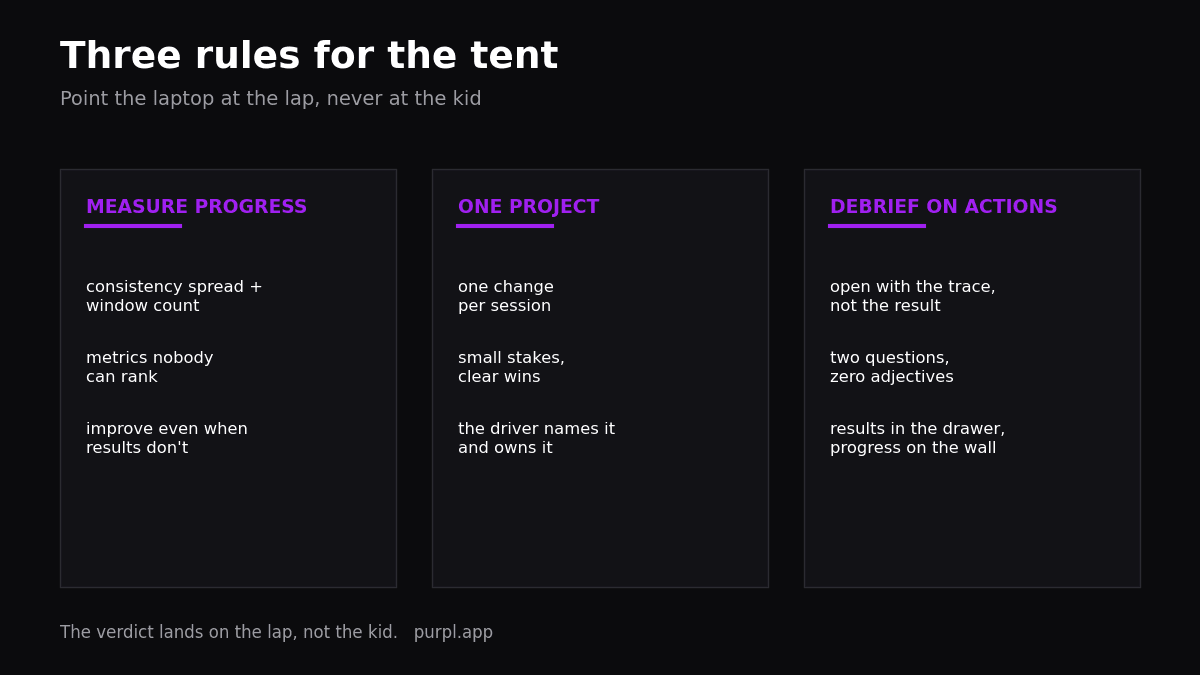
Three data rules protect confidence. First, measure progress on metrics nobody can rank: the consistency spread and the window count from lap consistency, which improve even on weekends the results don't.
Second, run one change at a time, because a single clear project shrinks the stakes of any session. And third, keep the live numbers out of the cockpit, the dash discipline from delta time. Mid-lap arithmetic is pressure with a screen.
In a real week the three rules look boring, which is the point. Boring is what low stakes feels like.
Tuesday test: the spread gets written down after every run, and nobody reads out the fastest kid's times. Each session carries one project, say the braking into turn one, picked from the sector analysis and nothing else.
The dash shows lap count. Nothing more. So the only numbers the driver meets all day are the ones on the laptop, after the helmet comes off, with a plan attached.
And teach the word YET. Not fast in the wet, yet. Not consistent, yet.
The growth frame isn't a poster slogan; it's the literal mechanism by which a driver two seconds off becomes a winner, documented one stint at a time.
The zone, and the routines that build it
Confidence on race day comes packaged in routine. The best drivers build theirs on purpose. The state they're aiming for is the zone: maximum focus, time flying, corners going exactly as imagined.
Mine, in the karting years, looked like a wall against distraction. Phone left at the hotel. Sitting by the kart on the pre-grid, visualising the start.
Studying rivals' lap times and corners session by session. Cleaning the helmet and visor every run, even the shoes when tyre pickup dulled the pedal feel.
The team knew me for barking "Make serious!" at chatty teammates, and one respected paddock figure summed up that period by calling me a war machine. The bubble worked.
The grown-up versions added structure: noise-cancelling headphones, eyes-closed visualisation with hand and foot movements, breathing exercises to bring the heart rate down, reaction-light warmups.
Sports psychology backs the quiet too. Talking too much drains the fuel that focus runs on, a point Dr Jim Taylor's sports psychology work makes formally. And Ross Bentley built a whole curriculum around the inner game in Inner Speed Secrets.
For a young driver, start with three pieces: a fixed pre-session visualisation of the perfect lap, one physical ritual that signals focus time, and a phone that lives somewhere else. Small bubble, real effect.
When data hurts instead of helps
The honest section, because the laptop has sharp edges.
Data hurts when it becomes a scoreboard instead of a mirror: lap times compared to the fastest kid in every free practice, moods swinging half a second at a time.
It hurts when the overlay becomes an interrogation, every trace a list of failures read aloud. And it hurts most combined with the grid-dash habit, instant comparison before the helmet is even off.
The tells that it's gone wrong: a driver who goes quiet when the laptop opens, who asks what the others did before asking what the data says. One who drives practice sessions protecting times instead of testing limits.
Any of those, and the data routine needs softening before the driving needs anything.
The repair is structural, not a pep talk. Debrief on actions, never outcomes. One project per session.
Progress metrics on the wall, results in the drawer, and the wider parent playbook in the junior karting guide.
What confidence actually is
Strip away the sports-psych words and confidence in a kart is one thing: trust in references, banked through repetition.
A driver who knows his braking point holds it under pressure, because pressure attacks doubt, not knowledge. That's why the confidence work and the data work are the same work.
Every verified reference, every converged corner, every closed loop on the debrief sheet is a brick of trust that race-day nerves can't dissolve.
Build the bricks on the quiet days, and the big days take care of themselves. That's the whole secret, and it's learnable, the same way tracks are learnable: method first, magic later.
FAQ
How do I stop my young driver obsessing over results?
Replace the metric, don't ban the ambition. Put the consistency spread and the one-change project where the results table used to be, and praise execution out loud while logging outcomes quietly. The obsession follows whatever the adults visibly measure.
Give it a month before judging the swap. Habits in the tent move slower than habits in the kart, and the adults adjust last.
Is getting angry after sessions normal?
Frustration is normal and even useful pointed at the right target. The healthy version is being annoyed at a specific, fixable error; the corrosive version is mood tied to the timesheet. Steer the anger toward the trace, where it converts into a project.
And watch the timing. Straight after a session the mood is still hot, so the laptop opens once the kart is packed away, not before.
What's a good pre-race routine for a junior?
Short and repeatable: a few minutes of quiet, one visualised lap with the hands moving, a fixed physical ritual, and no phone. The content matters less than the consistency, because the routine's job is signalling to the brain that it's time.
Keep it simple enough to survive a delayed grid. A routine that needs perfect conditions breaks at the first schedule change, and a broken ritual hurts more than none.
Can data replace a sports psychologist?
No, and it shouldn't try; serious anxiety deserves professional help. What data does is remove the most common pressure sources, vague criticism and constant comparison, by making every conversation specific and personal progress visible. That alone defuses most tent drama.
Think of the laptop as hygiene, not therapy. It keeps the everyday pressure low, so the rare real problem stands out early and gets the right help.
Alessio Lorandi started karting at six and won the 2013 CIK-FIA Karting World Championship. He raced through Formula 3, GP3 and Formula 2 before founding Purpl, an AI data coach for karting drivers.