How to Learn a New Kart Track Fast (Using Your First 10 Laps of Data)
I won a world title at a track nobody had driven. The method: homework before arrival, a disciplined first ten laps, and data that turns recon into lap time.
Let me start in Bahrain. The biggest race of my life happened at a track almost nobody had driven before.
The 2013 World Championship finale was held there, on a circuit new to the whole field. That levelled playing field was part of my luck that year.
When everyone learns from zero, the driver who can learn a new track fastest holds a real advantage. And that's a method, not a talent.
Here's the method: the homework, the track walk, and what to do with your first ten laps of data.
Before you arrive: steal laps for free
Track learning starts at home, where laps cost nothing.
Watch previous race videos from the circuit, onboards if they exist, broadcast if not, and study the track map until you can draw it.
Then visualise: eyes closed, run the lap corner by corner, mimicking the steering and pedal inputs and even your posture, the way you'd rehearse any performance.
Turn it into a checklist before you travel. Videos first, the map test second, the mental laps last, in that order, because each step feeds the next. Tick them off like homework, because that's exactly what they are.
This sounds like a small edge. It isn't.
Arrive with the corner sequence already in your head and your first real laps go into calibrating speeds, not discovering directions. That's a session saved before the engine starts.
The track walk: read the surface, not the line
Walk the track if the schedule allows it. And walk it looking down as much as ahead.
The line will reveal itself from the seat soon enough. What the walk gives you is the surface story: which kerbs are flat and usable, where the camber helps, the mud dragged onto exit kerbs. The shiny patches that stay slippery, the corners that will dry last if rain comes.
Those details take laps to discover from the kart and minutes to collect on foot. Cheap speed.
Frequent track walks were part of every serious preparation block I ever did, alongside the video study. Boring, free, and repaid every single time.
Learn a new track with your first 10 laps
Now the seat time, and the discipline that makes ten laps worth thirty.
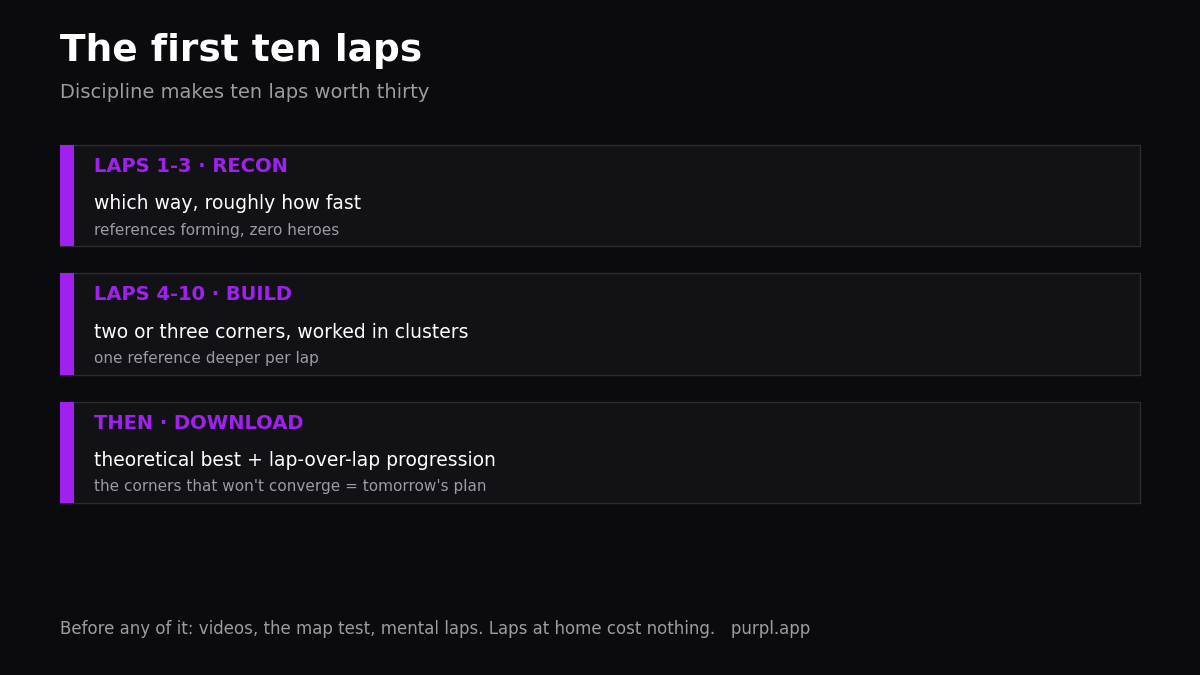
Laps 1 to 3: recon. Two questions only, which way does the next corner go and roughly how fast. No heroes, no lap times, just references forming: a brake marker here, a kerb to clip there.
You're laying neural pathways, and every lap literally builds them. Which is why lap fifteen will feel nothing like lap one.
Laps 4 to 10: build, in clusters. Pick the two or three corners that obviously matter most, usually the ones feeding straights. Work them deliberately and let the rest just flow.
One reference at a time, pushed a little deeper each lap. No leaps. The same creep discipline as every technique on this blog.
Then download. Ten laps of data at a new track is a complete syllabus.
The theoretical best already shows which corners you're learning slowest, per lap time analysis. And the lap-over-lap progression shows where the learning has stalled, the read from sector analysis.
That first download looks like this in practice. Say three corners refuse to converge: braking varies lap to lap, the minimum speed jumps around, the exits never repeat, and those are the corners still being driven on hope.
Now look at the shape of each one on the speed trace. A braking point drifting earlier means trust is shrinking, not growing. A minimum speed that swings says the reference hasn't been picked yet.
That's tomorrow's plan, written by the data. No opinions needed. Pick one corner, pick one reference, and go confirm it.
Trust is the speed limit
Here's the part nobody puts on a checklist. You go as fast as you trust, and not a tenth faster. That rule never changes, new track or home track.
Run the maths on what caution costs. Driving at 98% of the limit instead of 99.9% sounds like nothing, but on a 57-second pole lap at a track like Sarno, 98% is a 58.163.
More than a second, handed over, with no mistake made anywhere. That's the bill.
At a new track, trust comes from references banked. Which is why the recon laps matter more than they feel like they do.
Every confirmed braking point converts caution into commitment, corner by corner, and the download tells you which corners are still being driven on doubt. They're the ones where your laps refuse to converge, the spread reading from lap consistency.
Bahrain: how it actually went
That World Championship is my proof. Method beats raw pace at a new track, because raw pace wasn't what I had that weekend.
I'd struggled for grip all weekend and qualified the prefinal poorly, taking a P4. That meant starting the final eighth, on the outside, the lane where crashes come looking for you.
I got a better start than I had any right to, picked positions up, and led by lap nine. Three corners later I was hit at the turn-five hairpin and had to rebuild the race from there.
For the record, since people look it up: the result went through the stewards after the race, and the FIA International Court of Appeal later confirmed it.
P2 at the flag, enough points, world champion. The pace that weekend was ordinary. The preparation, the references, and the racecraft that experience buys were not, and at a track new to everyone, that was exactly enough.
Sessions two and three: from learning to racing
The first download sets the plan. The next two sessions execute it.
Session two is corner projects: the two or three worst corners from the data, one change each, verified against the morning's traces. Session three converts learning into race shape. Longer runs, consistency over best laps, and a first honest read of how the track evolves as rubber goes down, the moving target from track grip evolution.
Write the whole day down on the debrief sheet, because new-track notes are the highest-value notes you'll ever take. Next visit, they're the difference between learning the track and remembering it.
Picture the second visit. The map is already in your head, the kerb notes are already written, and the first session plan exists before the kart comes off the trailer.
Everyone else starts learning. You start confirming. That's what one honest debrief sheet buys you next time.
Coaches structure it the same way across motorsport: Ross Bentley's track learning guide and Blayze's track learning series both run homework, sections, then speed. The karting version just compresses the timeline.
Don't compare your lap five to their lap five hundred
One mindset note, because new tracks bruise egos efficiently.
The locals will be faster. They've banked thousands of laps you haven't, and matching them by lap ten was never the assignment.
Don't compare your chapter one with someone else's chapter ten; compare your lap ten with your lap three, because that's the number that measures whether the method is working.
Track learning speed itself improves with practice, like everything else. It compounds. Every new circuit you learn properly makes the next one faster to learn, and by the time it matters, at a Bahrain of your own, the method is the talent.
FAQ
How many laps does it take to learn a new kart track?
Direction and references come in a handful of laps; competitive pace typically takes sessions, not laps, and the last tenths take days.
The honest milestone is convergence: when your laps stack within a couple of tenths, the learning phase is done and the development phase starts. Until then, more laps at the same scattered pace teach very little.
Is sim racing useful for learning a real track?
For the corner sequence and rough references, genuinely yes. It's the modern version of video study, and the same homework rules apply. Sequence first, speed later.
Grip levels and kerb behaviour won't transfer, so hold the sim knowledge loosely for the first laps, treating it as a map you've memorised rather than a limit you've found. The crossover is covered in sim racing for karting.
What should I look for on a track walk?
Surface truth: kerb heights and angles, camber, grip patches, dirt on exits, where water would sit. Plus reference candidates, boards, cracks, fence posts, for braking points.
The racing line you can find from the seat; the surface story you can't. Walk slowly, photograph anything odd, and write the notes down the same day.
Should I chase lap times in the first session?
No. Chase references and convergence, and let the lap time arrive as a by-product. A first session driven for the timing screen produces scattered laps and no syllabus, the same dash trap covered across this blog.
The download afterwards is where the speed gets built. Compare your own laps against each other, the habit from overlay analysis, and the next session writes itself.
Alessio Lorandi started karting at six and won the 2013 CIK-FIA Karting World Championship. He raced through Formula 3, GP3 and Formula 2 before founding Purpl, an AI data coach for karting drivers.