How to Read a Speed Trace (and Spot Time Left on Track)
A speed trace shows every corner as a valley, and every valley holds a verdict. How I read braking shape, minimum speed and exit slope in kart data.

One graph holds more lap time than every other screen in your software. Speed on the vertical axis, distance on the horizontal. The speed trace.
Most of the speed trace analysis I do with drivers comes down to reading that single line properly. A kart lap drawn this way becomes a row of valleys, and every valley is a corner with a verdict written inside it.
Braked too early. Rolled enough speed. Killed the exit.
Drivers stare at this graph for years without learning its grammar. This article is the grammar.
What the graph actually shows
Every kart data logger draws it the same way. The line climbs on the straights, tips over when you brake, falls to a low point somewhere in the corner, then climbs again.
Valleys and plateaus. A 52-second lap at most kart tracks contains eight to twelve valleys, and your job is to learn what a healthy one looks like.
One setting before anything else: put distance on the horizontal axis, not time. On a time axis, slow sections stretch and fast sections compress, and nothing lines up when you compare laps. On a distance axis, every point on the graph is a physical metre of track.
The longtime F1 technical analyst Craig Scarborough wrote a good introduction to reading race telemetry years ago, and it starts from exactly this convention. Karting inherited it for the same reason.
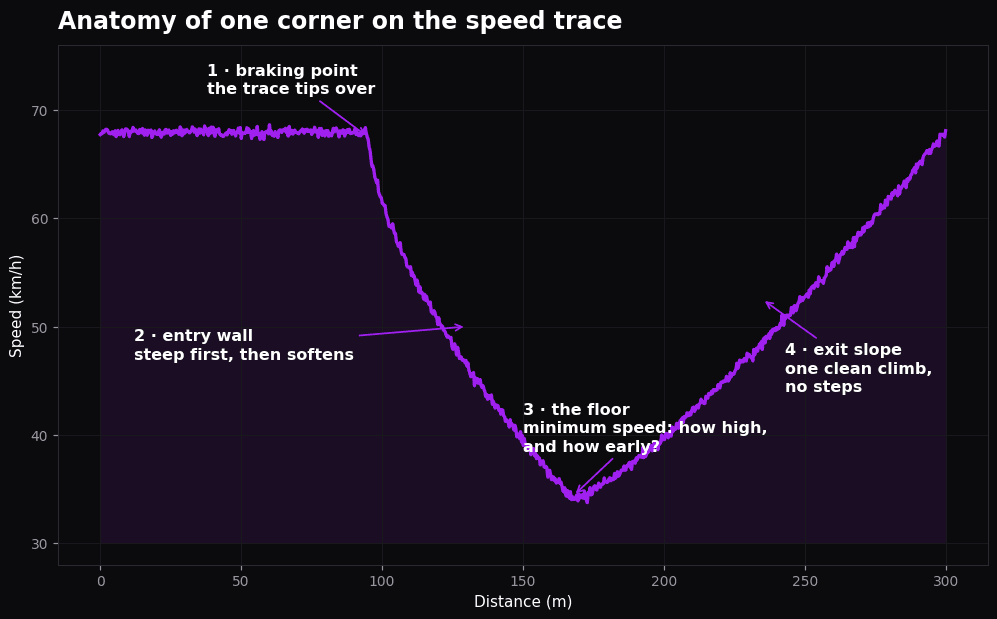
Each valley then has three regions, worth reading in order: the entry wall, the floor, and the exit slope.
The entry wall: where and how the line falls
The point where the trace tips over is your braking point. Fixed in metres, no opinion attached. That alone settles half the arguments in a race tent.
But the shape of the fall matters as much as where it starts.
A good braking zone in a kart drops steeply at first, while the tyres have all the load, and then softens as you bleed toward the apex. On the graph that's a wall leaning progressively into a curve.
When I see the opposite, a long lazy ramp, I know the driver braked early and gently. He carried the brakes like a passenger instead of using them.
Two drivers can start braking at the same metre and arrive at the apex three tenths apart, purely on the steepness of that wall. That's deceleration efficiency. It's the heart of karting braking technique.
Watch for the double dip too. The trace falls, flattens briefly, then falls again. That's a driver who released the brakes, didn't like what he felt, and grabbed them a second time.
It almost always means the first braking point was fine and the commitment wasn't. The cure lives in trail braking, not in braking earlier.
Speed trace analysis at the floor: minimum speed
The bottom of the valley is the number that matters most. In equal machinery, minimum speed explains most of the gap between two karting drivers. Karts have no suspension to hide mid-corner speed and very little to gain from hero braking, so the driver who keeps the floor higher is nearly always the faster one.
But height is only half the reading. The other half is position: where along the corner the minimum happens.
When I compare drivers I ask two questions of every floor. Who has the higher minimum speed? And who reaches their minimum earlier?
An early minimum means the rotation is done and the steering is already opening, so the whole exit happens on a loaded rear axle with the engine pulling. A late minimum means the driver was still slowing the kart in the middle of the corner, and everything after it is recovery.
Danilo Rossi, five times world karting champion, insists you can't win titles without a strong front end. This is exactly why. Front grip rotates the kart sooner, pulls the minimum earlier in the corner, and lifts it at the same time.
The trade is a more nervous entry. Data shows you whether the trade is paying.
There's an engine reason to obsess over the floor as well. Drop a couple of hundred RPM below the happy zone mid-corner and a kart engine bogs on exit. The trace shows it as a valley floor scraping too low, followed by a slope that can't climb.
Line choice feeds this directly. Using all the track makes a corner rounder and the minimum higher, which is why the racing line and the speed trace are really one subject. Gearing feeds it too, since a longer gear ratio punishes a low minimum twice as hard.
As a kid I trained with sprockets one or two teeth longer than optimal, precisely to force myself into higher minimum speeds. Brutal exercise. It works.
U shapes and V shapes
Two fast drivers can produce different valley shapes through the same corner. A U shape rolls speed: earlier off the brakes, higher floor, patient throttle. A V shape stops and fires: deeper braking, lower floor for less time, hard on the power.
Neither is universally right. Which is a sentence most data guides won't commit to.
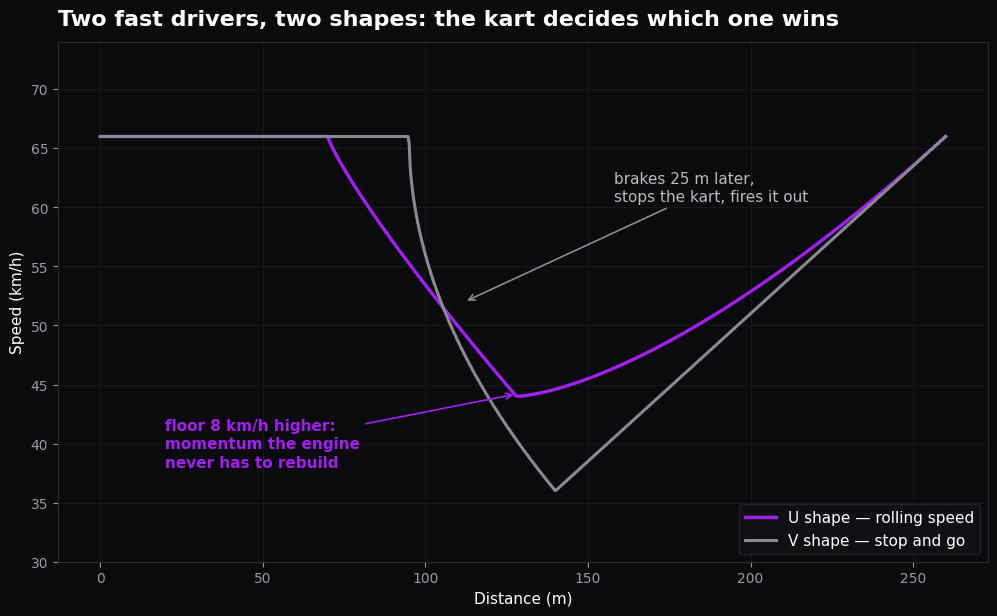
The kart decides. A low-powered single-gear kart, a 60 Mini or an OK-Junior, lives and dies on momentum. It almost always wants the U, because the engine can't repay a stopped corner.
A KZ shifter with six gears and real torque can afford a V where the corner rewards it. Usually that's a hairpin onto a long straight, where exit direction matters more than carried speed.
When your reference driver is quicker through a corner, the shape of his valley tells you how he's doing it. Rolling speed or rotation? Two completely different homework assignments.
The shape question is one of the first things I check in an overlay comparison.
The exit slope: where the straight is built
From the floor of the valley, the line climbs. The angle of that climb is your exit. Small differences here compound for the entire straight that follows, because a deficit at the corner exit is still there 150 metres later at the braking board.
A healthy exit slope is clean and unbroken. One continuous acceleration from minimum speed to the next braking point.
The two sick versions are easy to spot. A slope that starts late means the driver parked the kart mid-corner and lost the engine. A slope with a step in it means wheelspin, a slide, or a lift.
On a single-gear kart that step usually means the exit line pinched until the engine fell off its power band.
One warning from years of doing this with kids and adults alike. The earliest throttle application is not automatically the best one.
I see drivers proudly point at the data showing they touched the throttle before their teammate. Meanwhile their slope climbs slower, because the kart was still sliding and the engine was dragging against a scrubbing rear axle.
Read the slope, not the pedal. Where the speed actually builds is the truth. The full picture needs the throttle channel beside it, which I cover in throttle trace analysis, and the technique behind a strong exit lives in corner exit speed.
The plateaus: read with suspicion
Straight-line speed is the most over-blamed number in karting. A driver sees 1.5 km/h missing at the end of the straight and concludes the engine is down on power.
Then you check the reference lap. The other kart was towed along in someone's slipstream. Or it simply exited the previous corner 2 km/h faster and held that advantage the whole way down.
So before any conclusion about engines or carburetion, trace the plateau backwards to the valley that launched it. In my experience most "engine" deficits on the straights are exit deficits wearing a disguise. Almost every time.
The data engineer Samir Abid has a good piece on relating telemetry to track performance that makes the same point from the car-racing side. Channels lie when you read them in isolation.
A routine that takes ten minutes
Here's how this becomes practice rather than theory. After each session, open your fastest lap and walk the valleys left to right.
Three questions for each one.
Did the line fall steeply from the right metre? Did the floor stay high and happen early? Did the slope climb clean?
Mark the worst valley. That's your project for the next session. One corner, one change.
With a reference lap alongside, the same walk turns into the full detective routine I described in the lap comparison guide above. The delta channel will point you to the valley that matters most.
Without any reference, the shapes alone still talk. A lazy entry wall, a scraping floor, a broken slope. Each one is lap time with an address.
Twenty sessions of this and you'll glance at a speed graph the way you glance at a corner. Instantly, and without translating. That's when the tool starts paying for itself, and it's the foundation everything else in my karting telemetry guide builds on.
FAQ
Is a GPS-only logger enough for speed trace analysis?
Yes. Braking points, minimum speeds, valley shapes and exit slopes all come from GPS speed alone, and that's where most of the lap time hides.
RPM adds the engine's side of the story and is worth having. But I'd rather see a driver master the speed trace from a basic unit than skim six channels on a flagship one.
What's a good minimum speed for my corner?
There's no absolute number. It moves with grip, tyre, class and corner radius. That's why minimum speed only means something against a reference: a faster teammate, your own best lap, or the same corner earlier in the day.
Chase the comparison, not a magic figure.
Why does my trace look ragged in slow corners?
GPS speed gets noisy at hairpin pace, especially on 10 Hz units, and analysis software smooths it with varying success. Read slow-corner floors as a band rather than an exact value, and trust the shape more than the last decimal.
If the whole lap looks ragged, check the antenna mounting before blaming the driving.
Should I look at the speed trace or the delta first when comparing laps?
Delta first, always. It tells you where the gap grows, then the speed trace tells you why. The pairing is the core of overlay work, and I've broken the delta side down separately in delta time telemetry.
Alessio Lorandi started karting at six and won the 2013 CIK-FIA Karting World Championship. He raced through Formula 3, GP3 and Formula 2 before founding Purpl, an AI data coach for karting drivers.