Kart Data Loggers Explained: What They Record and Why It Matters
What a kart data logger actually measures, what the money buys, and the honest buying logic from a world champion who has used them all.

A kart data logger is the least glamorous purchase in your racing budget. And probably the highest-return one. It's also the purchase most surrounded by brand tribalism.
Walk through any paddock and you'll hear strong opinions about which unit is "better", usually from people who have never opened the analysis software of either.
I've raced and coached with every major system out there, so here's what these devices actually do, and what's worth paying for. And what the brand arguments get wrong.
The three parts of every system
Strip away the marketing. Every karting data system is the same three blocks.
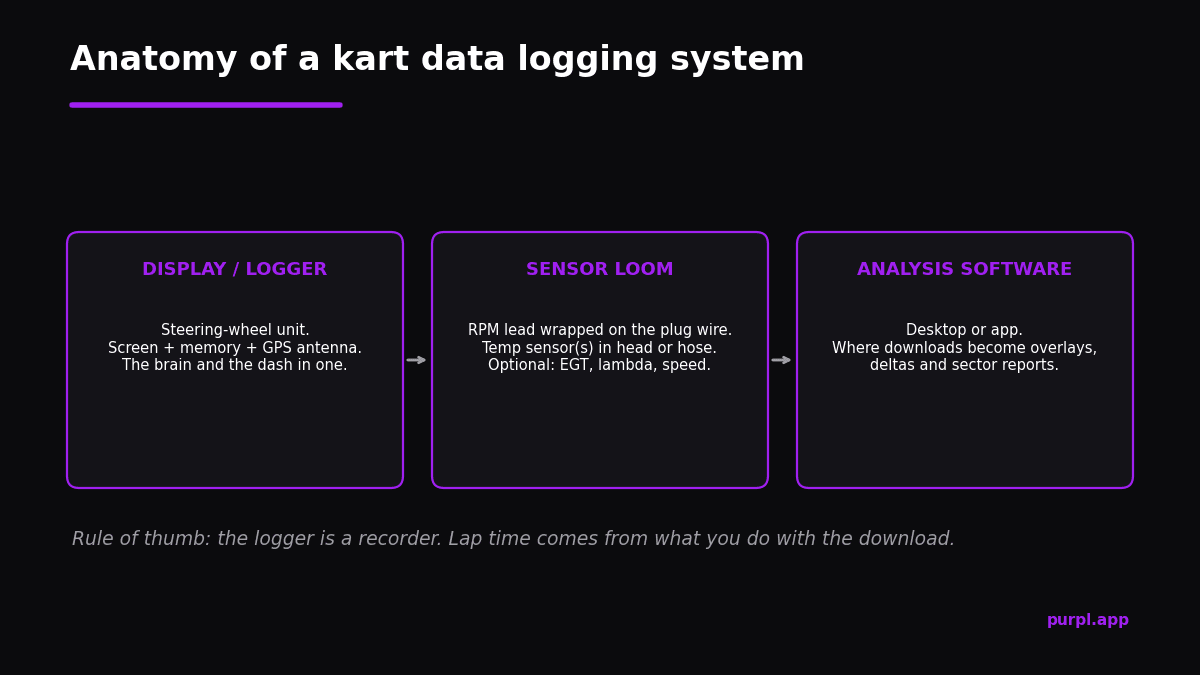
The steering-wheel unit is the recorder: screen, memory, GPS receiver, battery.
The loom brings it signals: an RPM lead wrapped around the spark plug wire, then a temperature sensor in the cylinder head or the water circuit. Optionally exhaust gas temperature or more.
And the software on your laptop or phone is where recordings become decisions, the part that actually produces lap time. And the part I cover separately in how to analyze kart racing data.
Notice what's missing compared to a race car. No brake pressure. No throttle position.
No steering angle as standard. Karting telemetry infers driver inputs from their consequences, speed and revs, which is why learning to read those two channels properly matters so much.
The full channel-by-channel tour lives in kart sensors explained.
What the channels are for
GPS gives you position. Position becomes speed. Then racing line, lap and sector times.
This is the channel that answers "where am I slow". Ten samples per second is honestly enough. Twenty-five draws prettier lines.
The accuracy debate has more myth than measurement in it, so I wrote a separate piece on GPS accuracy with the real numbers.
RPM tells you about gearing and engine use: whether you pull the right revs at the end of the straight, whether you drop out of the powerband in slow corners. How the clutch behaves off the line.
Paired with speed it exposes things neither shows alone. The detail is covered in reading kart RPM data.
Temperatures are insurance first. Tuning feedback second. Water temperature trends warn you before a seize.
EGT guides jetting on two-strokes. They don't make you faster on Saturday. They make sure you still have an engine on Sunday.
Where the money matters (and where it doesn't)
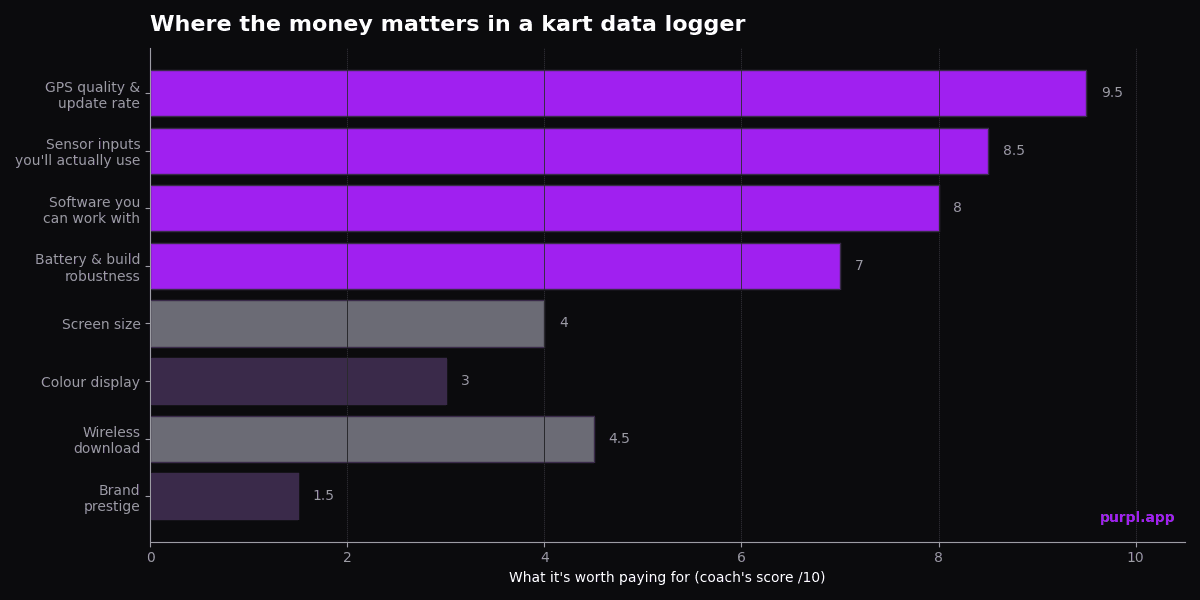
My buying logic, in order. Pay for GPS quality. Every analysis you'll ever do sits on top of it.
Pay for the sensor inputs you will genuinely connect. Not the expansion possibilities you won't.
Pick the system whose analysis software you can tolerate spending evenings with, because the best hardware feeding software you hate equals data you never look at.
Don't pay extra for screen real estate. A kart dash needs to show a lap time and a temperature, and as I argued in the telemetry guide, you shouldn't be reading it mid-lap anyway.
The dash is the least important part of a data system, and it's the part the brochures sell hardest.
And the brand question everyone actually asks. At the level of recording speed, revs and temperature, the major systems are interchangeable, and I've taken titles with different brands on the wheel.
Buy used. Buy what your team or your track's fast guys run, so you can share reference laps, then spend the difference on track time.
A previous-generation unit records the same physics the new one does.
What to run at each level
Different karting lives need different systems. So here's the honest matrix I give people who ask.
Rental and first-season club drivers? A phone app or an entry GPS lap timer is enough, because the skill you're building is driving. Not analysis.
And any money beyond €150 belongs in track time instead. The moment you own a kart and race a championship? Move up.
Club racers and juniors? A used previous-generation colour unit with GPS, RPM and one temperature input.
This is the sweet spot of the whole market: roughly €250-400 buys you ninety-five percent of the analysis capability of anything on sale.
This is also the level where the analysis habit gets built, which matters infinitely more than the hardware carrying it.
Serious national and international racing? Current-generation unit, two temperature channels, and most importantly the same brand your team runs.
Reference laps from teammates are the most valuable data you'll ever load, and formats don't always cross brands cleanly. At this level you're also analysing between every session, so the software workflow speed starts being worth money.
Four-stroke endurance and LO206-style racing? Prioritise battery life and water resistance over channel count. The engines are sealed anyway, so GPS quality is nearly the whole purchase.
Rules: what competition allows
Logging is broadly legal everywhere. Transmitting is the line you can't cross.
International technical regulations permit on-board data acquisition but prohibit live telemetry to the pits and two-way communication with the driver, and most national series copy that stance. Two practical consequences.
First, your analysis loop is necessarily between sessions. That's why the twenty-minute routine matters.
Second, check your class rules on sensor placement before drilling anything: some sealed-engine classes restrict what you may attach to the engine, even passively.
The current technical regulations live at FIA Karting. Your national federation's annexes override them locally.
Channels worth adding later
Once the core habit is built, some additions genuinely earn their wiring. A second temperature channel is first.
Water plus EGT on a two-stroke turns jetting from folklore into measurement, the method in the EGT guide.
A lambda sensor goes one step further into mixture truth, though it's tuner territory, covered in lambda sensors in karting.
A wheel speed sensor on a front wheel, compared against GPS speed, exposes locking in braking zones, which is as close as karting gets to a brake pressure channel.
What I'd skip? Steering sensors and accessory G-sensors at club level. The information is real.
But the analysis time it demands is the scarcest resource you have, and the same evenings spent mastering speed and RPM pay better.
Add channels when your questions outgrow your data. Not before.
The wishlist conversation comes up constantly in club paddocks. And the honest answer? Most of the grid hasn't extracted half the value of the two channels they already record.
How the data leaves the kart
The unglamorous detail that decides whether analysis actually happens? The transfer.
Cable downloads are the reliable workhorse. Slow but boring in the good way.
WiFi and app-based transfers are quicker when they work, and infuriating in a crowded paddock when sixty units share the spectrum. So always know your cable fallback.
Files land in each brand's proprietary format. Readable by its own software.
For anything cross-brand, spreadsheets, your own scripts, or AI analysis tools, you'll want the CSV export, the workflow documented in exporting telemetry to CSV.
Set a personal rule. Data off the kart before the kart goes on the trolley.
Sessions that don't get downloaded the same hour have a way of never getting downloaded at all. And an undownloaded session is a session you paid full price for and only half attended.
Second-hand buying checks
Most first loggers should be used ones, so here's the five-minute inspection.
Power it on and check the battery holds charge. Replacement internal batteries are cheap but corroded charging contacts are not, and battery neglect is the number one killer, something I've detailed in data logger battery care.
Check the GPS gets a fix outdoors within a couple of minutes, and inspect the RPM lead and connectors for cracked insulation.
Download a sample session to your laptop before money changes hands; a unit that records but won't export is a paperweight with a screen.
Mounting and wiring the thing properly is its own small science, vibration is the enemy of every connector. And the right way is documented in mounting a data logger the right way.
A short history, for perspective
It's worth remembering how new all this is. In the nineties, karting data meant a stopwatch in a parent's thumb and an exhaust temperature gauge if you were fancy.
The first affordable onboard lap timers arrived with magnetic strip detection, a sensor under the floor tray counting strips buried in the track. And drivers planned their weekends around which circuits had strips at all.
GPS units changed everything in the 2010s. Suddenly every lap carried its own map, sector times stopped depending on track infrastructure, and line analysis became available to anyone with a laptop.
The reason this history matters to a buyer: the core GPS-plus-RPM recipe has been mature for over a decade, which is exactly why used units are such good value. And why this generation's marketing leans on screens and apps.
The physics being recorded stopped changing long before the brochures did.
The next real shift is happening in the software layer, in what reads the data rather than what records it, and that's the part moving fast right now.
The honest limits
A logger records. It doesn't coach.
The drivers I see making the biggest gains from identical hardware are the ones treating it as a question machine. Pick a question before the session. Get the answer from the download.
Change one thing. The ones making no gains? They use it as a lap-time display with extra steps.
Know the failure modes too. GPS dropouts near tall structures or under metal roofs, which is why your timing reads strangely in some pit lanes.
Interference on RPM leads routed alongside the plug wire's full length. The fixes are simple, and most "my logger is broken" posts describe installation problems, which is why why your lap timer isn't reading laps exists as its own article.
If you remember one sentence from this article, make it this one: the logger on your wheel is a recorder. The lap time lives in what you do with the download, and the cheapest unit reviewed honestly beats the most expensive one admired on a shelf.
FAQ
Do I need a transponder if I have a data logger?
Yes, they do different jobs. The race organiser's transponder feeds official timing and scoring. Your logger is private analysis.
They don't talk to each other, and on a race weekend you'll run both.
1T or 2T version, what's the difference?
The number of temperature inputs. One or two. Two matters if you want, say, water plus EGT simultaneously.
Which two-stroke tuners do want. The full decision logic is in 1T vs 2T loggers.
Can I start with just a phone app?
For rental karting and first experiments, phone GPS apps are a real entry point, and the hardware conversation on communities like KartPulse covers them honestly. For owner karting the dedicated unit wins quickly: vibration-proof mounting, RPM and temperature inputs, and far better GPS.
Alessio Lorandi started karting at six and won the 2013 CIK-FIA Karting World Championship. He raced through Formula 3, GP3 and Formula 2 before founding Purpl, an AI data coach for karting drivers.