Lambda Sensors in Karting: Air/Fuel Data Explained
Lambda measures the mixture itself instead of guessing from heat. What a kart lambda sensor reads, why I rate it above EGT, and who should actually run one.
EGT tells you how hot the burn was. From the heat, you guess the mix.
Lambda skips the guessing.
A kart lambda sensor sits in the exhaust and reads the air-fuel ratio directly, from the oxygen left over after combustion. It's the same technology every modern road car carries, sharpened into a tuning tool.
It's my honest preference over EGT, because the information is simply more accurate. It's also more money and more fragility. That's the tension.
So this article covers all three: what it reads, what it buys you, and who should bother.
What lambda actually means
Lambda is the air-fuel ratio with the fuel chemistry normalised out.
Here's the plain version. Burning fuel takes air, and for any fuel there's one exact amount of air that burns every drop with nothing left over. Chemists call that point stoichiometric.
Lambda calls it 1.00. A value of 1.00 means chemically complete combustion, whatever fuel you're burning. Below 1.00 is rich, extra fuel in the mix; above 1.00 is lean, extra air.
Think of it as a fraction rather than a temperature. The sensor compares the air your engine actually got with the air a perfect burn would have needed.
The result lands on a scale where 1.00 is the balance point. No carb sizes, no fuel brands, no conversion tables. Just the mix, as a number.
That one convention is the whole vocabulary. It's why tuners across every motorsport speak lambda to each other, even when their fuels differ completely. The fuel chemistry is already baked into the number.
Race two-strokes live rich of 1.00, using the extra fuel for power and for cooling the engine from the inside, which is why lean is the scary direction. How rich? That's your tuner's territory and your engine's dyno answer.
It's the same "our numbers" discipline as every window in kart sensors explained.
What a kart lambda sensor tells you that EGT can't
One reads the thing. The other reads its shadow.
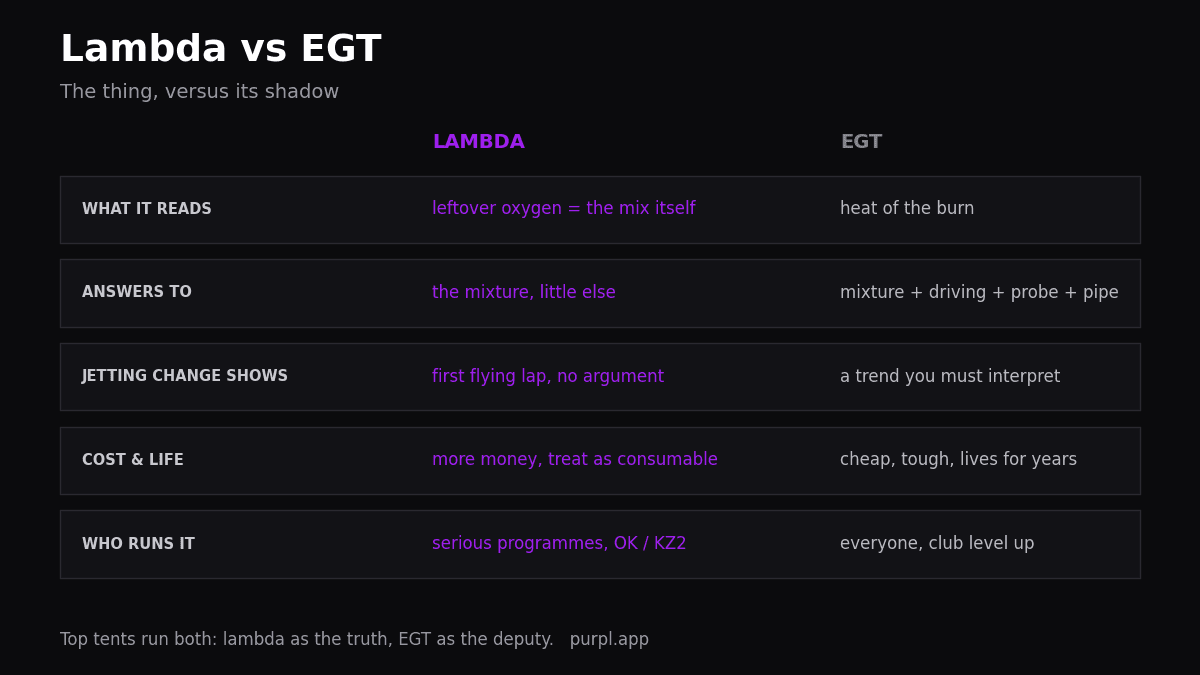
EGT reads heat, and heat answers to everything. Mixture, yes, but also driving style, probe placement, the pipe, and the last corner's throttle history.
Lambda reads leftover oxygen. Oxygen answers to the mix and very little else, so where EGT gives you a temperature you must interpret, lambda gives you the answer you were interpreting toward.
That directness is the entire pitch. A jetting change shows in lambda right away, with no argument. The rich-or-lean question that EGT answers with "well, it depends" gets answered in a number.
That's why I prefer it, and why serious data programmes treat lambda as the carburetion truth and EGT as its long-serving deputy. Plain and simple.
Let me make that concrete with a made-up Saturday. Say you go one step leaner on the carb before a practice run, chasing a crisper top end.
On the lambda trace, the change is visible on the first flying lap. The full-throttle value sits a touch closer to 1.00 than the run before. Clean, quick, settled.
Now imagine the same change with EGT alone. The peak climbs, but the peak answers to more than the jet. Maybe the track gripped up, maybe you caught a tow on the back straight, maybe you drove a bit harder, maybe the probe is reading a shade different today.
You'd wait a few runs before trusting the trend. Same change, two stories, and lambda tells the short one.
The wideband sensors that make this possible are a road-car commodity now. Bosch's wideband lambda page covers the hardware. Haltech's controller explainer covers why "wideband" matters.
The short version: older narrowband sensors only flag rich-or-lean near 1.00, which is useless for race tuning. Wideband units read the whole rich range a kart actually uses.
The costs, honestly
Three real ones. They explain why every kart doesn't carry one.
Money first. Sensor, controller and logger input cost meaningfully more than a thermocouple.
Fragility second. Lambda sensors hate vibration, run hot internally, and age faster in two-stroke exhaust. Oil and rich mixtures foul them quicker than in any road car.
From experience, treat the sensor as a consumable in a kart programme, not a fit-and-forget part, and budget a spare into the season the way you budget chains and sprockets.
And power: a wideband sensor heats itself to operate, which is a real draw on a kart's small battery. Wiring and battery discipline stop being optional. That's the territory of battery care and installation.
Who should actually run one
My honest sorting, from coaching and paddock years.
Club drivers: probably not yet, because EGT plus the ear covers club-level jetting, and the lambda money buys more lap time as tyres or track days. No shame in that.
Serious tuning programmes, engine builders and teams running multiple karts: yes, because lambda settles carburetion questions in one session that EGT debates for a weekend.
And anyone chasing the last few percent in OK or KZ2. There the seize margin is thinnest, and a wrong guess costs an engine.
The pattern at the top is both sensors together. Lambda as the truth channel, EGT as the cross-check, and the backup for the day the lambda sensor dies mid-weekend. Which it eventually will.
Reading the trace
The method mirrors EGT, with the guesswork removed.
Watch the full-throttle value at the end of the straights for the top of the carburetion, and the slow-corner values for the bottom, then log both in the session sheet.
Watch the stint trend too. As grip rises and the mixture leans, the drift that pushes EGT ceilings upward shows in lambda as values creeping toward 1.00, and the response is the same. Go richer before the engine makes the decision for you.
One extra habit lambda rewards: mark where the value moves during throttle transitions. Hesitant pickup, the "dirty" rich stumble off slow corners, draws a visible rich spike that EGT smears, which makes lambda surprisingly useful for the throttle work in throttle trace analysis.
Your first weekend with the sensor, keep it boring. Friday: change nothing, just log. Write down the straight-end value and the slow-corner value after every run, next to the jet, the air and the sky.
Saturday, start comparing. Did the numbers move the way your tuner predicted when the morning air cooled?
Line the lambda trace up against revs too, because a mixture problem and a gearing problem can look alike at the end of a straight. That side of the story lives in kart RPM data.
Don't chase the numbers yet. The first weekend is for learning what your engine's "normal" looks like, not for re-jetting after every run.
By Sunday you'll have a small table of "our numbers" for that track and that weather. That table is the whole point of the purchase. It's what turns a sensor into a tuning system.
Where it sits in the buying order
Late, deliberately.
The EGT guide and the core three channels come first, then tyre temperature money, and lambda after that, when the questions you're asking are genuinely carburetion-precision questions.
Buy it to answer a question you already have. The drivers who get value from lambda arrived with a specific argument for it to settle. Usually that's a season of EGT doubt, or one expensive seizure the heat channel never quite explained.
That's the honest sensor story. Not better for everyone, sharper for the few who need sharp. The complete decision tree across all the probes lives back in the sensors hub.
FAQ
What lambda value should a kart run?
Rich of 1.00, with the exact target set by your engine builder for your engine and fuel. I won't print a number here. That's deliberate.
Borrowing numbers across engines is riskier with lambda than with most channels. The number is so direct that a wrong target gets executed accurately. Get yours from the dyno, then treat it as the north star.
Will a lambda sensor survive two-stroke exhaust?
For a while. Oil and rich running foul the element faster than in a road car, so expect a service life measured in race weekends, not years.
Budget for replacement from day one. Once a sensor starts drifting, keep it as the emergency spare, because a tired unit that still tracks trends beats no lambda at all on a Sunday. Mounting position and a good controller stretch the life; nothing makes it immortal.
Can I use a cheap narrowband sensor from a road car?
No. Narrowband units only signal rich-or-lean around 1.00, and a race kart lives nowhere near 1.00.
You need a wideband sensor and controller. That's exactly the part of the system that costs the money, and there's no clever way around it.
Does lambda replace EGT?
It outranks it for mixture truth, but most serious setups keep both. Lambda for the answer, EGT for the cross-check and the cheap redundancy.
Two agreeing channels also catch a dying sensor early. When one drifts and the other holds steady, you know which one to suspect.
If you're choosing one on a budget, EGT first. Lambda when the programme earns it.
Alessio Lorandi started karting at six and won the 2013 CIK-FIA Karting World Championship. He raced through Formula 3, GP3 and Formula 2 before founding Purpl, an AI data coach for karting drivers.