Mounting and Wiring a Kart Data Logger the Right Way
A sloppy install makes confident fiction out of good sensors. Mounting, routing and wiring a kart data logger step by step, plus the checks that catch bad data early.

Bad installs don't fail loudly. That's the problem.
A loose mount, a cable near the ignition lead, a sensor a few millimetres off, and the logger keeps drawing beautiful traces. They're just fiction. Kart data logger installation is twenty minutes of care that decides whether every download afterwards tells the truth.
Here's the install, step by step, and the checks that catch a lying setup before it costs a weekend.
Bench first, kart second. Lay the unit, loom and sensors out on a bench, connect everything, and power it up before any of it touches the chassis.
You're looking for one thing: live channels. A sensor that reads dead on the bench is a faulty part found in two minutes, not an install mystery that eats two race weekends.
Then the kart, in order. Mount the unit, seat the sensors, route the cables loosely, and power up again before anything gets tightened or taped.
A channel that was alive on the bench and dead on the chassis points straight at one cable run. The order sounds fussy. It saves hours.
The dash mount: tight beats clever
The logger lives on the steering wheel or the dash bracket, and it lives a violent life there.
A kart vibrates harder than almost anything else in motorsport, so the mount's first job is to not loosen, ever. Use the bracket made for your wheel, torque it properly, and re-check it as part of the weekend routine. Because a unit working loose smears the G data, and eventually the GPS too.
Community install guides such as GoKart36's logger 101 repeat the same first rule: tight, then everything else.
Angle matters for two reasons. You need the screen readable in your normal eye-line for the dash glance, and a GPS antenna inside the unit wants the flattest view of the sky the mounting allows.
Give the GPS its sky
If your logger has an external GPS antenna, its position is the single biggest data-quality decision in the install.
Flat, sky-facing, and clear of your body. Not tucked under the front fairing, not shadowed by your torso at full tuck, and rigid, because an antenna that bounces smears every sample. The reasons live in GPS accuracy; the install is where you act on them.
And keep it away from the ignition system. The lead and coil are the two great noise sources on a kart, and centimetres of distance from them buy cleaner channels than any spec upgrade.
Sensor by sensor, the placements that matter
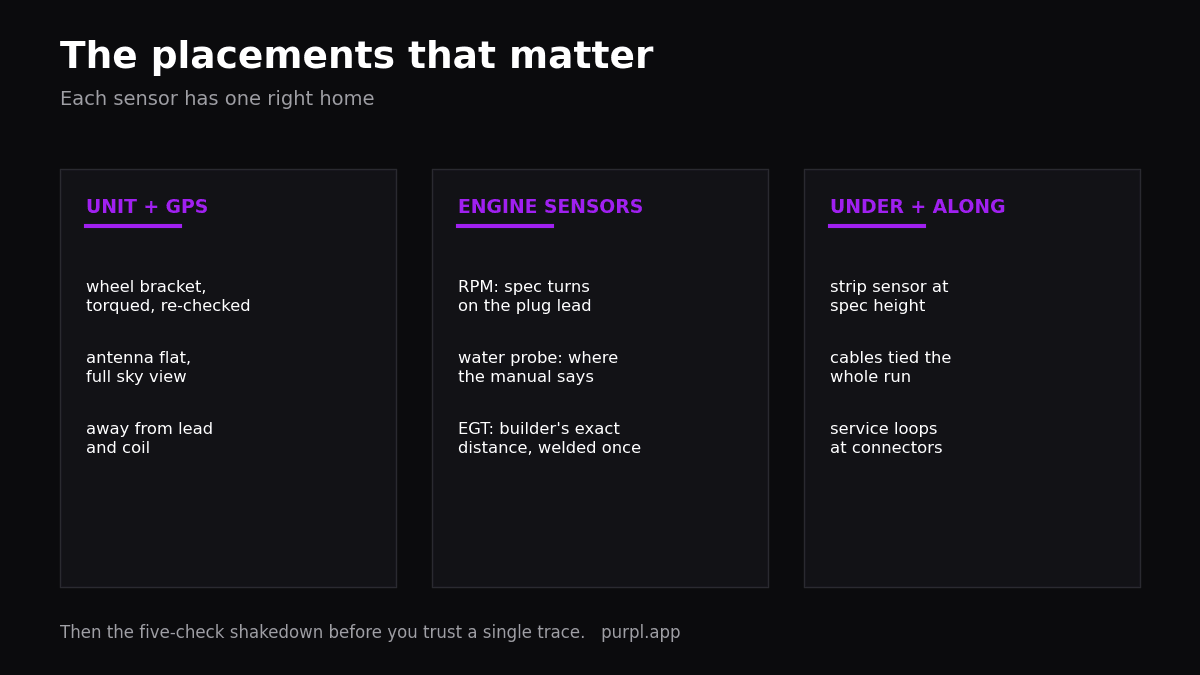
RPM. A wire wrapped around the spark plug lead, following the unit's specified number of turns. Too few turns reads dropouts, too many reads noise, so route it away from other cables and tape the end where vibration can't unwind it.
Water temperature. Seat the probe exactly where your engine manual says, and remember the location defines what your numbers mean, head exit reads hotter than radiator return. Consistency beats position, per kart water temperature.
EGT. The probe distance from the piston is specified by your engine builder, and comparisons only work between karts probed at the same distance. Drill and weld once, properly, the rule from the EGT guide.
Magnetic strip sensor. Hangs under the floor tray at the height the manual names. Too high and it misses the field; too low and the first kerb removes it.
Routing and wiring: the boring half that decides everything
Cables fail at race pace, not on the bench. Route for the worst lap, not the garage.
Three rules cover most of it. Tie every cable down its whole run, snug enough that nothing can catch, with slack only at the steering rotation point.
Cross other cables at right angles instead of running alongside the ignition lead. And leave service loops at connectors, because a cable with zero slack transmits every vibration straight into the pins.
Trim every tie tail flush. A sharp tail sitting against a cable saws through insulation lap after lap, and the damage it does shows up months later as a "random" glitch.
Connectors get dielectric grease if they'll see rain, and a strip of tape as a backup against vibration. None of this is glamorous. All of it is why some karts' data never glitches and some karts' data is a weekly mystery.
Rain changes the job. Water finds pins.
Before a wet session, give every exposed connector a drip loop. Let the cable dip below the connector before it rises into the pins, so water runs to the low point and drips off the cable instead of tracking inside.
Fresh grease in the connectors, tape over anything that faces the spray, and a quick wipe of the head unit's seals before it goes back on. None of it takes ten minutes. All of it beats drying a loom with a heat gun on Sunday morning.
The first-session shakedown
Never trust a fresh install until it survives this five-check shakedown, run after the first session on track.
Lap distance matches the track's published length. Speed-to-RPM ratio holds steady on a single-gear kart. Temperatures respond to the real world, climbing on the out lap, reacting to the curtain.
G traces show corners, not fuzz. And the lap count matches reality, no doubles, no misses.
Any check fails, fix the install before reading anything else, because conclusions from a lying logger cost more than no conclusions at all. That's mistake ten in data analysis mistakes, and it's the most preventable one on the list.
Five clean checks and the unit has earned its place. From there the work moves to reading, and the karting telemetry guide covers that whole side.
The maintenance rhythm
Installs age. The rhythm that keeps them honest is short and weekly.
Every race weekend: one minute checking the mount bolts, the RPM wrap, and the visible cable runs. Every month: connectors opened, inspected, re-greased where needed, and the battery contacts checked alongside the charging habits from battery care. After any crash or kerb strike: the full shakedown again, because impacts move things that look unmoved.
Karts shed bolts weekly. Assume the logger's hardware is no exception, and it never gets the chance to surprise you.
And write the logger checks into the same list as the chain and the hubs. Habits survive. Memory doesn't.
When to suspect the install
A short field guide, because install faults wear data costumes.
Speed spikes nothing else explains: antenna or mount. RPM dropouts at high revs: the plug-lead wrap.
A temperature that ignores the curtain: probe seating or connector. Missed laps: strip sensor height or gate placement, the full tree in lap timer troubleshooting.
Picture the classic case. A kart arrives with speed spikes on every straight, and the owner is sure the logger has died. The mount gets checked: solid.
Then the antenna cable turns up loose at the steering column, where the loop was cut too tight and full lock has been tugging the plug for weeks. Re-route, re-tape, spikes gone. The fix cost a cable tie.
The pattern in all four: the symptom appears in one channel while the others stay sane. Real driving events show up across channels together. Lonely glitches are wiring, and now you know where to look, with the wider context in kart data loggers explained and kart sensors explained.
FAQ
Where should I mount my kart data logger?
On the steering wheel with the manufacturer's bracket, torqued properly, screen in your natural eye-line. The wheel position survives vibration best and keeps the dash glance fast. Chassis mounts work for units without screens, with the same tight-and-rigid rules.
If the wheel is crowded, the dash bracket on the steering support is the usual second choice. Same rules: torque it, then check it weekly.
Why does my RPM signal drop out?
Almost always the plug-lead wrap: wrong turn count, loosened by vibration, or routed against another cable picking up noise. Rewrap to spec, tape the end, and re-route away from the loom. If dropouts continue at specific revs only, ask your dealer about the unit's sensitivity setting.
And re-check the wrap after every engine change. The lead comes off whenever the engine does, and the wrap rarely goes back on exactly as it was.
Can I install a logger without a mechanic?
Yes, it's hand-tools work, and the manuals are decent. Budget a quiet hour, follow the placement specs exactly rather than approximately, and run the first-session shakedown before trusting anything. The install is easy; the discipline is the product.
The one job worth handing out is the EGT weld, because a badly placed boss is permanent. Everything else forgives a second attempt.
Do I need to remove the logger between race days?
Take the unit indoors if nights are wet or freezing, batteries hate both, but leave the wiring and sensors installed and undisturbed. Repeated unplugging wears connectors faster than weather does. Cover the kart, pop the head unit, done.
In a wet paddock, point the open connector downwards and drop a dry cloth over it for the night. Cheap insurance.
Alessio Lorandi started karting at six and won the 2013 CIK-FIA Karting World Championship. He raced through Formula 3, GP3 and Formula 2 before founding Purpl, an AI data coach for karting drivers.