CHT vs Water Temp: Which Temperature Should You Monitor?
Cylinder head temperature or water temperature? What each sensor really watches, why air-cooled classes have no choice, and when running both makes sense.
Two thermometers, one engine, and a question every karting parent eventually asks at the counter: which temperature do we actually need?
The short answer is decided by your engine's cooling. A CHT sensor on a kart reads the metal of the cylinder head itself; a water temp sensor reads the coolant.
Air-cooled classes have no water to measure, so the choice makes itself. Water-cooled classes get a real decision, and a small case for both.
Each channel is good at something different, and the air-cooled details are the part most articles skip.
What each sensor actually watches
They sound interchangeable. They aren't, because they sit at different points along the heat's path.
Heat starts in combustion, soaks into the head and cylinder, and only then, on a water-cooled engine, hands over to the coolant and the radiator. CHT reads the metal near the source, usually from a ring sensor under the spark plug. Water temp reads the carrier fluid downstream.
So CHT answers "how stressed is the engine right now", while water temp answers "how well is the cooling system coping". Related questions. Not the same question.
Air-cooled karts: the CHT sensor is the whole story
In air-cooled classes, most Mini 60 categories above all, CHT isn't a preference. It's the only thermometer you get. Plain and simple.
And it matters more than people give it credit for. Head temp tells you whether the engine is overheating and quietly losing power, and the cause can be lean jetting or the driver and chassis working the engine harder. One sensor, watching both the jetting and the day.
The summer detail worth knowing: in air-cooled engines, lower head temp is better, and you can see it in the results. Cooler head, faster engine. The fastest laps of a hot summer race tend to come early, before the head heats fully, unless tyre grip peaking late outweighs it.
Engine tuners respect this so much that on the dyno they match engine and room temp from run to run. Why? Because a run on a cold engine is measurably more powerful than the same run hot.
Translation for race day: manage the warm-up, expect the early laps to be the engine's best, and read late-race pace drop with the CHT trace open before blaming the driver.
Water-cooled karts: water leads, CHT is a second opinion
Add a radiator and the picture changes. Water temperature becomes the management channel, the one with the famous target and the curtain habit from kart water temperature.
Why does water lead? Because it's actionable lap by lap.
The driver moves the curtain and watches the number respond. CHT can't offer that loop, because head temp answers slowly and to more causes. The community threads on optimal temps, like KartPulse's engine temperature discussion, circle the same conclusion: pick the channel you can act on.
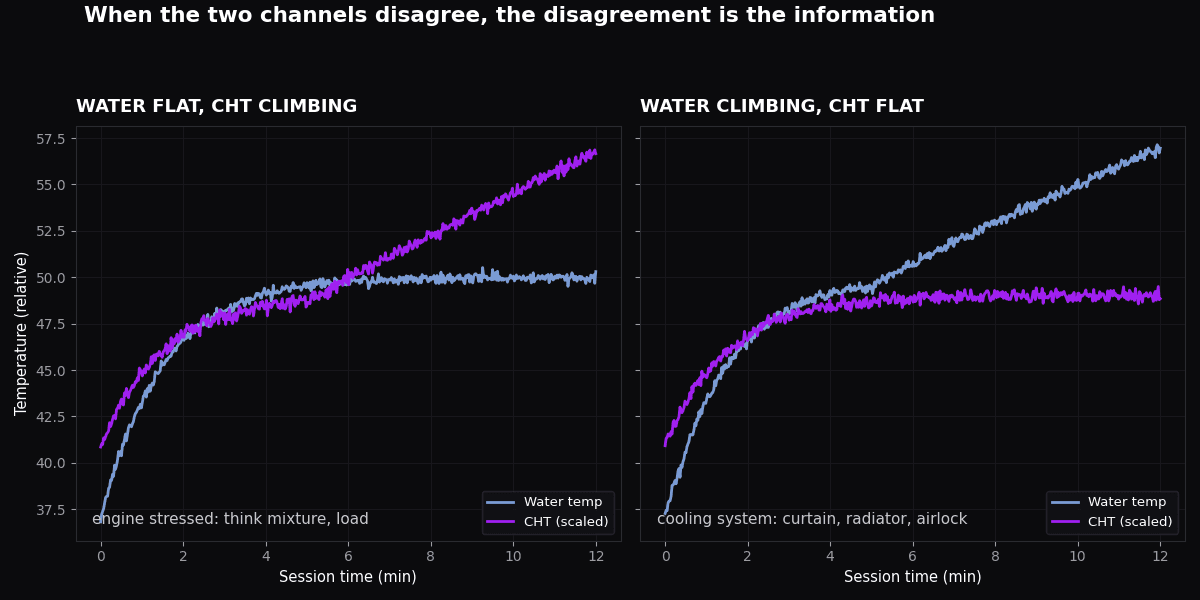
CHT earns its place on a water-cooled kart as a cross-check. When the two channels disagree, the disagreement is the information: water steady while CHT climbs points at the engine running stressed, lean or overloaded, before the coolant shows it. Water climbing while CHT holds points at the cooling system, a curtain, a radiator angle, an airlock, the hardware side that TKART's cooling accessories guide covers.
Let me make that concrete with a made-up afternoon. Say it's the second heat, and the water number sits exactly where it sat all day. But the head temp trace ends every lap a little higher than the lap before.
The radiator is coping, so the curtain isn't the story. The engine is making more heat than it was this morning. So you check the carb against the weather, because grip has come up through the day and the engine is working harder for longer on every lap.
Now flip it. Water creeping up while head temp stays flat says the engine is fine and the cooling side isn't. You'd check the curtain, the radiator angle, maybe an airlock, before you'd touch a single jet.
Two numbers, two opposite verdicts. Different culprit, different fix. That's the whole case for running both.
Reading CHT in the data
Three habits. All borrowed from the other temp channels and bent to CHT's personality.
Read averages on the fastest lap, not single peaks, and log them in the session sheet next to the carb numbers. Watch the stint trend. CHT creeping upward across a race carries the same warning as a rising EGT ceiling, mixture leaning as grip arrives, the drift covered in the EGT guide.
And calibrate your expectations per probe position. Under-plug readings run different absolute numbers from screw-in head probes.
That last point kills most cross-tent comparisons. Trend against yourself, always. Absolute numbers only against karts wearing the same probe in the same place, which in practice means your own teammates.
Comparing absolutes across awnings is one of the classic data analysis mistakes in karting. It happens in every paddock, every weekend.
My logging routine for this channel is boring on purpose. After every session, write three lines in the sheet: average head temp on the fastest lap, the carb setting that produced it, and the air that day. Ten seconds of writing.
Do that for one full weekend, every session, and by Sunday you own a baseline nobody at the track can sell you or argue with. Next time the engine feels flat, open the sheet and check the temp against the same conditions. No guessing, no paddock folklore.
If your software makes this awkward, export the telemetry to CSV and keep the sheet yourself.
Which one should you buy?
The decision tree is short.
Air-cooled class: CHT, today, and learn its trends before touching jetting. Water-cooled and choosing your first temp channel: water temp, because it's the actionable one and every reference number in the paddock speaks it. Water-cooled with a serious programme: both, wired into the same logger, for the disagreement diagnostics above.
If you're a Mini 60 parent reading this, one more reassurance. The CHT channel plus lap times is genuinely enough data for that age and class.
Picture the usual Saturday. Your kid comes in, the engine guy asks how the temp looked this run, and for once you have an actual answer instead of a shrug. That's the whole job of the sensor at this level.
It isn't there to turn an eight-year-old into a data engineer. It's there so the adults catch a lean engine before it hurts itself. Lap times do the rest of the talking.
Resist the urge to buy the full sensor tree yet. Spend the difference on seat time, the budget logic from the junior karting guide. The full sensor map, ring by ring, stays in kart sensors explained.
When the two channels lie
Temperature sensors fail politely, which makes them dangerous.
A CHT ring loosened by vibration under the plug reads low and steady, exactly like good news. A water probe in an airlocked system reads the bubble, not the coolant. Both failures look like healthy engines right up until they don't.
The defence is the same as every channel: sanity checks. Does the reading respond to the curtain, the weather, the session length the way it always has? That's the whole test.
A temperature that stops reacting to the world has stopped measuring it. The install checklist in data logger installation catches most of it before it costs an engine.
FAQ
What's a normal cylinder head temperature for a kart?
There's no portable number: it varies by engine, class, probe type and placement more than water temp does. Build your own baseline from a known-good session and watch trends against it.
Your engine builder's range, for your exact probe position, is the only absolute worth chasing. Ask once, write it down, and stop comparing with the awning next door. Trends beat numbers.
Can a CHT sensor replace water temp on a water-cooled kart?
It can exist instead of it, but it shouldn't. You'd lose the lap-by-lap curtain control loop that makes water temp so useful, and you'd be reading the slower, noisier channel for daily management.
Water first, CHT as the second opinion. Always. Add the second channel when you're ready to actually read both.
Why does my CHT climb at the end of races?
Usually the lean drift: grip rises, throttle comes earlier, mixture leans, head heats. Check it against the EGT or lambda trend from the same laps. If the carb channels are steady and CHT still climbs, look at airflow and the day's heat instead.
And on air-cooled engines, remember the pattern from above: the best laps come early, so some late drop is normal rather than a fault.
Where does the CHT sensor mount?
Most karting CHT sensors are rings seated under the spark plug, which makes placement consistent and installs trivial. Screw-in head probes exist and read differently.
Whichever you run, keep it consistent across engines, or your own history stops being comparable. If you switch probe type mid-season, start a fresh baseline, because old numbers and new numbers don't mix.
Alessio Lorandi started karting at six and won the 2013 CIK-FIA Karting World Championship. He raced through Formula 3, GP3 and Formula 2 before founding Purpl, an AI data coach for karting drivers.