Kart Sensors Explained: RPM, Temperature, Speed and GPS
Every kart sensor explained in one place: what each one measures, the operating window it guards, and which ones matter at your level of racing.
At club level, three numbers run the whole show. Tyre pressure, water temperature, RPM for the sprocket choice.
At international level the bar rises, big time, and the kart sensors multiply with it. Tyre temps, exhaust temps, head temps, brake temps, lambda, combined G. Each one guards a piece of performance, and each one is a small purchase that only pays if you know what it's telling you.
This is the map of all of them: what each sensor measures, the window it watches, and when it earns its place on your kart. The map goes ring by ring, from must-have to nice-to-have.
The idea that organises everything: the window
Every component on a kart has an optimal operating range. Engine, carburettor, exhaust, tyres, radiator, brakes.
A sensor exists to tell you whether its component is inside that window or outside it. That's the entire job. Water temperature has a target; the sensor reports the distance from it. EGT has a sweet spot the engine tuner found on the dyno; the sensor says whether today's carburetion lives there.
Miss one window and you give up lap time "to charity", as I like to say, even with everything else perfect. The windows move with conditions, track to track, session to session, which is why the sensors stay on the kart instead of being a one-time test.
The core three: every kart, every level
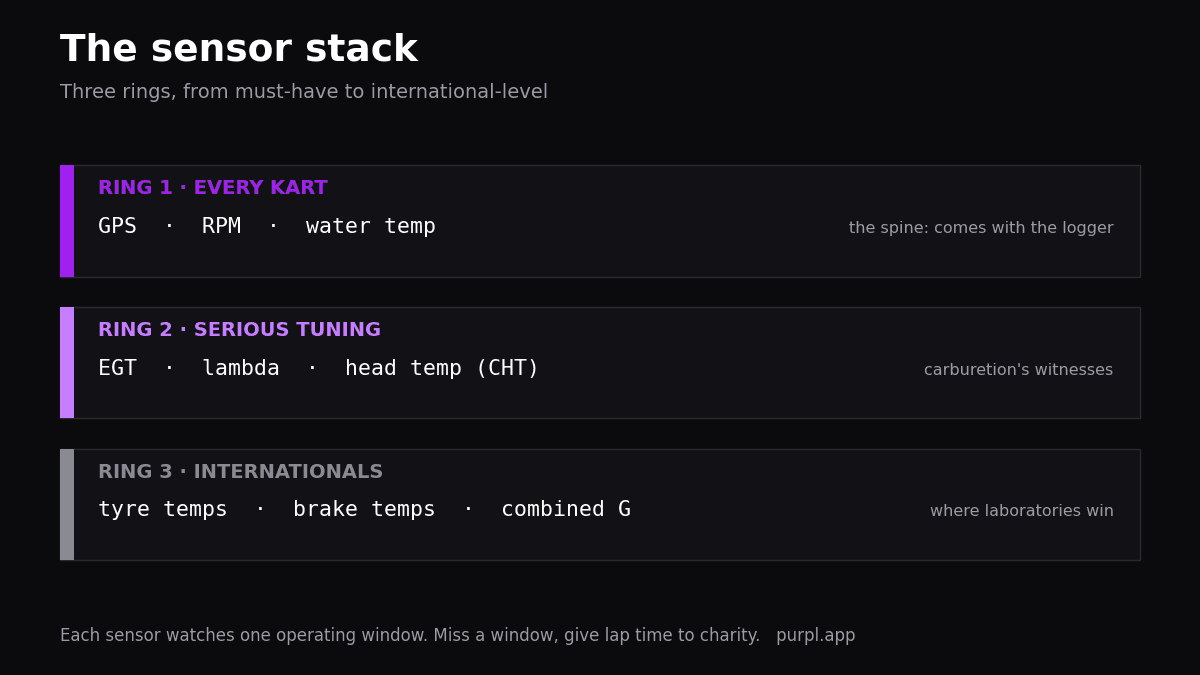
GPS. Speed, position, lap timing in one receiver, and the source of the speed trace that carries most analysis. Built into nearly every modern kart data logger; its honest limits are covered in GPS accuracy, and the timing side in how lap timers work.
RPM. Read off the ignition lead, no installation drama. Gearing, clutch health, corner-floor revs and limiter time all live here, the full reading in kart RPM data.
Water temperature. The engine's thermostat readout and the number drivers manage lap by lap with the radiator curtain. It has the clearest target of any channel, and its own deep-dive in kart water temperature.
Those three, plus lap timing, are the spine. A driver who masters only them is better instrumented than half a club grid. Genuinely. Walk any club paddock and count the loggers being used as lap timers only.
The second ring: carburetion's witnesses
Two-stroke engines live and die by mixture, and two sensors watch it.
EGT, exhaust gas temperature. The classic carburetion gauge: a probe in the exhaust reporting the burn. Tuners define a window for the top of the rev range and another for the bottom, say 630 to 640 degrees up top and 440 to 450 down low. The trace shows whether you're living in them. The full method is in the kart EGT guide.
Lambda. The oxygen sensor, measuring mixture directly instead of inferring it from heat. My own preference, honestly, because it gives more accurate information than EGT, at more cost and fragility. The trade-offs live in the lambda sensor guide.
Head temperature, CHT. The air-cooled classes' substitute thermometer, vital in Mini 60 where there's no water to measure. Whether you want CHT, water temp or both is its own small decision, settled in CHT versus water temp.
The third ring: where internationals are won
Past the carburetion pair, sensors stop being standard and start being statements.
Tyre temperature tells you whether you're overheating the rubber or never waking it up, through driving or setup. Brake temperature explains the spongy pedal on a hot day and guides pad choice, soft for cold conditions, hard for heat. And combined G, from the logger's accelerometer, scores whether the driver is using the grip at all, or whether the kart's balance never let him.
None of these wins a club race. All of them together are why international teams look like laboratories, and why their drivers get answers in one session that club drivers chase for a month.
One sheet, every number
Sensors multiply, and the tent drowns in numbers unless they're organised. Here's the habit I learned to keep them honest.
One row per session in a spreadsheet: average tyre temps, average hot pressures, average water temp across the fastest lap. EGT minimum and maximum recorded separately, RPM minimum and maximum, metres on the limiter. Then colour-code each cell against its window, green inside, red running hot, blue running cold.
One glance tells you which parameter left its window before anyone starts arguing. The ready-made version of that sheet lives with the data starter download in the analysis cluster, and the wider reading method in the karting telemetry guide. Numbers have got no emotions. That's exactly what makes them useful.
What chasing a window looks like
An example makes the window idea concrete, so take the one I lived every summer.
Water temp target, say 50 degrees. The driver runs the curtain lap by lap to hold it there, eyes flicking to the dash on the straight. If the dash says 56, lap time has already been given away, and the sheet will show it later in red.
Now multiply that by every sensor on the kart. Tyres at their best around 80 to 85 degrees. EGT inside the tuner's dyno window. RPM floor above the bog line. Each one a small dial, each one watched by a cheap probe, and the kart only flies when they all agree.
That's what teams mean by being "in the window". Not magic. Dials.
Buying order, from my coaching years
The question I actually get isn't "what sensors exist", it's "what next". My order, assuming the core three are on the kart.
EGT or lambda first the day you start tuning carburetion seriously, lambda if the budget allows my preference. Head temp instead, immediately, if you're in an air-cooled class. Tyre temperature gun before tyre temperature sensors; the gun teaches the same lessons for a tenth of the price, and it never has a wiring fault. Brake temps only when you're racing somewhere hot enough to cook the pedal.
And before any of it: make sure the install is right, because a perfect sensor mounted badly produces confident fiction. Wiring and placement are covered in data logger installation, the faults it prevents in lap timer troubleshooting, and the power side in battery care.
The sensor that matters most is the cheapest
After all the probes and the price tags, the most valuable sensor package on a kart is still the free one.
The driver. Your hands feel the front grip, your back reads the rear, your ears track the engine, and no probe on the market measures commitment. Sensors exist to confirm, sharpen and sometimes overrule what the driver felt, never to replace the feeling itself.
I've seen kids with full international sensor kits who couldn't tell you what the kart was doing in turn three. And club drivers with a bare logger who could read their session like a book. The hardware gap was real. The understanding gap mattered more.
Buy sensors to answer questions you already have. The drivers who do are the ones whose tents get quieter and faster at the same time.
What the dash should show
A pile of sensors does not mean a busy screen. While driving, you scan between the braking zone, the apex, and occasionally the dash: water temp, exhaust temp, lap time, RPM, in fractions of a second.
So the dash gets the live-management numbers only, water temp for the curtain and EGT if you're actively jetting. Everything else records silently for the laptop. A sensor's home is the post-session debrief, not your eyeline at 100 km/h, and which logger tier records what is mapped in 1T versus 2T loggers.
FAQ
Which kart sensors should a beginner start with?
The ones already in the box: GPS, RPM and water temperature come with practically every modern logger. Master reading those three for a season before spending another euro, because no added sensor fixes an unread speed trace.
What's the difference between kart temp sensor types?
Water temp reads coolant, CHT reads the cylinder head itself, and EGT reads exhaust gas. Water and CHT guard engine health and cooling; EGT guards carburetion. Air-cooled classes substitute CHT for water; everyone else treats EGT as the tuning channel.
Are more sensors always better?
No. Sensors you don't read are weight, cost and wiring failures waiting to happen. The KartPulse forums are full of temperature threads from drivers with full sensor kits and no targets. Buy the sensor after you know its window, not before. Your spreadsheet's blank columns are the shopping list.
Do rental karts have any of this?
Usually just lap timing from the venue. Which is fine: rental driving builds precision and consistency, the skills covered in this blog's getting-started articles, and none of them need a probe. Sensors join the story when you own the engine they're protecting.
Alessio Lorandi started karting at six and won the 2013 CIK-FIA Karting World Championship. He raced through Formula 3, GP3 and Formula 2 before founding Purpl, an AI data coach for karting drivers.