How Kart Lap Timers Actually Work: GPS, Magnetic Strips and Beacons
Transponders and loops, magnetic strips, infrared beacons and GPS gates: how every kart lap timing technology works, and why your timer disagrees with the official screen.
The beep is the most trusted sound in karting. Cross a line, the dash flashes, a number appears, and nobody questions it.
Worth thirty seconds of curiosity, though: how do lap timers work, exactly? What knows you crossed the line? The answer is four different technologies, often running on the same kart at the same time, and knowing which is which explains most timing mysteries.
Including why your dash and the official screen never quite agree.
Here's the tour, beep by beep.
The official clock: transponders and loops
Race results run on one system. An active transponder on your kart, and detection loops buried in the tarmac.
The transponder broadcasts a unique ID. The loop is a wire antenna embedded across the track at the start-finish line, sometimes at sector points too, and it picks up that signal as you pass over it.
A decoder in race control stamps the exact crossing time, to the thousandth of a second, against your ID. That's the whole architecture. It's why the system survives rain, traffic and forty karts crossing nose to tail.
And race control itself is less mysterious than the locked door suggests. The decoder sits in there collecting time stamps from the loop, one for every transponder on every lap, and the timing software turns those stamps into everything published. Lap times, gaps, positions.
Nobody is holding a stopwatch. The decoder stamps, the software does the arithmetic, and the screen updates.
When the screen shows your gap to the kart ahead, that's the chain you're trusting: loop, decoder, software, screen. Boring, mechanical, and very hard to argue with.
The technology family is called transponder timing, and MYLAPS is the name you'll meet everywhere as the de facto karting standard. The loop-and-decoder detail lives on their X2 system page.
Your series either rents you the transponder or expects you to own one. Either way, it's the only timer that decides results. Full stop.
How magnetic strip lap timing works
Before GPS, onboard timers needed something physical to trigger on. Tracks buried it for them.
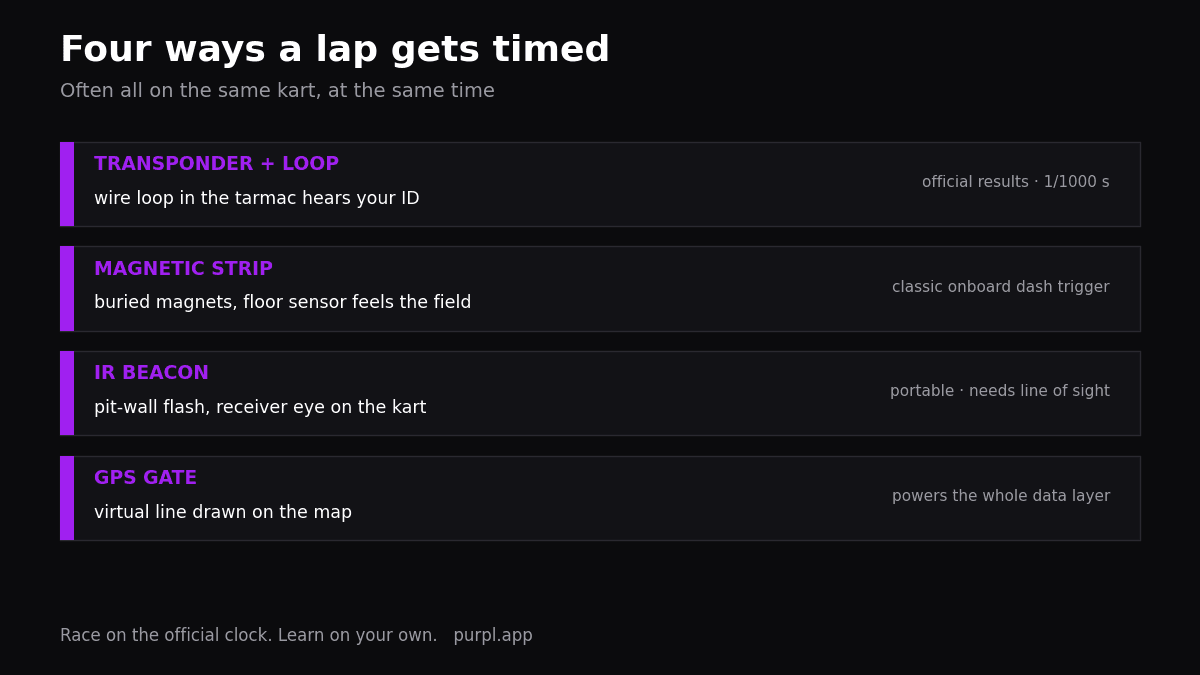
A magnetic strip is a line of magnets under the surface, usually at the start-finish straight and often at one or two more points. A small sensor hanging low on the kart's floor tray feels the field as you cross, and the dash starts the next lap.
Simple, cheap, weatherproof, and still built into most karting dashes.
The quirks are physical too. The sensor must hang at the right height to feel the field, and some tracks have multiple strips your timer must be told about.
A sensor knocked loose or mounted too high simply misses laps. That's the classic case in lap timer troubleshooting.
Infrared beacons, the pit-wall flash
The third classic is a tripod at the pit wall. A small infrared transmitter, flashing a coded beam across the track.
A receiver eye on the kart catches the beam each pass, and the dash beeps. IR beacons made lap timing portable, any team could suddenly time at any track, and they still appear at tests and in car racing paddocks everywhere.
The karting catch is line of sight. The eye must see the beacon, another kart alongside can shadow it for a lap, and rain on the lens does rain things.
If you run one, park it where traffic won't block it, and tell your neighbours which channel you're flashing. Two teams on the same code at the same wall produces creative lap times for everyone.
The virtual line: GPS gates
The newest answer needs nothing at the track at all. Nothing physical, anyway.
A GPS logger knows its position several times a second. So software simply draws a line across the map, the gate, and stamps a lap every time your trace crosses it. No strip, no beacon, no loop.
Every modern kart data logger times this way out of the box. It's what makes data analysis possible at tracks with no infrastructure.
The trade is the satellite footnotes. Gate crossings are consistent to small fractions of a second rather than thousandths, and everything in GPS accuracy applies.
For learning, plenty. For deciding a championship, that's what the loops are for.
Why your dash and the official screen disagree
Every newcomer asks this by Sunday. The answer is built into everything above, so follow one lap through all four systems and watch them split.
You cross the start-finish line. The loop under the tarmac hears your transponder, the decoder stamps the moment, and that's the official lap.
A few metres earlier or later, your floor sensor felt the strip and the dash beeped. That's your onboard lap. If a beacon was flashing at the pit wall, your receiver eye caught the beam at a third point, a few metres from both of the others.
And your GPS gate sits wherever the software drew it on the map. Four clocks, four lines, one lap. Same kart, four slightly different numbers.
Different systems time different lines. That's the whole mystery.
The official loop sits at one exact point; your magnetic strip or GPS gate sits somewhere else, even if only by metres. Cross them at different speeds and the same lap genuinely measures differently on each clock.
Neither is wrong. They're answering at different addresses. Plain and simple.
The practical rule: race on the official time, learn on your own. Your onboard timer's job is consistency with itself, lap against lap, session against session, which is exactly what analysis needs, per the comparison habits in the karting telemetry guide.
And that self-consistency is the door into the work that actually matters: chasing repeatable laps. The kind of work I walk through in lap consistency.
The live timing screen deserves a habit
One more output deserves a habit: the live timing feed.
Every loop crossing from every kart flows to that screen, which means the screen carries everyone's sector story, not only your own position, updating in real time.
I grew up studying rivals through it, watching which sectors they owned and where their pace lived. That scouting habit is half of sector analysis.
Most drivers glance at their own row and pocket the phone. The information was free, and they left it on the table.
Which timing do you actually need?
If you're starting out, the buying answer is shorter than the technology tour.
The transponder question answers itself: your series tells you to rent or buy, and you do that. For your own kart, any modern GPS logger covers timing and the entire data layer in one box, no strip sensor or beacon needed. The budget logic from getting into karting.
The strip and beacon inputs still matter in one case. If your logger supports them as the lap trigger, using the physical trigger alongside GPS gives you cleaner lap splits at the tracks that still have the hardware. A nice refinement, never a requirement.
Whichever timer you run, make it reliable before the first session. Five minutes in the garage saves a wasted run later.
- Mount things properly. GPS antenna up top with a clear sky view, strip sensor down low at the right height, the same jobs covered in data logger installation.
- Tell the timer which track it's on. A config that doesn't know about a second strip misses laps, and a missed lap always looks like a hardware fault right up until someone opens the settings.
- Charge it. A dead timer records nothing, and nothing is hard to analyse.
- After the first run, compare your dash against the official screen once. A steady offset is normal. A wandering one means something is loose.
FAQ
How accurate is each lap timing technology?
Transponder loops resolve to the thousandth of a second and decide results. Magnetic strips and IR beacons trigger very repeatably at their fixed point. GPS gates are consistent to small fractions of a second, which ranks them last.
That ranking only matters when clocks get compared. For your own lap-to-lap work, repeatability beats absolute precision, and all four deliver plenty of it.
Why did my lap timer miss a lap?
Strip timing: sensor height, a loose sensor, or a track with extra strips your config doesn't know. Beacon: line of sight blocked. GPS: gate drawn badly or brief signal loss.
Each failure is specific to its technology. That makes diagnosis quick once you know which one beeped. Check the mount before you blame the menu.
Do I need to buy my own transponder?
Only if your series says so; many clubs rent them per weekend. Owning one pays off once you race regularly, since rental fees accumulate and a personal unit just lives on the kart, paid for once and forgotten.
It contributes nothing to data analysis either way. That's the logger's job.
Can a phone app time my laps?
Roughly. Phone GPS updates slowly and wanders metres, so app lap times drift by tenths and the traces aren't analysis-grade. As a curiosity at a rental track, fine.
The moment timing starts informing decisions, you want a proper receiver, per the accuracy guide above. Until then, treat the phone as a notebook, not a stopwatch.
Alessio Lorandi started karting at six and won the 2013 CIK-FIA Karting World Championship. He raced through Formula 3, GP3 and Formula 2 before founding Purpl, an AI data coach for karting drivers.