MyChron vs Alfano: What Each Kart Logger Measures
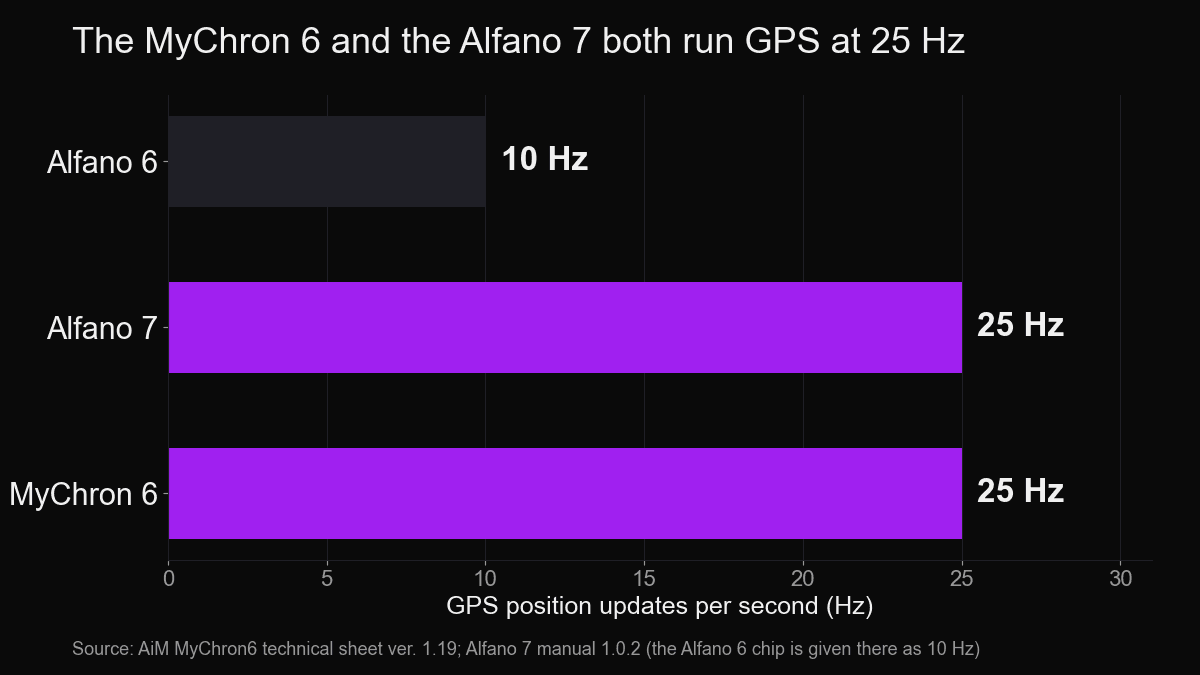
MyChron 6 and Alfano 7 both run 25 Hz GPS. The difference is what each records around it: motion, steering, RPM, temperature. Checked against the manuals.

Which logger measures more, the MyChron 6 or the Alfano 7?
On GPS they are level. Both run a 25 Hz receiver on four satellite systems, so the position and speed trace is the same class of data. The difference is what each one records around the GPS, and who has to buy it as an extra.
Listen, I would not pick on the brand. I would pick on the channels you will actually open on Sunday night. So here is what each maker says its logger measures, taken from the manuals and not from the paddock.
One thing first. The current Alfano on the maker's site is the Alfano 7, so that is the one I compare. The Alfano 6 only appears here as the older unit: the Alfano 7 manual gives its GPS chip as 10 Hz.
What does each logger record on its own?
The table is the whole answer in one place. Every cell comes from the AiM MyChron6 technical sheet and user manual, or from the Alfano 7 manual. The links are at the bottom of the page.
| Measured | MyChron 6 | Alfano 7 |
|---|---|---|
| GPS | 25 Hz, four satellite systems | 25 Hz, four satellite systems |
| Motion inside the unit | 6 axis IMU, 50 Hz in the technical sheet. The manual uses it for the steering wheel angle | Not described for the unit alone. The G-force sensor appears in the manual for the Box4Move and Box12 add-on boxes |
| Engine RPM | From the spark plug cable. You choose 20 or 50 times per second | From the RPM cable. Rate is set in the menu |
| Temperature inputs | 1 on the MyChron 6, 2 on the 6 2T. Thermocouple or thermoresistor | 1 on the 1T, 2 on the 2T, one NTC and one K thermocouple at the same time |
| Steering, brake, throttle | Steering angle from the IMU. Throttle through the ACC3 expansion | Steering, brake pedal and accelerator through the Box4Move |
| Tyre pressure | Not in the technical sheet | Wireless A1210 sensors, up to 8 in two sets of 4. The manual marks them "coming soon" |
| Lambda | LCU series controller on the CAN bus | LSU 4.9 sensor on the BUS port or a Box12 |
| Memory | 4 GB | Capacity not stated in the manual |
| Track database | More than 2500 tracks (user manual) | More than 5000 tracks (manual) |
| Battery | About 20 hours | Up to 40 hours (Alfano site) |
Read it like this. The MyChron 6 puts a motion sensor in the dash. The Alfano 7 gets its motion, pedal and steering channels from a box you add.
Why does the sample rate on each channel matter?
Because a fast GPS does not make a fast RPM trace. Each channel has its own rate, set in the menu, and a higher rate costs file size and download time.
AiM says it directly for RPM: 50 Hz is more accurate, but you get a bigger file that takes longer to download. Alfano says the same about its channels, and the Alfano 7 manual lists 10, 20 or 50 Hz for several of them, with GPS at 25 Hz. Its overview and its settings page do not lay the RPM rate out the same way, so check what your own unit is set to before you compare two traces.
That matters when you compare. If one kart logs RPM at 20 and the other at 50, the two traces can look different on a shift or a lift, and the cause is the logger setting, not the engine.
What happens when the memory fills up?
The Alfano 7 tells you. When its memory passes 99 percent it switches to Endurance Mode on its own. It stops recording at your set rates and keeps only lap times, sector times and the minimum and maximum of each sensor per lap.
The manual does not give the memory size, so I cannot tell you how many minutes that is. The MyChron 6 lists 4 GB, and AiM sells a 16 GB memory module as an option.
Where does the data go after the session?
The MyChron 6 downloads by cable or by Wi-Fi into AiM Race Studio 3. The Alfano 7 shares by Bluetooth to the ADA app on a phone or a PC, by USB cable to ADA on Windows, or wirelessly to ADA on Windows through the Alfano A4550 dongle.
One detail from the Alfano manual is worth knowing. The analysis on the unit itself is limited to 10 Hz, and for a 100 Hz look you open ADA. So the screen on the dash is for a quick check, and the real reading happens on the laptop or the phone.
In my book I say it plainly: you can analyze your data in minutes once the session file is on your laptop. The file is the product. The dash is a display.
Which channels do I actually need first?
If you are starting, the speed trace from GPS and the RPM trace carry most of the first questions, and both loggers give you both. You will find how to read them in how to read a speed trace and kart RPM data.
The temperature question is separate. If you want water and exhaust at once, you need the 2T version of either one. That choice is the whole subject of 1T vs 2T loggers.
Lambda and tyre pressure are the add-ons that decide it for a tuner. Check the table: each maker has its own sensor and its own port, and the Alfano manual says its LSU 4.9 lambda sensor does not work with an Alfano 6. Before you buy a second-hand unit, check the model number against the sensor you want.
And the lap time on the dash is not your session. In my book I tell about a qualifying where I drove looking at the number on my dash, finished ninth, and the driver who took pole had taped over his MyChron. The logger measures. What you do with the number is a different question, and that one is coaching, so it belongs with a coach at the track.
What did I not verify?
Everything above comes from the makers' pages and manuals, and I have not bolted either logger to a kart for this page. A few things I could not confirm, so I left them out: a price for each unit, the Alfano 7 memory size and any internal motion sensor in the Alfano 7 unit itself. AiM's own pages also disagree on the MyChron 6 motion sensor rate, 50 Hz in the table and 100 Hz in the text, so I give the table figure.
For the general picture of what a logger does, start with kart data loggers explained. For GPS accuracy, see GPS lap timer accuracy.
Sources: AiM MyChron6 product page, AiM MyChron6 technical sheet, AiM MyChron6 user manual, Alfano 7 manual, Alfano ADA page.