GPS Accuracy in Karting: How Much Can You Trust Your Data?
GPS gives braking points within metres and lap times within hundredths, then lies at hairpin speed. What 10Hz vs 25Hz really buys, and when to trust the trace.

Every braking point in your data, every speed trace, every track map comes from satellites eleven thousand miles overhead. It's worth knowing how much to trust them.
The honest answer about GPS lap timer accuracy is reassuring with footnotes. For the questions karting actually asks, where you braked, what speed you carried, where the lap differed, GPS is plenty. For a few specific jobs it wobbles, and knowing which jobs keeps you from chasing ghosts.
Here's the trust map, without the marketing.
Thirty seconds on how it works
A constellation of satellites broadcasts time signals from atomic clocks. Your receiver hears several at once, measures how long each signal travelled, and triangulates position from the differences. The FAA keeps a clean explainer if you want the full picture.
Two consequences matter for karting. Position accuracy depends on how many satellites the receiver sees and how cleanly, which is why mounting and surroundings matter. And speed comes from the change in position over time, which is why slow, tight corners are where the numbers get nervous.
There's also a small lag between truth and report. The receiver computes where you were a fraction of a second ago, which matters to engineers and not at all to your braking-point homework.
What the sampling rate really buys
The spec sheet number everyone argues about is the rate: 10 Hz versus 25 Hz, ten or twenty-five position fixes per second.
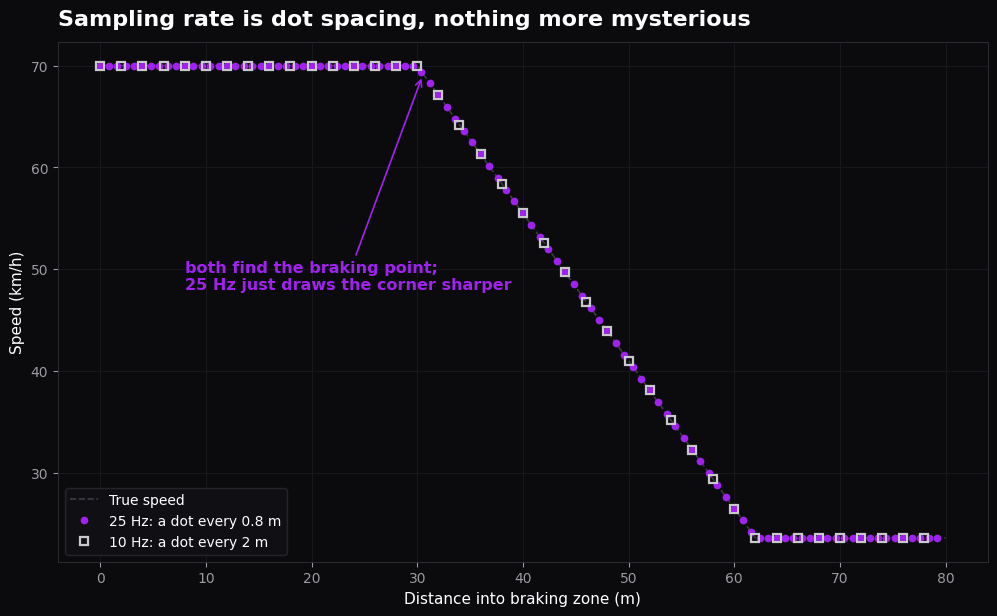
Translate it to track. At 72 km/h a kart covers 20 metres a second, so 10 Hz drops a sample every two metres, 25 Hz every 80 centimetres. That's the entire difference: dot spacing. More dots draw sharper braking walls and catch the exact metre the trace tips over; fewer dots draw the same story slightly blurred.
And here's the part the spec war skips: signal quality beats refresh rate. A clean 10 Hz receiver, mounted well under open sky, produces more trustworthy traces than a 25 Hz unit by the ignition coil. Rate sharpens a good signal. It cannot rescue a bad one.
What GPS answers confidently
The good news list is long, and it covers most of this blog.
Braking points land within a couple of metres at 10 Hz, sharper at 25, which is precise enough to settle any tent argument. Speed traces, minimum speeds and exit slopes are dependable everywhere the kart moves quickly. Lap and sector times from a GPS gate are consistent to small fractions of a second, and consistency is what comparison needs. Track maps and line comparisons hold to roughly a kart's width, enough to see line differences that matter in wet sessions.
In short: every reading method in the speed trace guide and the overlay method works at 10 Hz. I'd rather see a driver read a 10 Hz trace properly than own a 25 Hz unit as a stopwatch. The argument settles itself the first evening you overlay two laps and watch the braking points line up, metre for metre.
Where it wobbles, and why
Four honest weaknesses, all with workarounds.
Hairpin speed. At walking-pace corner speeds the position change per sample is tiny, so the speed calculation gets noisy and the valley floor turns ragged. Read slow-corner minimums as a band, not a decimal. Absolute position drift. The whole track map can sit a metre or two offset from reality day to day; shapes and comparisons survive, painted-kerb-level precision doesn't.
Obstructions. Trees, walls, grandstands and bridges briefly degrade the fix, and indoor karting kills it entirely; that's transponder territory, covered in how lap timers work. And installation. A receiver flat under open sky behaves; one shadowed by the driver or near the ignition lead invents adventures, the failure mode from lap timer troubleshooting.
The mounting rules that buy you accuracy for free
Three rules, all cheap, all worth more than a spec upgrade.
Sky view first. The receiver wants the widest view of the sky you can give it, flat, not tucked under the front fairing and not shadowed by your torso. Distance from noise second: route the GPS away from the ignition lead and coil, the two great liars of kart wiring. And rigidity third, because a unit shaking on a loose mount smears every sample it takes.
I've watched a kart's "engine problem" vanish when the logger moved ten centimetres. Not because the engine changed. Because the data stopped lying about it. Ten centimetres. Free.
Five minutes with a bracket beats a hundred euros of refresh rate. Do the five minutes first.
GPS versus the alternatives
Karting times laps three ways, and they're complements, not rivals.
Track transponders are the official clock: race results, protests, the championship table. Magnetic strips trigger old-school onboard timers reliably but say nothing about the lap between beeps. GPS owns everything in between, the entire shape of the lap, which is why it carried the whole data analysis stack in the first place.
So the practical setup is boring: race on the transponder, learn on the GPS. If your logger supports a beacon or strip as the lap trigger alongside GPS, use it for cleaner lap splits; if not, a well-placed GPS gate is fine. Your buying decision rarely hinges on timing tech anyway, as the lap timer market guides like Your Data Driven's point out: it hinges on what you'll actually review.
The five-second trust check
Before believing any session's data, I run three glances. They catch nearly every GPS lie.
Lap distance: does the data's lap length match the track's published length, within a few metres, lap after lap? Satellite count, if your software shows it: a session that dipped to a handful of satellites will show it in the traces. And the ratio check from kart RPM data. On a single-gear kart, speed divided by RPM should hold steady, and GPS noise shows up as the speed side of that ratio twitching.
Pass all three and trust the session. Fail one and fix the install before drawing a single conclusion, per mistake ten of data analysis mistakes.
Do you need 25 Hz?
My buying advice, from experience rather than spec sheets. Short version: probably not yet.
If you're choosing between two units and the price gap is small, take the higher rate; sharper braking walls are a real, visible benefit. If upgrading means real money, spend it on seat time or tyres instead, because no reading in this blog's method requires more than a clean 10 Hz. If you're choosing a first logger, weigh screen, software and support above the rate, because the unit you enjoy reviewing is the unit that gets reviewed. And if your current data looks noisy, fix mounting and sky view first. Most "my GPS is inaccurate" complaints I've seen were installation complaints wearing a spec-sheet costume.
Sampling rate is the last tenth of data quality. The first nine are whether you open the file at all.
A note on predictive lap timing
One GPS feature deserves its own caution: the live predictive lap time, the running plus-minus on the dash.
Technically it's impressive, and accurate enough to trust. That's exactly the problem. A live delta on the dash invites your brain to do maths instead of driving, the trap I covered in delta time. And no hertz rating fixes a lap you talked yourself out of mid-corner.
Use the predictive screen in testing if it helps you bisect a setup change. Hide it in qualifying. The satellites will still be there after the flag. So will the maths.
FAQ
How accurate is a GPS lap timer for lap times?
Consistent to a few hundredths against itself, which is what analysis needs. It won't always match the official transponder to the digit, because the timing lines differ, but it will rank your laps and measure your gaps faithfully. Use transponder times for results, GPS for everything between. That self-consistent ranking is what every method on this blog actually runs on.
Is 25 Hz worth it over 10 Hz?
It's a real improvement in braking-zone sharpness and slow-corner smoothness, not a revolution. Clean mounting and open sky matter more. Buy 25 Hz happily in a new unit; upgrade an installed, working 10 Hz unit only when something else justifies the change.
Why is my speed trace ragged in hairpins?
Low speed means tiny position changes per sample, so the computed speed jitters. It's physics, not a fault. Read slow corners as shapes and bands, and let your software's smoothing help, as covered in the speed trace guide's FAQ.
Does GPS work for indoor karting?
No, roofs block the satellites. Indoor timing runs on transponders and loops, and your data layer indoors is the venue's timesheet plus your own consistency work. Outdoor karting is where the GPS analysis stack lives.
Alessio Lorandi started karting at six and won the 2013 CIK-FIA Karting World Championship. He raced through Formula 3, GP3 and Formula 2 before founding Purpl, an AI data coach for karting drivers.