10 Data Analysis Mistakes Karting Drivers Keep Making
The logger isn't the problem. From stopwatch-mode to the excuses hat, ten data analysis mistakes I see in every paddock, and the fix for each one.
The hardware is fine. In fifteen years of reading kart data, mine and other people's, I can count the genuinely broken loggers on one hand.
The reading is the problem. The same data analysis mistakes appear in karting paddocks every single weekend, at every level. Most of them cost more lap time than the driving errors they were supposed to find.
Here are the ten I see most, each with its escape route. Count how many are yours. My own worst-season score was four, so no judgement here. The list is cheap to read and expensive to ignore, because every mistake on it compounds quietly until the day the material is equal and the excuses run out.
Why these mistakes cost so much
A driving mistake costs you a corner. A reading mistake costs you the whole project, because every session afterwards chases the wrong problem.
Blame the engine for an exit problem and you'll spend a month of tuning on a braking habit. Trust a slipstreamed reference and you'll chase a deficit that never existed. The data was right both times. The reading sent the work in the wrong direction, and that's why this list earns its place next to any technique article on this blog.
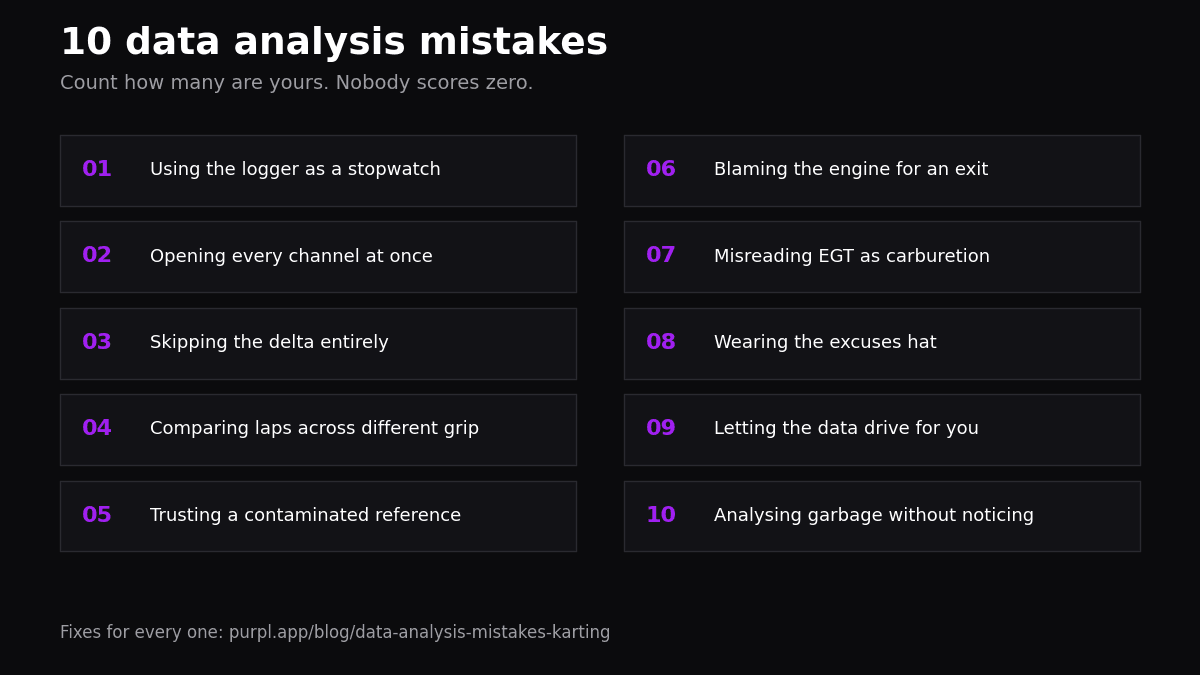
1. Using the logger as a stopwatch
Glance at the lap time, feel good or bad, go home. The most expensive habit in karting, because the hardware gets blamed for being useless when it was never opened.
The escape is one evening: put two laps on top of each other and watch where the time actually lives. That first overlay converts more drivers than any article, and the karting telemetry guide is the on-ramp.
2. Opening every channel at once
Twelve traces, zero conclusions. Drowning looks like diligence.
Three channels in a fixed order find almost everything: delta to locate, speed to diagnose, RPM to confirm. The full reading order is in how to analyze kart racing data.
3. Skipping the delta entirely
The one line that answers "where am I losing time" is the one most drivers never open. They scroll speed traces looking for vibes instead.
Delta first, always, then the other channels only where it moved. Five minutes with delta time replaces an hour of scrolling.
4. Comparing laps across different grip
Friday's lap against Sunday's, or a 9am lap against the rubbered 2pm final. The comparison measures the track, not you.
Grip moves by whole tenths as rubber goes down, so references come from the same session, full stop. Cross-session comparisons are for shapes only, never numbers, per the rules in comparing two laps.
5. Trusting a contaminated reference
The teammate's "fastest lap" had a tow down both straights. Now your engine looks slow and his driving looks divine, and neither is true.
Check the reference before you copy it: was it slipstreamed, was it one banzai corner, can he repeat it? A reference lap is a measuring stick. Bent stick, bent conclusions.
6. Blaming the engine for an exit
The classic. A 1.5 km/h deficit at the end of the straight, and the tent declares the engine dead.
Trace the plateau backwards and the deficit usually starts at the corner exit, then rides the whole straight. Most "engine" problems in karting data are exit problems wearing a disguise, the diagnosis from kart RPM data.
7. Misreading EGT as carburetion
Two EGT lines split, and someone announces the jetting is wrong. But EGT follows the right foot as much as the fuel.
Two drivers picking up the throttle at different points produce different EGT lines on identical carburetion. Compare the temperatures where the throttle behaviour matches, or you're tuning the carburettor to fix a driving style.
8. Wearing the excuses hat
Some drivers open the data to find the problem. Others open it to find the proof that the kart was the problem.
The excuses hat finds its evidence every time: 100 missing RPM, a temperature one notch off, anything except the four metres of braking left on the table. Data is a mirror, and if you're not willing to look at yourself in it, the laptop is a very expensive comfort blanket.
9. Letting the data drive for you
The opposite failure, and the one I warn the strongest drivers about. Copying a teammate's braking points from the overlay instead of building your own feel for them.
I see it at WSK weekends: kids who can't find a braking point on their own because the reference lap always found it first. Telemetry is backward-looking; the moment grip changes, the file is history and your internal references are all that's left. The data should sharpen them, never replace them.
10. Analysing garbage without noticing
Loose logger mount, GPS antenna by the ignition coil, a magnet strip the software doesn't know about. The traces still draw beautifully. They're fiction.
Sanity-check before trusting: does the lap distance match the track, does the ratio of speed to RPM hold steady, do the G numbers pass the smell test? Five seconds of suspicion per session, detailed in GPS lap timer accuracy.
How to spot your own mistake
Reading a list is easy. Catching yourself mid-mistake is the skill, so here are the tells.
If your sessions end with a feeling instead of a sentence, you're in stopwatch mode. If your analysis evenings run long but next session has no single change attached, you drowned in channels. If your conclusions usually flatter you, check which hat you're wearing, because the detective's verdicts sting about half the time.
The monthly read-back of your debrief sheets catches the slower drifts too, the mistakes that creep in across a season rather than a session. Reading your own March verdicts in June is humbling in a useful way.
And there's a tell for the whole tent, not just the driver.
Count how often the conclusion is something nobody in the tent can act on, weather, engine lottery, the other kids' rich fathers. A healthy debrief produces actions. An unhealthy one produces explanations.
The cure for all of it is embarrassingly small. One question before the session, written down. Everything in the reading then has a job, and readings with jobs don't wander, the routine formalised in the debrief template.
What fixing one mistake is worth
Put numbers on it, because "read better" sounds like homework until it's tenths.
Catching a slipstreamed reference saves you from chasing a phantom two tenths of engine. Swapping the excuses hat for the detective hat converts about one corner per weekend into a real project. And breaking the stopwatch habit is the big one, because the first proper overlay usually finds the most expensive corner of a driver's season in a single evening.
None of it needs new hardware. It's the same logger, read with intent, the habit that starts in lap time analysis.
A bonus habit that prevents most of the ten
Almost every mistake above survives because the session had no question.
Drive with one question, read with one method, leave with one change. That loop, run honestly, makes the stopwatch habit impossible, the channel-overload pointless, and the excuses hat embarrassing. TKART's two-driver walkthrough shows what disciplined reading looks like in practice. The theoretical best deserves the same respect: it's a direction, not a target, as Occam's Racer explains in their theoretical best piece.
Print the checklist card above and tape it inside the laptop lid if that helps. Mine lived there for two seasons, metaphorically speaking, while I unlearned numbers six and eight.
And if the list stung anywhere, good. It stung me first. Half of these mistakes are scars from my own seasons, which is exactly why I can spot them across a tent at twenty laps' distance.
FAQ
What's the single most common data mistake in karting?
Stopwatch mode: owning a logger and reading only the lap time. It's most of the paddock, at every club. The first overlay evening fixes it permanently, because once you've seen where the time lives, you can't unsee it.
How do I know if my data itself is bad?
Run three sanity checks each session: lap distance against the known track length, speed-to-RPM ratio steadiness on a single-gear kart, and G values inside plausible kart ranges. If any fail, fix the install before drawing a single conclusion.
Are these mistakes different for kids and juniors?
Same list, different weights. Juniors over-index on mistake nine, copying references instead of building feel, because they grow up with the data. Adults over-index on mistake eight. The fixes don't change with age, only the embarrassment does.
Which mistake costs the most lap time?
Number six, blaming the engine for exits, because it redirects weeks of effort and real money at the wrong problem. The reading error is free. The engine rebuild it triggers isn't.
Alessio Lorandi started karting at six and won the 2013 CIK-FIA Karting World Championship. He raced through Formula 3, GP3 and Formula 2 before founding Purpl, an AI data coach for karting drivers.