How to Run a Post-Session Debrief (Template Included)
A 15-minute karting debrief that actually gets done between sessions: feelings first, one verdict, one change. With a printable template to take trackside.

Between sessions you have maybe twenty minutes. A loud tent, a mechanic asking about pressures, and a brain that's already rewriting what happened out there.
That last part is the problem the karting debrief exists to solve. Memory is a terrible engineer, and it gets worse by the minute. The session you remember at dinner is a story. The session you write down within ten minutes is data. Ten minutes is the whole price.
Here's the routine I use and teach, plus a printable template so you can run it at the track today.
Feelings first, laptop second
The order matters more than any single step. Before you open the data, write what you felt.
Which corners felt strong, where the kart fought you, what you'd change blind. Two minutes, bullet points, no full sentences needed. Ross Bentley's Speed Secrets has a good piece on remembering what you felt on track, and the core trick is the same: capture the feel before anything overwrites it.
Coaches see it constantly. The driver swears the kart understeered all session, then the data shows the fronts barely loaded. Neither witness is lying, which is exactly why both get written down.
Why before the laptop? Because the moment you see the traces, the data rewrites your memory, and you lose the one thing only you can log. The gap between what you felt and what the data says is the most instructive number of the day. You can only measure it if you wrote the feeling down first.
The karting debrief, step by step
Fifteen minutes, same order every time. Routine is the entire trick, because a debrief that changes shape every session stops happening by round three.
1. Feel notes. Two minutes, before anything else, as above.
2. The lap table. Best lap, theoretical best, and how many laps landed within a tenth of your best. Three numbers, straight off the software, the method from lap time analysis and lap consistency.
3. One worst corner. Delta against your reference, find the biggest climb, open the speed trace there. The overlay method, compressed to five minutes.
4. One verdict, one sentence. "Braking three metres early into T4 and coasting." Written down, no hedging. If you can't write the sentence, you haven't finished looking.
5. One change for next session. Exactly one. The discipline that runs through everything I write, because two changes produce zero conclusions.
6. Close last session's loop. Did the previous change work? Data answer, not a feeling answer. This single step is what turns isolated sessions into a season of compounding progress, and it's the step every paddock debrief skips.
7. Setup line. Sprocket, pressures, axle, conditions, one row on the sheet. My old mechanic kept every adjustment in his papers, and when we struggled for pace he knew exactly where to look for inspiration. Be your own version of that, with the setup notebook habit.
The template
All seven steps fit on one page, and the page is the product. Print a stack, clip them to a board, one sheet per session.
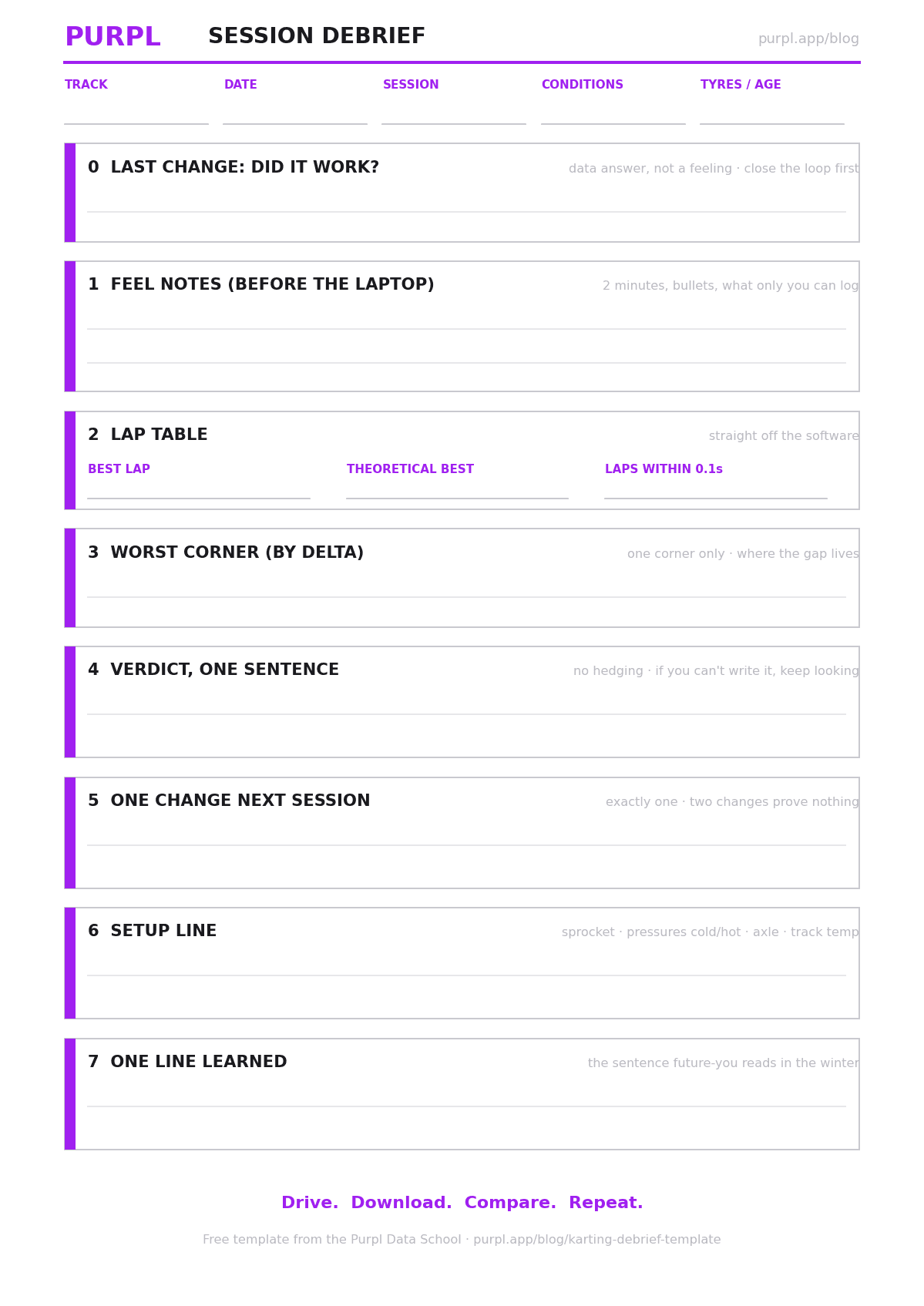
Download the printable debrief template (PDF). It's free, no email wall, A4, deliberately boring. The session that fills it in is the interesting part.
If you'd rather rebuild it in your own app or spreadsheet, copy the seven boxes and keep the order. The order is the method.
One design choice worth explaining: the "last change result" box sits at the top, not the bottom. You close the previous loop before you open a new one. That ordering is the difference between testing and wandering.
A real sheet, filled in
Fifteen honest minutes produce something like this, from a hypothetical but typical club Saturday.
Feel notes: kart loose on entry T3, strong out of the hairpin, brain checked out last four laps. Lap table: best 52.41, theoretical 52.18, four of twelve laps within a tenth. Worst corner by delta: T3, losing 0.15.
Verdict: braking too late into T3 and arriving crossed-up, entry slide costing the whole middle phase. Change: brake two metres earlier at T3 and trail in, nothing else touched. Last session's change: wider line in T7, confirmed by data, kept.
One line learned: "When entry is calm, the hairpin exit fixes itself." That sheet took less time than the espresso queue, and next session has a job.
Why most debriefs die by round three
Three killers, all avoidable.
The sheet was too long, so it became homework instead of habit; one page is the ceiling. The verdicts were vague, "find more pace in sector two" is a wish, not a verdict. And nobody closed loops, so the sheets never proved their value, which is why the last-change box sits at the top of mine.
Keep it short, keep it specific, close the loop. The routine that survives is the one that fits in the gap between sessions, with a data method behind it.
The race-day variant
Race days compress everything, so the sheet flexes.
After heats, skip the lap table and go straight to verdicts. One sentence on the start, one on the best overtaking corner, one on whoever fought you hardest. Race pace outranks best laps on Sundays, the argument from delta time.
Then the final gets the full fifteen minutes at day's end, even exhausted, even packed up. The hardest debrief of the season is the one after a bad final. It's also worth double.
Make it survive the season
A debrief sheet is worth little. Forty of them are a coaching library.
Keep them in one folder, and read the stack back every month or so. Patterns appear that no single session shows. The same corner type costing time at three different tracks, pressures drifting the same direction every hot weekend, the one change that never sticks. Winding Road's Speed Secrets piece on the handling debrief process pushes the same discipline from the car side: written answers, same questions, every time.
The month-end read costs twenty minutes. It's the cheapest coaching session you'll ever book, and after a season it tells you exactly what the off-season homework should be.
Debriefing with a team, a parent, or a kid
Add people and the structure matters even more, because debriefs drift into blame without it.
Same sheet, same order, every session, whoever is in the tent. The data plays referee: when the conversation reaches step three, the worst corner is whatever the delta says it is, not whatever annoyed the loudest person. Wearing the detective hat instead of the excuses hat changes the whole tone, the distinction I drew in data analysis mistakes.
For young drivers, one extra rule. The kid speaks first, before parent, mechanic or coach, and the kid owns step five. A driver who chooses the change drives the change. A driver handed the change drives a favour, and favours don't stick.
What this looks like after a year
Run this routine for a season and three things happen, in my experience coaching drivers who actually did it.
The debrief gets faster, settling near ten minutes, because the questions are pre-decided. The one-change discipline starts working mid-session too: drivers begin noticing the project corner while driving it, the mental sticky-note habit from sector thinking. And the season stops feeling like twenty separate weekends. It becomes one continuous experiment with twenty data points.
That's what the sheet is actually for. Not paperwork. Compounding. And compounding is the only force in karting that's free, which is a strange thing for a sport this expensive to leave lying on the table. Print the sheet. Drive. Fill it in. Repeat.
FAQ
How long should a karting debrief take?
Ten to twenty minutes between sessions, and the short version beats the skipped version every time. If time is brutal, do steps one, four and five only: feel notes, one verdict, one change. That's still a debrief. Scrolling laps in silence isn't.
Paper template or an app?
Whichever you'll still be using in August. Paper survives gloves, sun glare and dead batteries, and the physical stack invites the month-end read-back. Apps search better. I push paper at the track and photos of the sheets into a folder afterwards, the lazy version of both.
Is a race debrief different from a practice debrief?
Same sheet plus one section: racecraft. Where you attacked, where you got attacked, which rivals were strong in which corners, the scouting habit from sector analysis. Race pace numbers also outrank best-lap numbers on Sunday sheets.
What if I don't have a data logger yet?
The routine survives without one. Timesheet for the lap table, your own references for the worst corner, the one-change rule unchanged. The template has nothing on it that requires telemetry, though the verdicts get sharper the day you add a logger.
Alessio Lorandi started karting at six and won the 2013 CIK-FIA Karting World Championship. He raced through Formula 3, GP3 and Formula 2 before founding Purpl, an AI data coach for karting drivers.