Lap Time Analysis: How to Find Exactly Where You're Losing Time
Theoretical best laps, sector maths and the sum-of-deltas exercise I make my drivers do. A coach's method for finding lost lap time.

Every driver knows their best lap time. Almost none of them know where it came from, or why the other eleven laps of the session were slower. That difference is what lap time analysis is for, and it's the most direct route from "I feel quick" to "I know which corner owes me two tenths".
I'll give you the full method here, including an exercise I use that you've probably never been asked to do, and that nobody enjoys. It works anyway.
Start with the theoretical best
Your analysis software builds it automatically. Take your fastest sector 1, fastest sector 2, fastest sector 3 from the session, and stitch them together. You get the lap you would have done if you'd driven your own best pieces in a single lap.
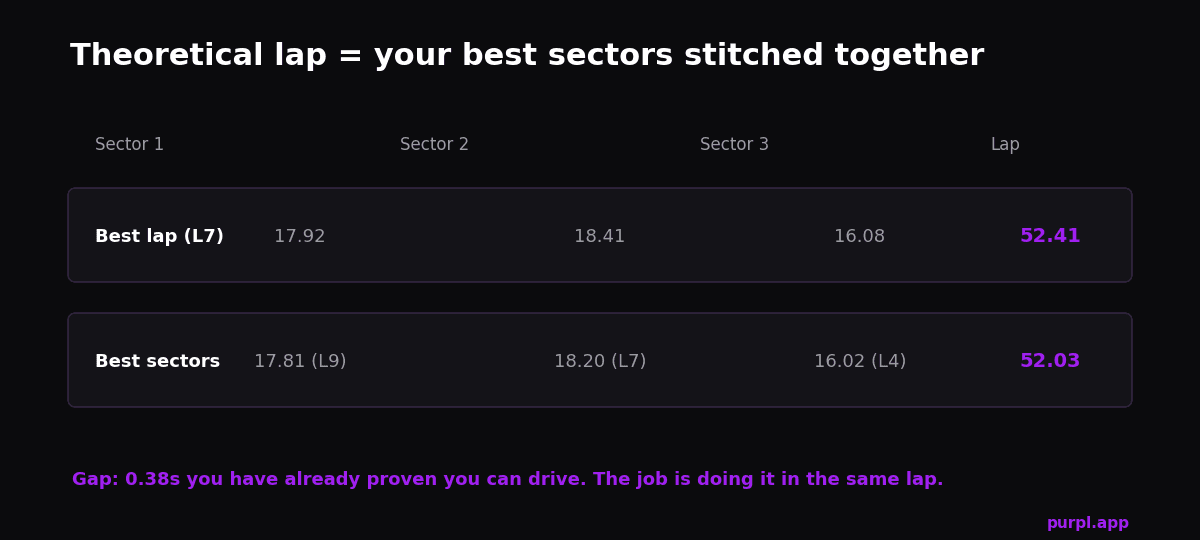
Here's the standard I hold drivers to, and yes, it's strict. Be upset if your theoretical is more than a tenth faster than your actual best.
A 0.32s gap is completely normal at club level. But it means you already drove every piece of a much faster lap and never assembled it.
That's a precision problem rather than a speed problem. You've already proven the speed.
When I was coming through the ranks I had a rule for myself about this, half joke and half not: ten push-ups for every tenth of gap to the theoretical.
The point wasn't fitness. The point was that the gap is yours, not the kart's, not the engine's, and it should sting a little.
The exercise nobody does: sum the gaps
Now the painful part. Don't stop at comparing your best lap to the theoretical. Calculate the gap between the theoretical and every lap of the session, excluding the out-lap and lap one, and add them up.
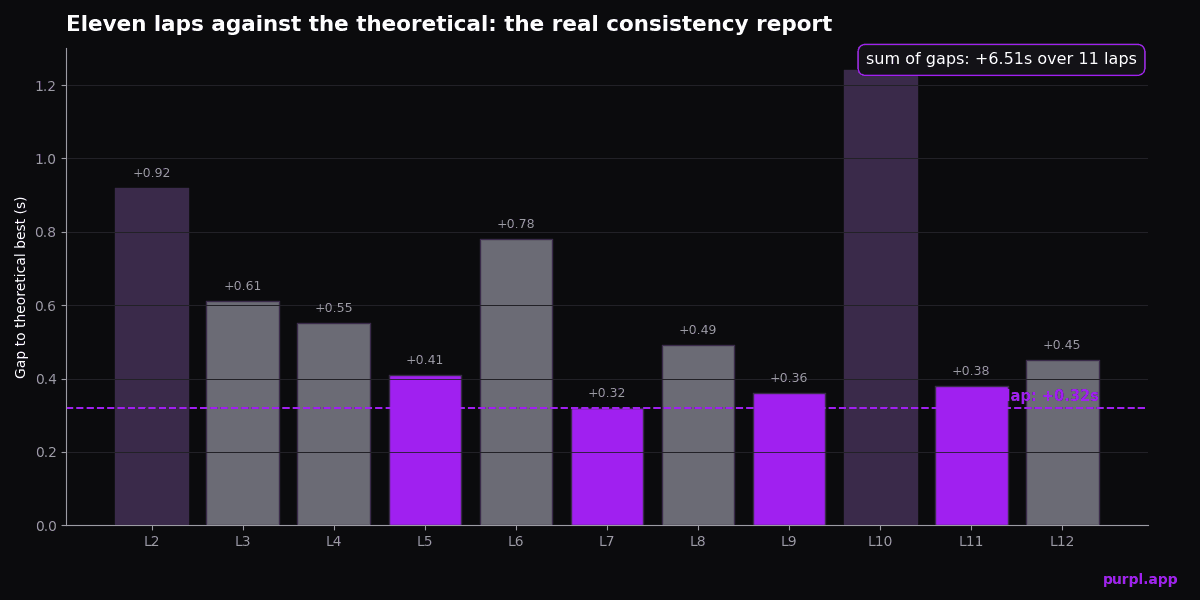
Why do this to yourself? Because it kills excuses one by one.
"I had to overtake" explains one slow lap, not nine. And while we're there: the best drivers lose less than a tenth making a pass, ideally half.
"The chassis was sliding and hard to drive": could be. Who said it would be easy? The fastest setup is often the trickiest one to drive, so drive it.
"I made a mistake on my best lap": fine, that happens to everyone pushing properly. Did you also make a big mistake on all the other ten?
You see where I'm going. A driver who is four tenths off the theoretical once had a moment. A driver who averages four tenths off across a session lacks laser-focused precision, and that was completely me at the start of my career too.
You can do a corner fast. Doing it every lap, that's the sport.
Run the numbers on the session in the chart above and the scale of it lands properly. Eleven flying laps. An average gap of 0.59s to the theoretical.
A total of six and a half seconds donated to imprecision in one twelve-minute session. Multiply by six sessions in a test day. Half a minute of pure, already-proven speed, given away.
No engine upgrade on sale anywhere offers you thirty seconds.
The number this exercise produces, total time donated to imprecision per session, is the single most honest metric of your driving I know. Track it across weekends the way you track lap times. The deeper measurement methods are in how to measure lap-to-lap consistency.
Then go one level down: sectors
A lap time is a story with the pages glued together. Sectors pull them apart. Three is what most timing systems give you.
If your software lets you define your own splits, make each significant corner its own sector. Because averaging a strong chicane with a weak hairpin into one number is how problems hide. The mechanics are in sector and split analysis.
Read sectors against two references.
Against your own best: which sector is the unstable one, the one that swings lap to lap? That's where your precision leaks.
Against a faster driver: which sector holds the biggest gap? That's where your pace leaks.
Two different leaks, two different fixes. And confusing them wastes months.
Pick the right reference for the job
Every comparison needs a reference lap, and choosing it badly produces confident nonsense. Three references, three different questions.
Your own best lap answers "where am I inconsistent". It's the gentlest reference and the right one for the sum-of-deltas work, because every difference it shows is by definition within your proven ability.
A faster driver's lap from the same session answers "where am I slow". This is the harshest and most useful mirror, with one warning: only borrow what transfers.
A driver ten kilos lighter or on fresher tyres will show differences that aren't driving. Look for the corners where the gap is concentrated rather than spread evenly; concentrated gaps are technique, spread gaps are usually equipment or conditions.
Your own benchmark from a previous visit answers "am I actually progressing", so keep one golden session per track, best conditions, best form, and measure against it each visit. Track evolution muddies single-day comparisons, but season-over-season trends against your own benchmarks are the truest progress report you'll get.
Qualifying analysis is its own discipline
Race sessions reward the consistency work above. Qualifying asks a different question: can you produce your peak in a narrow window, often on lap two or three when the tyre is at its best?
So analyse your qualifying sessions separately. Check which lap of the run your best came on, and compare that against where the tyre peak actually was. A driver whose best lap consistently arrives two laps after the grip peak is leaving pole positions on the table out of caution.
Then check lap one specifically. The time you need on the opening lap of a stint is free in races too, at starts and restarts. And the early-laps evidence below says almost everyone undervalues it.
From sector to corner: the final zoom
Once a sector is convicted, the speed trace tells you which corner did it and how. Overlay your fast and slow laps in that sector, look at where the lines split: braking point, minimum speed, or exit slope. The reading technique is its own discipline, covered in how to read a speed trace and the lap overlay guide.
One pattern shows up so often it deserves its own mention: the time rarely disappears where you think it does. A driver feels slow on the straight and asks about engines.
The trace shows something else: 3 km/h lost at the exit of the previous corner, carried the whole way down. Exit speed compounds. Corner exit speed explains why that number multiplies the way it does.
The early laps tell you something too
One more place to point the analysis: your first three laps. I learned this watching the 2012 Winter Cup at Lonato, more than a hundred drivers per category, everyone testing all January for it.
One driver pulled a tenth to a tenth and a half per lap on the field, but only in the first nine or ten laps, then the gaps stabilised. Everyone around me reasoned about tyre pressures. It wasn't tyre pressures.
He was simply at one hundred percent from the moment the flag dropped while everyone else took three laps to believe the grip. That driver was Max Verstappen, and the following year the same script played out again.
So when you analyse a session, compare your lap 2-3 pace to your peak pace. If you need five laps to reach a limit your data proves was available on lap two, that's free time, in qualifying especially. And most drivers never even look for it.
Race pace: the analysis that predicts results
Everything so far measures one-lap speed. Races are won by a different number: average lap over a full distance, and how it decays.
Pull your last final into the software and compute three things: your mean lap excluding lap one and any laps with contact or major traffic. Your spread, the gap between your fifth-best and your twentieth-best lap, tighter is better and champions are freakishly tight.
And your decay, the trend of your lap times across the stint as tyres age and your concentration is taxed.
Now compare those three against the driver who won. The common discovery is humbling. Similar best laps, completely different averages.
A driver who qualifies two tenths behind you and beats you by four seconds in the final didn't find pace on Sunday morning. He's simply driving his theoretical more often than you are, which sends you right back to the sum-of-deltas exercise above.
Qualifying speed gets the photographs. Average lap pays the championship points.
Traps in the numbers
Three ways lap time analysis lies to honest people.
Track evolution: the session got faster underneath you, so your "improvement" from lap three to lap eleven might be rubber, not driving. Check whether the whole field's times fell by the same margin.
Traffic accounting: deleting laps you "had traffic" on requires honesty, a kart half a second ahead is traffic, a kart three seconds ahead is an excuse.
And cherry-picked sectors: a theoretical built from sectors achieved under completely different fuel loads or tyre ages is an aspiration, not a target. Build it from a single session's laps and it stays honest.
The defence against all three is the same boring habit: log conditions with the laps, compare like with like, and let trends across multiple sessions outvote any single spectacular number.
Make it a habit, not a project
All of this fits in the twenty-minute routine from the data analysis method. Theoretical gap, sum of deltas, worst sector, one corner, one change.
Write the line in the notebook. Repeat next session.
The cadence that works: full analysis at the track between sessions, then a second fifteen-minute pass at home in the evening while the session is still fresh. The evening pass catches what the paddock rush misses, and it's where the season-long patterns first show themselves. Sunday night with a coffee and the week's deltas is worth more than most paid test days.
Numbers you produce once are trivia. Numbers you track for a season are a coaching program. And the day a pattern jumps out of your own notes, you'll understand your driving better than most paid coaches at a club paddock would.
For what the very top of that looks like, the data habits that separate the quickest drivers, I've collected the evidence in what separates fast karting drivers.
If you want the official sector timing standards used at international level, the technical regulations on FIA Karting define how timing loops are placed. For community debate on consistency training there's a long-running thread culture on KartPulse worth reading.
Alessio Lorandi started karting at six and won the 2013 CIK-FIA Karting World Championship. He raced through Formula 3, GP3 and Formula 2 before founding Purpl, an AI data coach for karting drivers.