Corner Exit Speed: Why It Matters More Than Apex Speed
Exit speed compounds down the whole straight, but the usual advice for getting it is wrong. What exits are made of, and why braking early isn't it.
Drivers brag about the wrong number. The apex speed flashes on the screen, somebody's is 2 km/h higher, and the tent treats it like a trophy.
Meanwhile the stopwatch only cares about a different number. Corner exit speed is the one that gets multiplied, because whatever you carry out of the corner, you keep for the entire straight that follows. An apex is a moment. An exit is an investment.
And yet the standard advice for buying that investment is mostly wrong. We'll get to that, because it's the part of this article some coaches won't like.
The compounding math
Take a corner leading onto a 150-metre straight. Exit 1 km/h down and you don't lose that speed once. You drag the deficit all the way to the next braking board, and the slower start also means every metre of the straight is covered at a slightly lower average.
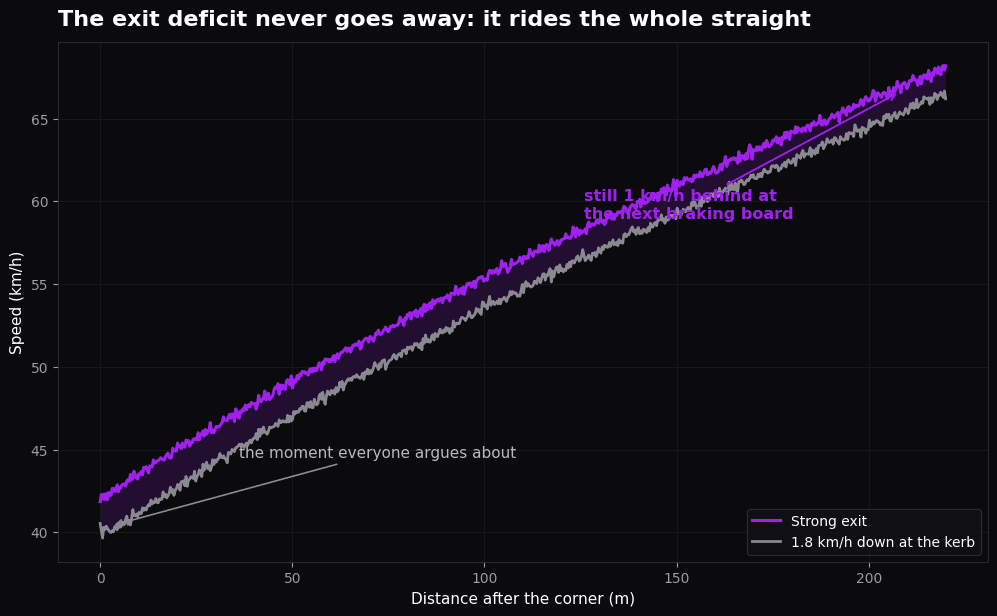
That's why exit mistakes read so big in the data. On the speed trace they're a lazy slope. On the delta time channel they're a ramp that climbs the whole straight, long after the corner is behind you.
Exits also hide behind excuses beautifully. Early in my karting I kept blaming the kart to my mechanic, "it's sliding on exit", no traction, while sitting around two seconds off the pace. The kart wasn't ruining my exits. My corners were making the kart slide.
Apex speed enjoys no such multiplier. Carry 2 km/h extra through the apex and ruin the drive, and the trace forgets your trophy within fifty metres. The straight remembers the exit.
Multiply that across the four biggest exits at your track and you're looking at the gap between the second row and pole, every single weekend, from corners that felt fine.
What corner exit speed is actually made of
Four ingredients, all visible in data.
Rotation finished early. The kart that reaches its minimum speed early in the corner spends the exit accelerating on an open steering wheel. The kart that's still turning at the kerb spends it scrubbing. Where your minimum happens matters as much as how high it is.
All of the track. Using the full exit, kerb included, makes the corner's radius bigger exactly where the power is on. I've reviewed laps where the driver left five centimetres of exit kerb unused, lap after lap, for no reason beyond habit. Five centimetres sounds like nothing. The racing line says otherwise.
The engine in its band. A perfect line with the RPM below the power band still produces a dead exit. Exits and gearing are one conversation, covered from the engine's side in kart RPM data.
Throttle the kart can use. Earliest pedal isn't best pedal. What counts is where speed actually starts building, the whole subject of throttle trace analysis.
Now the part the coaches get wrong
Here's the standard recipe you'll hear at every club track: prioritise exits over entries. Brake early, get on the gas early, sacrifice the way in to win the way out.
I think that's nonsense. Or at least, it's not how anyone becomes a phenomenal driver.
And some of that advice has a motive. "Prioritise exits" is also what gets said to justify a lack of speed down the straights when nobody wants to discuss the engine.
Braking early and throttling early is the easy thing to do. And if it's easy, where's the advantage? Where's the lap time nobody else can find? Michael Schumacher's signature, the one his engineers and rivals kept describing, was carrying the highest speed into the entry of corners. Not the middle. Not the exits. The entries.
The misconception underneath the standard advice is that a fast entry must cost you the exit. It doesn't have to. The goal is to make both: an entry near the limit of physics AND a strong drive out. If the exit suffers, the fix is rarely entering slower. Ninety percent of the time the real problem is deceleration efficiency, how well you slow the kart once you've committed. That's a braking skill, built in karting braking technique and refined through trail braking.
So yes, exit speed beats apex speed. But you buy it with technique, not with surrender.
What teaming with Leclerc taught me about exits
In 2015 I was Charles Leclerc's teammate in FIA Formula 3 at Van Amersfoort Racing, fresh out of karting. That season was a reality check.
That season even made me question my own driving. When we compared data, Charles wasn't beating me on the exits the way the club-track recipe would predict. He was carrying entry and mid-corner speed without losing time on the exit, V-ing the slow corners harder than me. He drove the entry on the very limit while still getting the drive. The exits looked after themselves because everything before them was right.
By Macau at the end of the year I'd closed most of the gap. He finished second, I finished seventh. And I carried the lesson into every kart I've coached since: a great exit is the result of a great corner, not a substitute for one.
When exits really do come first
Concession time, because the standard advice contains a real grain of truth.
The corner feeding the longest straight is the one place where trading entry for exit usually pays. More straight means more metres multiplying your exit speed, so the compromise maths shifts. Even there, the trade should be deliberate and measured, not a habit applied to all ten corners. Ross Bentley's Speed Secrets answers the "does slow-in fast-out always work?" question with the same nuance, and Driver61's guide to corner types maps which corners deserve which priority.
Karting adds one twist of its own. With no gearbox in most classes, a bogged engine punishes a stopped corner harder than any car. That's why low-powered karts bias toward rolling speed everywhere except that one cash-out corner. The full corner taxonomy is in karting corner types.
Reading exits in your data
Three checks after every session, ten minutes total.
First, exit slope: pick your three corners onto the longest straights and compare the climb out of each against your best lap or a teammate's. Second, speed at a fixed point 100 metres after each of those corners; that single number is your exit grade, compounding included. Third, where the slope breaks: a step means wheelspin or a pinched line, a late start means the corner was over-slowed.
The fixed-point speed check is the one I'd keep if you keep only one, because it converts a feeling argument into a number argument in ten seconds flat.
With a reference lap, the questions get sharper: who gets the better exit, and why? That's one of the core questions in the overlay method, and the answer is usually visible in one evening.
The could-have audit
Here's an exercise from my own debrief routine. After a session, pick your three most important exits and ask two questions of each.
Could I have picked up the gas half a metre earlier, even if it felt like the limit of push understeer? Could I have used a touch more track on exit, even feeling I was at the edge of dropping a wheel?
The answer is almost always yes to one of them. Half a metre. Every exit. Every session. Feelings run conservative. The audit converts felt limits into tested limits, half a metre at a time, and the data grades every test the same evening.
FAQ
Is exit speed or entry speed more important in karting?
Wrong question, honestly. Exit speed determines your straight; entry skill determines how much exit you can have without giving the corner away. Prioritise the exit's result, build it with entry technique, and reserve the deliberate entry-for-exit trade for the corner onto the longest straight.
How do I measure my corner exit speed?
Pick a fixed distance marker after the corner, 50 or 100 metres, and read GPS speed there on every lap. Tracking that one number across sessions beats staring at the whole trace, and any logger from the data logger guide provides it.
Why is my exit speed low even when I'm on the throttle early?
Because the pedal isn't the drive. If the kart is still rotating, sliding, or below its power band, early throttle produces noise instead of acceleration. Check where speed actually starts climbing, and check your minimum-speed position: a late minimum poisons every exit that follows it.
Does a higher apex speed ever matter?
Yes, in fast corners that flow into other corners, where carried speed is the whole game. The apex-versus-exit trade is corner-specific. What never matters is apex speed as a bragging number divorced from what it did to the lap.
Alessio Lorandi started karting at six and won the 2013 CIK-FIA Karting World Championship. He raced through Formula 3, GP3 and Formula 2 before founding Purpl, an AI data coach for karting drivers.