Syncing Onboard Video With Telemetry Data
Data says what happened, video says why. How to sync video with telemetry three ways, the camera habit worth building, and how to read the pair.
I have one big regret from my karting years, and it isn't a race. It's a camera.
Onboards were spreading through the paddock by 2010 or so, and I only used mine occasionally, for no good reason. I still beat myself up about it. Once you sync video with telemetry you own the most objective coaching tool in the sport, and I left half of it on the shelf for years.
Don't repeat that. Here's the why, the how, and the habit.
Data says what. Video says why.
The two tools answer different questions, and the gap between them is where mechanics' opinions live.
Data tells you the exit was 3 km/h down. Video tells you the hands pinched the steering at the kerb. Data shows a soft braking wall; video shows the kart arriving crossed-up because of the line into it. One witness gives you the number, the other gives you the cause.
And together they end arguments. A mechanic watches you run wide once and tells you to stay tight on exit. Then the video of every other lap shows you using too little track, never too much. I've watched video prove the correct point against confident tent wisdom over and over. It's a mirror with a timestamp.
My rule for the tent follows from that: nobody's opinion outranks the pair. Not mine, not the mechanic's, not the parent paying for the engine. Two witnesses, one verdict.
The full data-side method is in how to analyze kart racing data. This article adds the second witness.
How to sync video with telemetry: three ways
Same goal every time: the video frame and the data cursor pointing at the same metre of track.
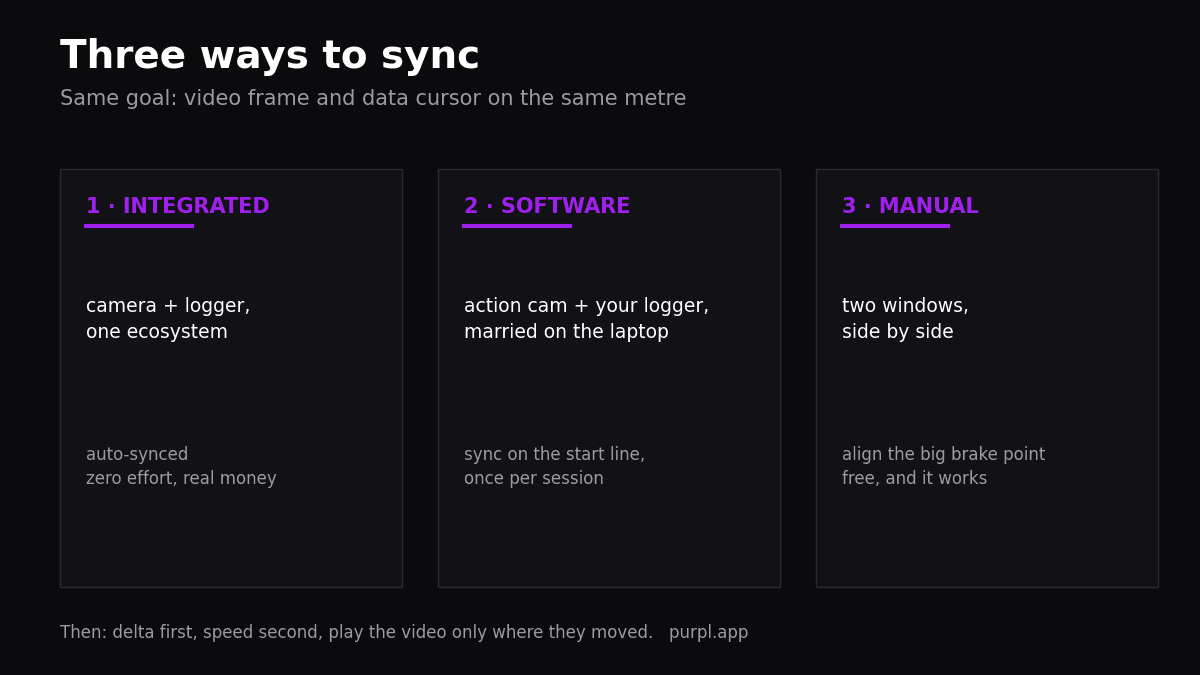
Integrated camera systems. Camera and logger from the same ecosystem record together and sync themselves, SmartyCam-style setups being the known example in karting. Zero effort after install, at a price. Worth it for teams reviewing many drivers; optional for one kart.
Software alignment. A GoPro-class camera plus your existing logger, married afterwards on the laptop. Overlay tools read your logger's export directly, Telemetry Overlay handles the mainstream karting loggers, and RaceRender does the same job from CSV and GPS files. Sync once per session, usually on the start-line crossing, and every lap after inherits it.
Manual, costs nothing. Two windows side by side: analysis software left, video player right. Find an unmistakable moment in both, the brake point into the biggest stop works best, line them up, then scrub together. Crude, free, and honestly how most of my own karting review worked.
A phone in a chest pouch is how most club drivers start, and it's genuinely workable for studying lines and reference points. Know its limits, though. Vibration, no data sync, and footage that's hard to compare frame-accurately. That's why a basic action camera, costing less than a set of tyres, is the upgrade that pays first.
Exporting the data side for those tools is covered in exporting telemetry to CSV.
The camera habit, honestly costed
Here's the whole price of the second witness, because drivers imagine it's heavier than it is.
Buy once: camera, SD card, case, bracket. Charge it once a day. Clear the card every couple of races. Then per session it's mount, press record, press stop, and pull the file at the laptop.
Does that sound too complicated? It isn't, and I say that as someone who still got lazy about it sometimes. Lazy once in a while is forgivable. Lazy every time is a choice, and you won't win big races making it. Treat karting like a profession early, and the camera is part of the uniform.
Reading the pair, corner by corner
Synced footage is only useful with a reading order, otherwise it's just racing television.
Start in the data: delta time first, find the corner where the gap lives, check the speed trace shape there. Only then press play, at that corner, and ask the video questions.
How much track am I using on entry, mid, exit? How does my chassis behave compared to the reference kart? Was there a slipstream inflating his straight? Are my steering inputs smoother or more aggressive than his? That last one alone is worth the camera, and it pairs with steering technique.
Every serious sport reviews film. Tennis players rewatch matches with their coaches, football teams study game tape, and they do it because reliving the moment shows the micro-decisions that memory edits out. Karting is no different, just smaller screens. The difference is that a karting film session costs ten minutes in a tent instead of an afternoon in a video suite, which removes the last excuse anyone had.
Watching yourself without a reference
No teammate footage? Your own video still earns its card space, with a different method.
Watch your average laps before your fast lap. The fast lap is an outlier, and outliers are hard to learn from until you know what normal looks like. Three ordinary laps of the same corner teach you your habits; the fast lap then shows you which habit broke in your favour.
And watch with one question, the same discipline as the data side. "What are my hands doing at turn five?" beats forty minutes of general viewing, every time. Film study works because it's specific, not because it's long.
Then write the verdict on the debrief sheet like any other finding. Video conclusions evaporate even faster than data ones, because the footage feels memorable while you're watching it. It isn't.
When video beats data outright
Three situations where the camera is the primary witness, not the backup.
Traffic and racecraft. Data can't tell a defended corner from a slow one; video can, and it's how you study where rivals attack, which feeds the planning habit from sector analysis. Kerbs and surface. The logger doesn't know you dropped two wheels in the dirt; the footage does. And chassis behaviour. A kart hopping, sliding, or lifting its inside rear at the wrong moment is visible long before it's measurable.
Slipstream study deserves a special mention for race weekends. Data shows the tow as free straight-line speed; video shows how the driver ahead earned or wasted it, and where the pass actually launched from. Review every heat's first three laps this way and your race starts improve within a weekend.
The reverse is also true: video without data flatters everyone. The lap always looks committed from inside the helmet. Numbers keep the film honest, which is why the pairing beats either one alone, every time.
Storage: the boring step that decides everything
The camera habit dies in the file system, so steal my naming rule.
One folder per track day, files renamed to session and driver before the day ends, deleted only after the debrief is written. Footage you can't find next month is footage you never shot. Star the laps worth keeping the same evening, because "I'll sort it in winter" is how libraries die. Thirty seconds of renaming per session keeps a season of reference laps alive, and a season of synced reference laps is a private coaching library nobody can take from you.
No one serious works blind anymore
Imagine Max Verstappen's race engineer trying to coach him purely by eye. No data, no footage, just impressions from the pit wall. No chance, right?
And while karting isn't Formula 1, the direction is the same and it isn't reversing. Teams and drivers keep stepping up to objective review season after season, because nobody is bringing back the eighties. The kids building the camera-and-logger habit now are the ones the ladder will favour later.
The cost of entry is one camera and one habit. The cost of skipping it gets renegotiated every season, and it only goes up. I paid that price once, in regret, watching rivals review footage I never shot, and I'd rather you pay for a camera bracket than for the same lesson.
FAQ
Where should I mount the camera on a kart?
The common solid options are a bracket behind the seat looking forward over your shoulder, or on the front fairing looking back at your hands and the track. Shoulder view teaches lines and track usage; hands view teaches steering inputs. Check your series' technical regulations first, since mounting rules and helmet-camera bans vary.
Do I need an integrated camera-logger system?
No. A mid-range action camera plus your existing logger covers ninety percent of the value, synced in software or by hand. Integrated systems buy convenience and frame-accurate overlay, which matters most for teams processing many drivers every session.
Why does my video drift out of sync over a session?
Because camera clocks and logger clocks tick slightly differently, small errors accumulate over long recordings. Sync per stint rather than per day, use the start-line crossing of each run as the anchor, and the drift stays invisible.
What frame rate should I record at?
1080p at 60 frames per second is the sweet spot: smooth enough to judge inputs, light enough to store a whole season. Higher resolutions fill cards and add nothing you can read from a vibrating kart.
Alessio Lorandi started karting at six and won the 2013 CIK-FIA Karting World Championship. He raced through Formula 3, GP3 and Formula 2 before founding Purpl, an AI data coach for karting drivers.