Smooth Hands, Fast Laps: What Steering Data Reveals
Smooth doesn't mean slow hands. What kart steering technique actually looks like, the angle tax karts charge, and how to read your hands in data and video.
"Be smooth" is the most repeated advice in karting. It's also the most misunderstood.
Smooth doesn't mean slow. The fastest steering technique karting rewards is often quick, decisive, even aggressive, and still smooth, because smooth means something specific: one clean input, held, then opened.
Not gentle. Uncorrected.
So: what that looks like, why karts tax steering angle harder than any car, and how to read your own hands in the data.
What smooth actually means
Watch a quick driver's hands and the surprise is how little happens.
One turn-in, sized right the first time. A held angle through the middle. An early, progressive opening on the way out.
The slow driver's hands are busy. Turn, correct, add, take away, a conversation with the kart that never settles. Each correction is a small grip event at the front tyres, and the corrections are what "not smooth" actually costs.
The phrase that stuck with me from scouting young talent is "smooth yet aggressive": fast hands, used once. Speed of input isn't the sin. Recounting is.
And good equipment hides the sin, which is the trap. Strong material covers for dirty steering inputs the same way it covers for late throttle, right up until the material is equal and the bill arrives.
Where the hands live
Quiet hands start with where they sit. Quarter to three, both hands, and they stay there. All lap.
Kart steering is direct enough that no corner needs a shuffle or a hand-over-hand moment.
The grip itself stays light. Fingertips, almost. Strangle the wheel and every bump in the tarmac travels up your arms and back down as a tiny steering input you never chose.
The seat does more of this job than most drivers credit. A torso held properly by the seat lets the arms do nothing but steer. A driver sliding around under lateral load ends up using the wheel as a handle, and a handle can't be a precision instrument at the same time.
The angle tax: why karts punish steering hardest
A kart has no differential. That one fact rules everything your hands do.
The solid rear axle means the kart only turns happily while the inside rear unloads. Every degree of steering angle beyond what the corner needs is scrub, pure friction, paid in speed.
Cars forgive held angle. Karts invoice it by the metre.
This is why the fast version of every corner uses the minimum angle that makes the apex. It's also why a strong front end matters so much.
With the front gripping, you reach maximum rotation early, then open the steering early, extra precise at the apex with a limited steering angle. Rotation first, then hands quiet. The setup side of that lives in chasing the front end.
The opposite pattern, more and more angle as the corner goes on, is the kart telling you the entry was wrong. The hands are compensating for a rotation that never happened, and the scrub is collecting the fee. Every metre of it.
Reading steering technique in karting data
Here's the honest catch: most karts don't log steering angle. Like the throttle, you read the hands through proxies, and the proxies are good.
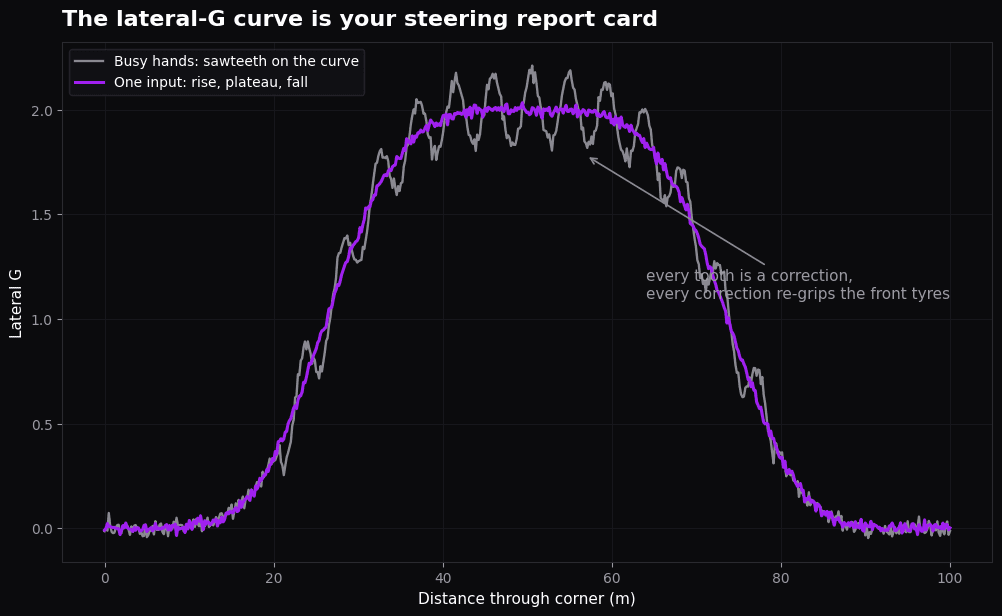
Lateral G smoothness. Clean hands draw a clean lateral-G curve: one rise, a plateau, one fall. Corrections show as sawteeth on that curve, each tooth a re-grip of the front tyres.
Compare your G shape with a reference driver's through the same corner and the hands difference is visible without any steering sensor.
Picture the before and after. The "before" lap rises into the corner, then the trace chatters through the middle, a row of teeth where the hands kept renegotiating a deal the front tyres already signed. Each tooth lines up with a small flat spot in the speed trace.
The "after" lap, same corner, same driver, draws one rise, a plateau, one fall. The dip mid-corner is gone and the exit speed builds earlier. Nothing else changed.
Read the pair the same way you'd read two laps in an overlay comparison, against distance, corner by corner, worst corner first, one verdict per session. A cleaner G curve and a healthier speed trace arrive together. That's no coincidence.
Line consistency. Lay five laps' GPS lines over each other: quiet hands produce lines that stack, busy hands produce a cloud, and the cloud's width is your correction habit.
The same map view that earns its keep in the wet works as a steering report card in the dry.
Video. The direct witness. "Are my steering inputs smoother or more aggressive than his?" is one of the standard comparison questions for exactly this reason.
A session of footage answers it bluntly, per video with telemetry. No interpretation needed.
Steering sensors exist for serious testing programmes, and they sharpen all of this. But no kart needs one to start; the proxies above catch every habit worth fixing.
Fast corners: where quiet hands get extreme
The faster the corner, the stricter the steering discipline, because at speed every input is amplified.
My own track briefings made this explicit. Flat corners came with notes like keep the steering smooth and apex perfectly.
The very fast stuff carried the full version: keep it flat, super smooth steering, then head down and chase the next reference. At those speeds the steering wheel is a scalpel, not a lever.
The skill that makes flat corners possible isn't bravery, it's a turning point nailed so precisely that one smooth input is enough. Miss the turning point and no amount of mid-corner correction recovers it, only a lift does. Which is the whole connection between steering technique and corner types: sweepers are steering exams.
The corrections diagnostic
Corrections aren't random. They cluster, and the cluster names the cause. Read the cluster.
Corrections right after turn-in point at entry speed or a turning point chosen late. Corrections at the apex point at rotation that never finished, often the entry work from trail braking arriving incomplete. Corrections on exit point at throttle and steering fighting, power applied before the hands opened.
Run one worked example. A driver's hands are quiet everywhere except the slow hairpin, where the corrections pile up between turn-in and apex. That cluster says the rotation isn't finishing.
Either the entry speed is too high for the kart to take the angle, or the turning point came late. So the fix isn't hand discipline at all. It's the entry.
Slow the corner down a fraction, finish the rotation, and the corrections disappear on their own, without the driver ever thinking about his hands.
And corrections everywhere, all lap, every corner, are usually the kart. A setup that won't rotate makes busy hands compulsory, and no hand discipline fixes a front end that isn't there.
Diagnose the kart with one question: do the corrections survive a known-good setup? If yes, the hands own the project.
The drill: count to one
One session, one number, no lap-time pressure.
Pick three corners of different types. For each, the only goal is one steering input per phase: one turn-in, one hold, one opening. Have someone film the hands, or judge from the lateral-G shape afterwards, and count the corrections per corner honestly.
The count drops fast once it's watched, because most corrections are habit, not necessity. Within a few sessions the hands quiet down, the front tyres stop being renegotiated mid-corner, and the lines start stacking. The full line theory lives in the racing line guide.
Kart coaches have built entire methods on this idea, and Terence Dove's smooth steering piece is a good karting-specific read, while Ross Bentley's steering wheel guide covers the grip-and-hands fundamentals.
FAQ
Should steering inputs be fast or slow in a kart?
Sized to the corner, used once. Slow corners take a quicker, larger input; fast corners take a small, precise one. The speed of your hands matters less than whether the first input was right, because corrections cost more than either speed.
A useful test is whether the wheel ever moves back toward straight before the apex. If it does, the first input was too big, however fast or slow it was.
Why does my kart scrub speed mid-corner?
Usually held steering angle the corner didn't need, the no-differential tax. Check whether the angle keeps growing past the apex: if yes, the rotation never finished and the hands are compensating. Fix the entry, and the scrub usually leaves with it.
Tyres and pressures can fake the same symptom, so rule the obvious out first. But when the scrub shows up just in corners where the hands stay loaded, the steering is the suspect.
How do I know if my hands or my kart are the problem?
Corrections that cluster at one corner phase point at technique. Corrections spread across every corner of every lap point at setup, usually a missing front end. A back-to-back in a teammate's known-good kart settles it in three laps.
Be honest about the order. Drivers love blaming the kart, because setup is painless to change and habits aren't.
Is there any case for deliberately aggressive steering?
Yes: the quick, decisive turn-in that fast corners and committed entries demand, and the assertive rotation that low-grip moments reward. Aggressive sizing, single application. What never pays is aggression as correction, the saw-saw-saw that renegotiates grip already spent.
Wet tracks are the clearest example. The first input often needs to be quicker to make the front bite, but it's still one input, opened just as deliberately.
Alessio Lorandi started karting at six and won the 2013 CIK-FIA Karting World Championship. He raced through Formula 3, GP3 and Formula 2 before founding Purpl, an AI data coach for karting drivers.