Trail Braking in Karting: How to Do It and How to See It in Data
Trail braking is a release skill, not a braking skill. How it works on a kart, the drill that builds it, and the three data signatures that prove it's happening.
No technique gets argued about more in karting paddocks. And almost everyone arguing is debating the wrong end of the corner.
Trail braking in karting is not about braking later. It's about how you let go. The brake and the steering share the tyre for a moment, slowing and turning at the same time.
The skill lives entirely in the release.
Here's the technique, the drill that builds it, and the data traces that prove whether you're actually doing it.
What trail braking actually is
Strip the mystique and it's three phases. Hard initial braking while the kart is straight, when the tyres have nothing else to do.
A progressive release as you turn in, trading brake grip for cornering grip. And off the brake entirely by the time rotation peaks.
The release is the entire art. Let go too fast and the kart un-squats, the front goes light, and the nose washes wide. Hold too much and the rear, doing both jobs at once on a kart's rear-biased brakes, runs out of grip and steps out.
Done right, the brake becomes a rotation tool. The kart turns while still slowing, the minimum speed arrives earlier in the corner, and the whole exit happens on an open wheel. That early-minimum signature is the one I keep coming back to across this blog, from the speed trace to corner exit speed.
The kart-specific part nobody mentions
Most trail braking content is written for cars. Karts change two things.
First, the brake bias is decided for you. Single-gear classes brake on the rear axle only. So "trailing" the brake deep into a corner is really a conversation with the rear tyres.
And the margin is thinner than any car gives you. KZ karts add front brakes and move the picture closer to the car version.
Second, there's no suspension to soak up a clumsy release. The weight shifts the instant your foot moves. That's why the kart rewards a release that's progressive to the millimetre, and punishes a snapped-off brake with instant understeer.
Deceleration efficiency, how well you convert brake pressure into stopping while staying turnable, is the real skill underneath, the one built in karting braking technique.
The general theory transfers fine, and Driver61's trail braking guide covers it well from the car side. The karting version just plays it on a knife-edge.
Why the fast entries run through the brake
The drivers who carry shocking entry speed aren't braking less. They're braking better, deeper into the corner, with the release doing the steering's first job. Plain and simple.
That's what carrying speed "on the limit of physics" into an entry actually means mechanically. The brake still working as the steering loads, the two blended instead of sequenced.
The blend is also exactly what the friction circle draws. Dots arcing through the corner of the graph instead of an L-shape with an empty wedge, the picture from the friction circle.
And it needs a kart you trust. Knowing how the kart behaves when you overshoot slightly, predictably or snappily, decides whether you can even attempt the deep version.
With a predictable kart you can hold the brakes at maximum pressure a touch longer, stop more, give up a little minimum speed and still make the apex. With an unpredictable one, you'll always brake to a margin.
One trailed entry, start to finish
Picture a medium-speed right-hander with a wide entry. Nothing exotic. Every track has two of them.
You arrive flat, brake hard while the wheel is still straight, and the kart hunches into the stop with everything the rear tyres have. Full pressure, short and honest. So far this looks identical to a normal entry, and it should.
The difference starts at turn-in. Instead of dumping the pedal before the wheel moves, you bleed it off as the steering loads, brake easing out and front grip coming in at the same rate. One trade, run through your foot and your hands together.
By peak rotation the foot is off entirely, the nose is planted, the minimum speed has already happened, and the corner has turned into an exit problem.
That's the whole move. One smooth handover instead of two separate jobs.
Seeing trail braking in the data
Three signatures, no steering sensor needed.
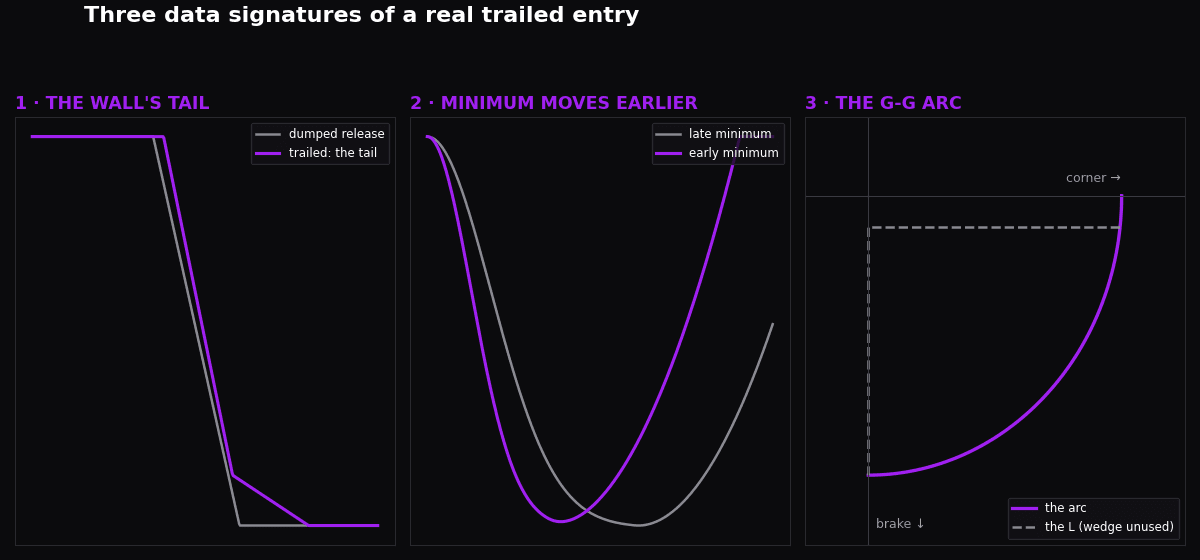
The braking wall's tail. On the speed trace, straight-line braking draws a wall that simply stops. Trail braking draws a wall that softens into a curve, speed still falling, more gently, as the corner begins.
A double dip, fall, flatten, fall again, is the opposite tell: a release that didn't hold, grabbed again mid-entry.
Minimum speed position. Trailed entries pull the minimum earlier in the corner. If your floor sits late and your exits feel like recovery, the entry is where the time went.
The G-G arc. Braking dots handing over to cornering dots through a curve instead of a corner. The empty wedge between braking and turning is unused grip, and it's the single clearest trail braking scorecard a kart produces.
Compare any of the three against a reference lap with the overlay method and the verdict takes one evening.
The drill: creep, don't leap
Trail braking is learned in metres, not in epiphanies.
Pick one corner, medium speed, decent runoff, nothing that feeds a long straight. Brake at your normal point, but release the last portion of the pedal progressively as you turn, instead of all at once before you turn. That's the whole change for session one.
Then creep. Each session, carry the release a metre deeper, and let the data grade the experiment. Did the wall grow a tail, did the minimum move earlier, did the lap time follow?
One corner, one metre at a time, with the verdicts written on the debrief sheet.
When the release feels natural at that one corner, add the next step. Keep the release shape you've built and move the first brake point a metre deeper, so the whole sequence shifts toward the apex.
Then repeat the experiment at a second corner of a different type. Same creep. New corner.
The skill transfers. The exact release point doesn't, and the trace will show you the difference.
Expect the rear to talk to you around the edges of the exercise, because the axle reports on every stage of the release. Under full pressure it feels hunched and heavy, committed to nothing but stopping. Through the first part of the release it goes quiet, which is the sign the grip trade is balanced.
Deeper in the entry the messages sharpen: a small wiggle is the boundary being found, the rear near its budget but still working. A sudden lightness means the budget is spent, and the next centimetre of brake is a spin.
If it spins, the creep jumped. Step back two metres and resume. Learning this vocabulary is the drill's real product, more than any single release point, and Blayze's trail braking guide teaches the same patience from the coaching side.
When not to trail brake
The honest section. The technique has limits, and the paddock arguments skip them.
Fast corners mostly don't want it. Stability beats rotation when commitment is the currency, and a flat or near-flat corner is a steering exercise, not a braking one, per karting corner types.
Wet first laps don't want it either, traction is too scarce to share between jobs, and karting in the rain runs on its own braking rules anyway.
And some corners simply pay better with a straight stop and an early rotation. The cash-out corner onto the longest straight is the clearest case, where a stable entry protecting the exit beats a heroic one. The technique is a tool, not an identity.
The deciding vote always goes to the stopwatch and the trace, never to the paddock argument. Which is fitting, because that's how the technique should have been settled all along.
FAQ
Is trail braking faster in a kart?
In slow and medium corners, usually yes, because it pulls the minimum speed earlier and opens the exit. In fast corners, usually no. The data signatures above settle it per corner, which beats settling it per argument.
Treat it as a per-corner verdict, not a philosophy. Some corners reward the trailed entry, the rest prefer a straight stop, and the trace sorts one group from the other faster than any paddock debate.
How is trail braking different on a rear-brake-only kart?
The trailing happens entirely on the rear tyres, which are also doing the cornering, so the grip budget is tighter and the release must be finer. Same principle as anywhere, smaller margins. KZ karts with front brakes get a more car-like, more forgiving version.
The drill is identical either way. Creep the release deeper one metre at a time and let the rear axle report back.
Why do I spin when I try it?
Too much brake held too deep, too suddenly. The drill is a creep, not a leap: release earlier than feels heroic, then move the release point deeper a metre at a time. If the spins persist at gentle settings, check the rear grip and setup before blaming the foot.
And give it sessions, not laps. The release is a fine motor skill, and those arrive with repetition rather than with one brave afternoon.
Can data really show trail braking without a brake sensor?
Yes. The braking wall's tail on the speed trace, the minimum-speed position, and the G-G arc together leave no room for doubt. A brake pressure sensor adds precision, not truth.
Most karting loggers never record a brake channel anyway. The three signatures are how the technique gets judged on a kart, with or without the extra sensor.
Alessio Lorandi started karting at six and won the 2013 CIK-FIA Karting World Championship. He raced through Formula 3, GP3 and Formula 2 before founding Purpl, an AI data coach for karting drivers.