Sector and Split Analysis: Breaking the Lap Into Pieces
Whole lap times hide where you're fast and slow. How I use sectors, splits and the theoretical best lap to find exactly which pieces need work.

A lap time is a verdict on sixty things at once. That's exactly why it teaches you almost nothing.
Sector analysis in karting is the fix. Cut the lap into pieces, time each piece, and suddenly the question stops being "was that lap good?" and becomes "which third of it was good?". Smaller questions get answered. Big ones get argued about in the tent.
This is the method I use, from three-sector splits down to single corners.
What counts as a sector
Official timing gives you three sectors, set by wherever the series planted its loops. Useful, but arbitrary. Your data logger doesn't care about loops.
With GPS you can define your own splits anywhere, and you should. The splits worth having follow the track's logic: one per corner complex, with the straights attached to the corner that launches them. A straight's time belongs to its exit. Time it that way and the data starts pointing at causes instead of symptoms.
Most analysis packages let you save these custom sectors per track. Build them once, reuse them every visit.
A note on words, since timing screens mix them freely. A split is the timing line itself, and a sector is the piece of track between two splits. Split times in karting usually means the cumulative time at each line. Same data, three vocabularies.
The theoretical best: your fastest lie
Stitch your best sector times together and you get the theoretical best lap. Every software computes it, and the maths is described well in Race Technology's technical note. The gap between it and your actual best lap is the most motivating number in karting.
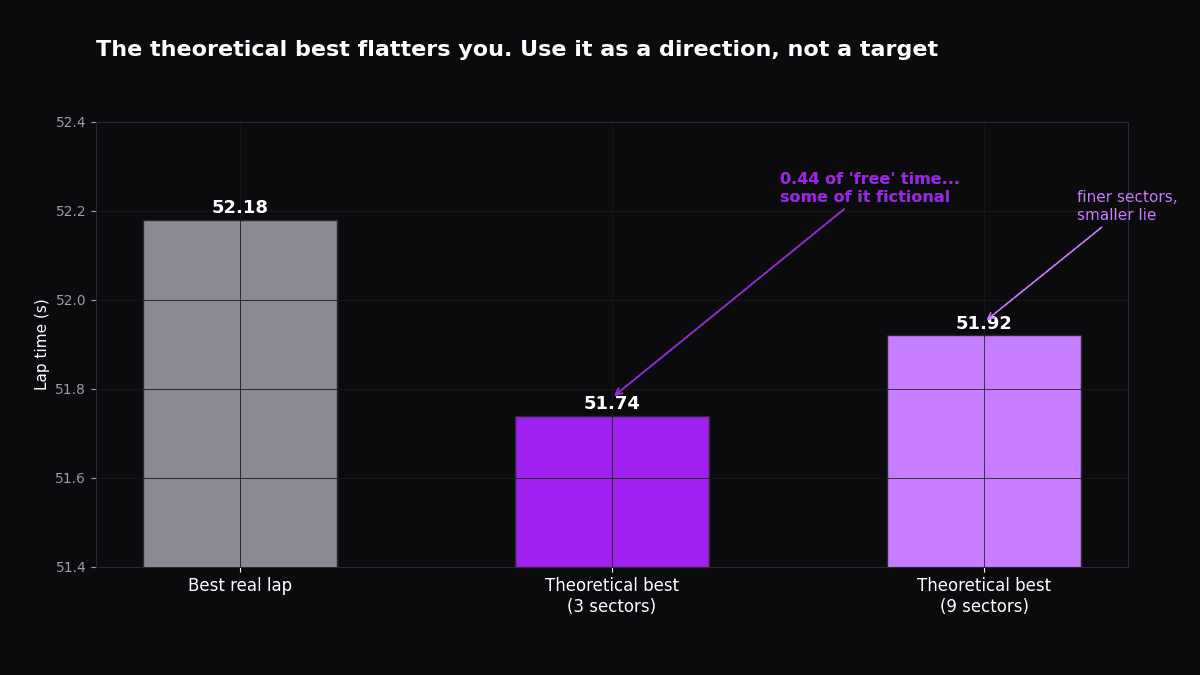
It's also slightly dishonest. Be aware of how.
Some sector combinations can't coexist on one lap. The line that wins sector two can compromise the entry to sector three, so a theoretical best built from coarse sectors flatters you a little. Occam's Racer wrote a good piece on what theoretical bests can and can't tell you, and the finer your sectors, the smaller the lie gets.
My rule of thumb from years of doing this: treat the theoretical best as a direction, not a target. If the gap is over three tenths at club level, you have a consistency project before you have a speed project, and that project lives in lap time analysis.
How I run sector analysis on a karting weekend
After each session, one table. Rows are laps, columns are my sectors, and the software highlights each column's best in green.
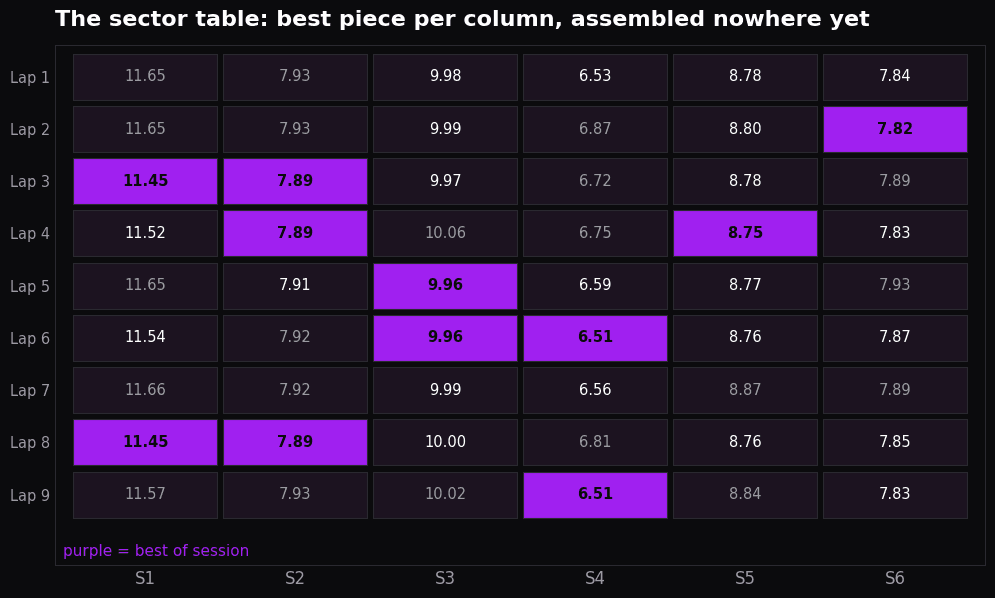
Three reads, in order. Which sector has the biggest gap between its best and its average? That's the inconsistent one, and it's the priority. Which sector's best came on a different lap than my best lap? That's hidden pace, already proven, waiting to be assembled. And which sector never varies at all? Leave it alone, it's done.
Then I go one level down. Take the worst sector and open the speed trace for just that piece, the reading method from how to read a speed trace. With a reference lap alongside, the delta time channel does the pointing for you.
Ten minutes, every session. The table tells you where, the traces tell you why.
Then write the worst sector's name somewhere you'll see it at the grid. A project you can see is a project that gets driven. Two sectors of homework per weekend is plenty.
There's no such thing as "doing it the same"
One belief ruins more sector work than any software limitation. The belief that a sector you nailed once is banked.
I learned this in a qualifying I still think about. My sector three on lap two, driven on tyres that weren't even at temperature yet, was good enough for the front row if I simply repeated it on lap three. I didn't repeat it. And here's the uncomfortable truth I took from that day: there isn't such a thing as doing a sector the same as before. You either do it faster or slower.
So a sector PB is not a possession, it's a data point. The job is making your average sector converge toward your best sector, which is the entire subject of lap consistency.
Rolling best: the honest version
Fixed sectors have a blind spot: they judge the lap at the boundaries someone chose. The rolling-best method removes the boundaries.
Take any distance window, say 200 metres, and slide it around the lap, asking at every position: what's my best time through this window across all laps? Plot that against my current lap and the weak spots appear wherever they actually live, even straddling a sector line.
A concrete version. Say your best lap is a 52.1. If your best time through the final 200 metres happened on a 52.6 lap, you've already proven a faster finish exists. Assemble it, don't invent it.
Not every karting package offers it under that name. You can approximate it with many small sectors, eight or ten instead of three. The finer the grid, the closer your theoretical best gets to something physically driveable, and the harder it becomes to hide a weak corner between two green columns.
Sectors as a race weekend weapon
Sector thinking isn't only self-analysis. It's scouting.
As a kid I'd watch other groups' sessions and pull their lap times from live timing. Not just the headline numbers. I wanted to know which corners my rivals were strong in, which ones they were slow through, and where they liked to overtake. By the final I had a map of everyone around me. Heck, I could have written a book about my rivals.
Live timing gives you sectors for every kart on track. If your main rival wins sector one every session and you win sector three, you know where to defend and where to attack before the lights go out. In the heats especially. Heat racing rewards knowing your rival's weak sector more than your own strong one, and most overtakes are planned two sectors before they happen. Most drivers never read past their own row. Their loss.
Sector thinking while you drive
The table is post-session. The skill it builds is mid-session.
One of the techniques that helped me most in my career is creating mental sticky notes. Memorise what went on in the previous lap, corner by corner, so you can adjust that exact corner on the next lap. It happens in fractions of a second while driving, and it's nothing more than live sector analysis run in your own head.
Data trains this. After enough evenings with the sector table, you start noticing mid-session which piece of the lap is drifting. The download then confirms instead of revealing. It costs nothing, and no logger measures it.
That's when the tool has done its real job.
Make the pieces talk to each other
One caution before you fall in love with the table. Sectors are connected, and karting punishes anyone who optimises them separately.
A heroic sector two that scrubs your exit speed sends a slower kart into sector three for the full length of its straight. The table shows green then red and you'll chase the red in the wrong place. When two adjacent sectors trade like that, zoom out and read the corner that joins them, usually with the overlay method.
The lap is still one thing. Sectors are how you study it, not how you drive it. That mindset, applied across every channel, is the spine of my data analysis routine.
FAQ
How many sectors should I use for karting?
Start with the official three for comparability, then build your own set with one split per corner complex, usually six to ten on a kart track. Fewer hides problems, many more drowns you in columns. The right number is the one where each split answers one driving question.
Is the theoretical best lap actually achievable?
Almost. Built from three coarse sectors it's a touch optimistic, because some sector combinations fight each other. Built from fine sectors it gets close to honest. Either way, drivers regularly get within a tenth of it once consistency improves, which is exactly what it's for.
Can I do sector analysis with just a stopwatch?
Roughly, yes: many tracks have natural markers and a helper can take splits. But GPS sectors are automatic, repeatable and free with any modern logger, and the comparison table is where the value lives. The fuller picture is in the karting telemetry guide.
Why is my best sector never on my best lap?
Because pushing for a whole lap forces compromises that a single flying sector doesn't. It's normal, and it's information: it tells you which corner you only get right when you mortgage the ones around it. Fix the compromise, not the sector.
Alessio Lorandi started karting at six and won the 2013 CIK-FIA Karting World Championship. He raced through Formula 3, GP3 and Formula 2 before founding Purpl, an AI data coach for karting drivers.