Math Channels: Derived Data That Makes You Faster
Math channels turn the data you already log into answers: combined G, corner radius, brake aggression, consistency. The five I'd build first, with formulas.
Your logger records maybe six channels. The fast questions usually live in a seventh one that doesn't exist yet.
That's what math channels are in telemetry: new traces you build out of the ones you already record. No new sensors, no new money. Just a formula that turns raw data into an answer, computed for every metre of every lap you've ever logged.
Car racing engineers live on these. Karting mostly ignores them, which makes them one of the cheapest edges left in the paddock.
What a math channel is
A normal channel comes from a sensor. Speed from GPS, revs from the ignition, temperature from a probe.
A math channel comes from arithmetic. You write a formula using existing channels as ingredients, and the software draws the result as if a sensor had recorded it. Acceleration computed from speed. Gear position computed from speed and RPM. Combined grip computed from two G channels.
The best way to think about them: every math channel is a question you've taught the software to keep asking. "Am I braking hard enough?" is vague at the kart stand and exact as a formula. And the formula never gets tired of asking, on every lap you'll ever drive.
Every serious analysis package supports them, whether you run Race Studio, Alfano's software or Unipro's. The engineering site Automotive Papers keeps a thorough review of the main math channels if you want the full menu, because arithmetic doesn't care about brands.
Five math channels telemetry beginners should build
Hundreds are possible. These five earn their place on a kart, in this order. Each one answers a question you've already asked yourself at the kart stand this season, which is the only test a math channel ever needs to pass.
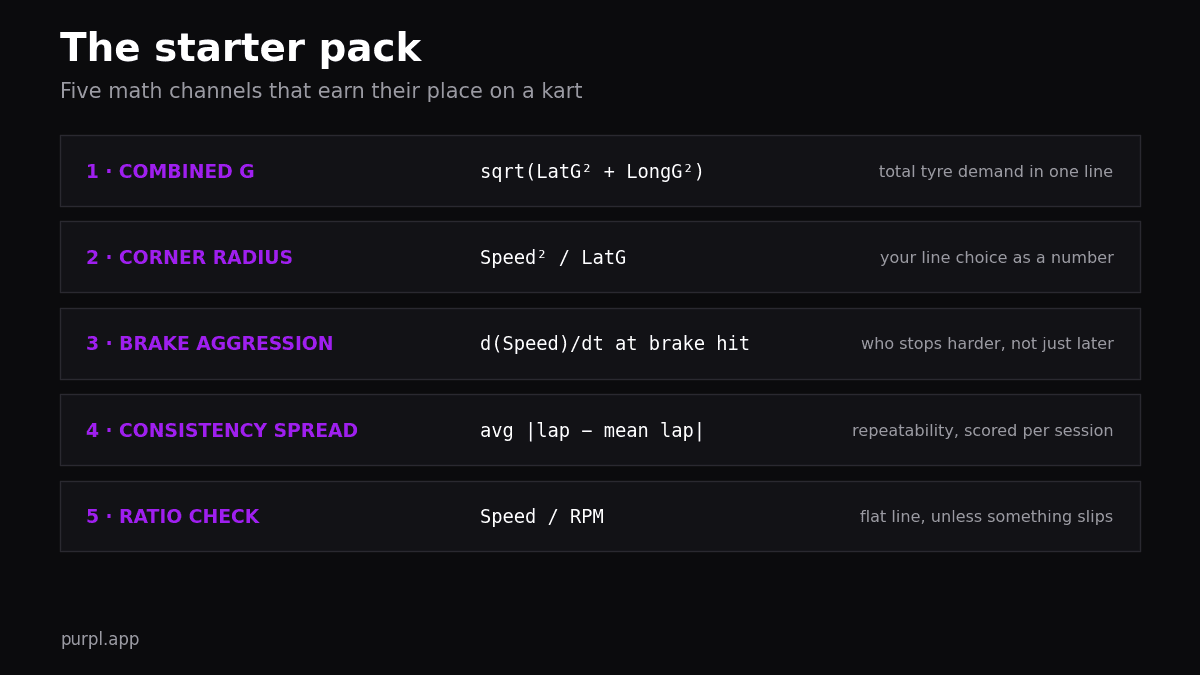
1. Combined G. The square root of lateral G squared plus longitudinal G squared. One line showing total tyre demand, the working version of the friction circle. Where it dips mid-corner-entry, you're leaving grip unused.
2. Corner radius. Speed squared divided by lateral acceleration. It redraws your line choice as a number, which makes two drivers' lines comparable without any video. Tight-radius spikes show pinched exits long before they show in lap time.
3. Brake aggression. The rate of speed loss in the first moments of braking. Two drivers can brake at the same metre and stop differently, and this channel is that difference. It's deceleration efficiency made visible, the data twin of braking technique.
4. Consistency spread. The average gap between each lap and your mean lap. One number per session that scores repeatability, the engine behind lap consistency.
5. Ratio check. Speed divided by RPM. On a single-gear kart this should be a flat line; slip, chain stretch and clutch problems all bend it. The reading method is in kart RPM data.
The spreadsheet confession
Let me tell you how unglamorous this can be, because the fanciest math channel I ran for years lived in Google Sheets.
At indoor rental sessions I'd ask for the printed sheet of my lap times. Then, on the days I wasn't lazy, I'd paste the laps into a spreadsheet and compute the average lap and the variance, basically the average delta between my lap times. One formula. The goal was simply to bring that number lower the next time out.
I'm pretty brutal about what it measures, too. If I can only put three or four laps within a tenth of my best, I'm not doing a good job. That's it. Consistency over twenty laps is an index of how good the driver is, and a derived number tracks it better than memory ever will.
That habit is a math channel in spirit: existing data, one formula, new answer. The software just automates the laziness problem.
And think about what that means. If a printed sheet of rental lap times can coach a world championship season, imagine what six logged channels and a formula editor can do. Most drivers own that laboratory already and use it as a lap counter. Don't be most drivers. The formulas are sitting right there.
And if you'd rather build these in a spreadsheet first, export is covered in exporting telemetry to CSV.
Building one without breaking anything
Every package hides the formula editor somewhere different, but the recipe is identical everywhere.
Create the channel, write the formula, set the units, and then sanity-check the result against one lap you know by heart. If combined G reads 4G mid-corner on a kart, you haven't discovered talent, you've mixed up units. Metres per second against km/h is the classic crime. Five minutes of sanity checking saves five weekends of believing a channel that was lying from the moment you wrote it, and yes, that estimate comes from experience.
Name them properly too. A season later, "ch_math_7" tells you nothing, while "BrakeAggression_v2" still explains itself. Treat formulas like setup sheets: dated, named, kept.
One more habit from the engineering world. Change one formula at a time, and keep the old channel until the new one survives a full weekend. It's the same one-change discipline as everywhere else in the data work.
Brake aggression between teammates
A quick worked case. Hypothetical numbers, but it's a pattern I've watched play out between teammates for years.
Two drivers brake for the same hairpin at the same marker board. Driver A's brake aggression peaks immediately and then tapers as he bleeds toward the apex. Driver B's builds gently to the same peak, two tenths of a second later.
Same braking point. Same peak force. Different shape, and the delta charges B for the difference at every single corner of every single lap.
Neither kart carries a brake pressure sensor. The whole verdict came from GPS speed, differentiated and smoothed. That's the quiet trick of derived channels: they manufacture sensors out of arithmetic, and the braking they exposed here is exactly the entry work from trail braking. B fixed it in two sessions once he could see it.
What I'd skip on a kart
Not every car-racing channel survives the move to karting.
Tyre slip needs wheel speeds we don't log. Aero channels need aero we don't have. Oversteer metrics want a steering sensor, which most karts only fit for serious testing programmes.
The five above need nothing beyond a standard logger. Master them before you go shopping for exotic inputs.
Where derived channels lie
Arithmetic amplifies whatever you feed it, including the garbage.
Differentiating GPS speed to get acceleration multiplies the noise, so a raw brake aggression channel looks like a seismograph. Smooth the input first, or the channel will diagnose problems your kart doesn't have. Corner radius goes wild at low lateral G, because dividing by a tiny noisy number produces nonsense; clamp it or ignore the straights.
And every derived channel inherits its parents' faults. A loose logger mount corrupts combined G, corner radius and brake aggression in one go, while both ancestors look merely untidy. When a math channel surprises you, audit the raw channels before believing it. The checking habit comes from the same place as the rest of my data analysis routine.
A worked example: finding a pinched exit
Here's the five-minute version of how these channels earn dinner.
The delta time shows a ramp building down the back straight. Speed trace says the exit was slightly slow, but the line looked fine from the seat. Corner radius says otherwise: a spike right at the exit kerb. That's the signature of a hand that tightened the arc to stay off the kerb instead of using all of it.
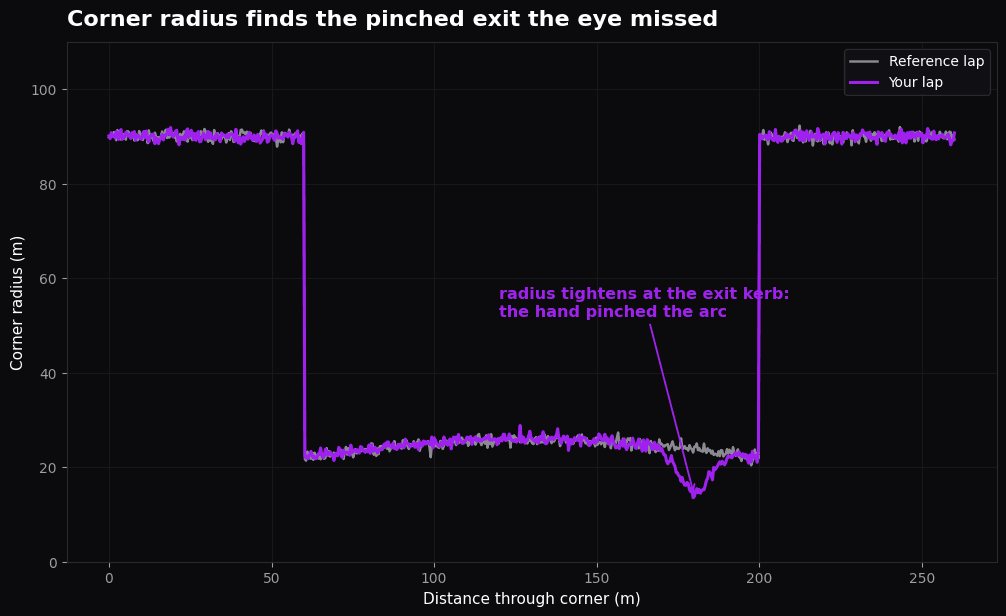
No video, no coach standing at the corner. One derived channel, one verdict, one thing to change next session. That's the trade these formulas offer, and it's why the PCA's data school keeps math channels in its core curriculum for club drivers.
FAQ
Do beginners need math channels?
Not on day one. Learn the speed trace and the delta first; they answer most questions. Build your first math channel the first time you catch yourself asking a question the standard channels can't answer, usually within a season.
Which math channel should I build first?
Combined G. It's one formula, it earns its keep on every track, and it teaches you the friction circle by making you watch tyre demand as a single line. Ratio check comes second the moment you suspect the clutch.
Can I do this in Excel or Google Sheets instead?
Yes, and it's a good way to understand the formulas before trusting software to apply them. Export the session to CSV, build the columns, sanity-check a lap by hand. The software version is just the same arithmetic without the copy-paste.
Are math channels legal in competition?
They're analysis, not hardware. The rules that restrict karting electronics concern what's on the kart and what transmits during sessions; what you compute on a laptop afterwards is your business. Check your series' technical regulations if you add sensors, not formulas.
Alessio Lorandi started karting at six and won the 2013 CIK-FIA Karting World Championship. He raced through Formula 3, GP3 and Formula 2 before founding Purpl, an AI data coach for karting drivers.