Kart Corner Speed: Why Radius and Grip Set the Number
Kart corner speed is set by radius and lateral g. In the model a 15 m arc at 1.5 g reads 53.5 km/h, and a wider arc raises it and takes longer to drive.
What does the corner speed on your trace tell you?
It tells you how tight your arc was and how much grip the kart gave you. Nothing more. The number is one sample, the lowest point of the corner on your GPS speed trace, and it comes from two inputs only: the radius you drove and the lateral g you pulled.
The relation is plain. Speed squared is lateral acceleration times radius. So once the line fixes the radius and the grip fixes the g, the speed is already decided. It is a result, not a skill, and that is why chasing it as a number goes wrong.
Everything below comes from a model of a KZ shifter on an OTK chassis. It is not a measurement of a real kart, a driver or a day. I chose the radius and the g as inputs, and "calculated" means the number follows from those inputs by arithmetic.
How much do radius and grip move the number?
A 15 m arc at 1.5 g gives a calculated minimum speed of 53.5 km/h. Mass does not enter into it: I took the driver from 70 kg to 150 and to 190 kg and the speed did not move.
| Arc radius | Minimum speed at 1.5 g (calculated) |
|---|---|
| 10 m | 43.7 km/h |
| 12 m | 47.8 km/h |
| 15 m | 53.5 km/h |
| 17.5 m | 57.8 km/h |
| 20 m | 61.8 km/h |
Ten metres of radius is 18 km/h on the trace. Now hold the radius at 15 m and move the grip from 1.0 g to 1.5 g: the number goes from 43.7 to 53.5 km/h.
And here is the catch. A 10 m arc at 1.5 g and a 15 m arc at 1.0 g both come out at 43.7 km/h. Same number, a different corner.
What does the number hide?
It hides which of the two you changed. Radius and grip are folded into one figure, so speed alone cannot tell you whether you found grip or just drove a wider arc.
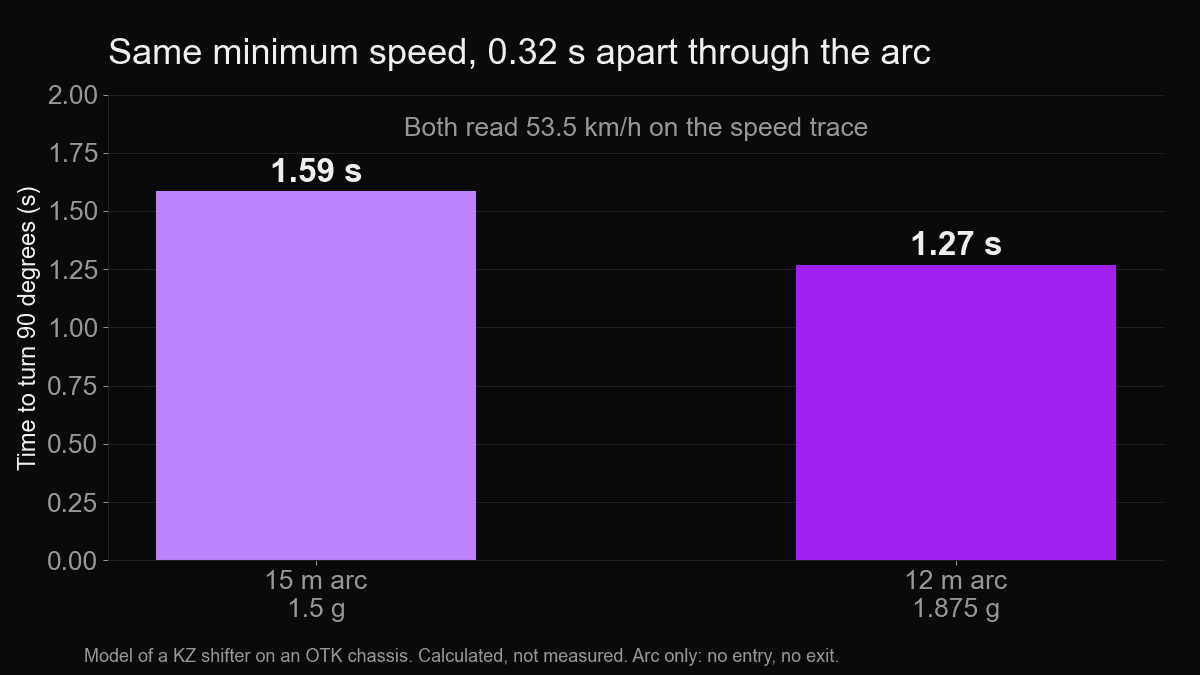
Take two laps that both read 53.5 km/h. One is a 15 m arc at 1.5 g. The other is a 12 m arc, and to give the same speed on a tighter arc it needs 1.875 g, which is 25 percent more lateral g. The tighter lap also needs a yaw rate of about 71 degrees a second against about 57 (calculated). The model estimates the inside rear carries about 5.8 kg on the tight lap against about 11 kg on the wide one, resting on an estimated centre of gravity height.
Whether a kart can really give 1.875 g on a given day is a grip question. The tyre grip in the model is a placeholder, so I will not answer that from it. Your logger can: the AiM MyChron 6 user guide lists lateral acceleration among its GPS channels, and that is the other half of the friction circle, which I explained in the friction circle for karting.
Is a higher minimum speed always faster through the corner?
No. Put the arc on the clock. For a 90 degree turn at constant radius and speed, the time is 90 divided by the yaw rate the corner needs, which the model gives as a derived number.
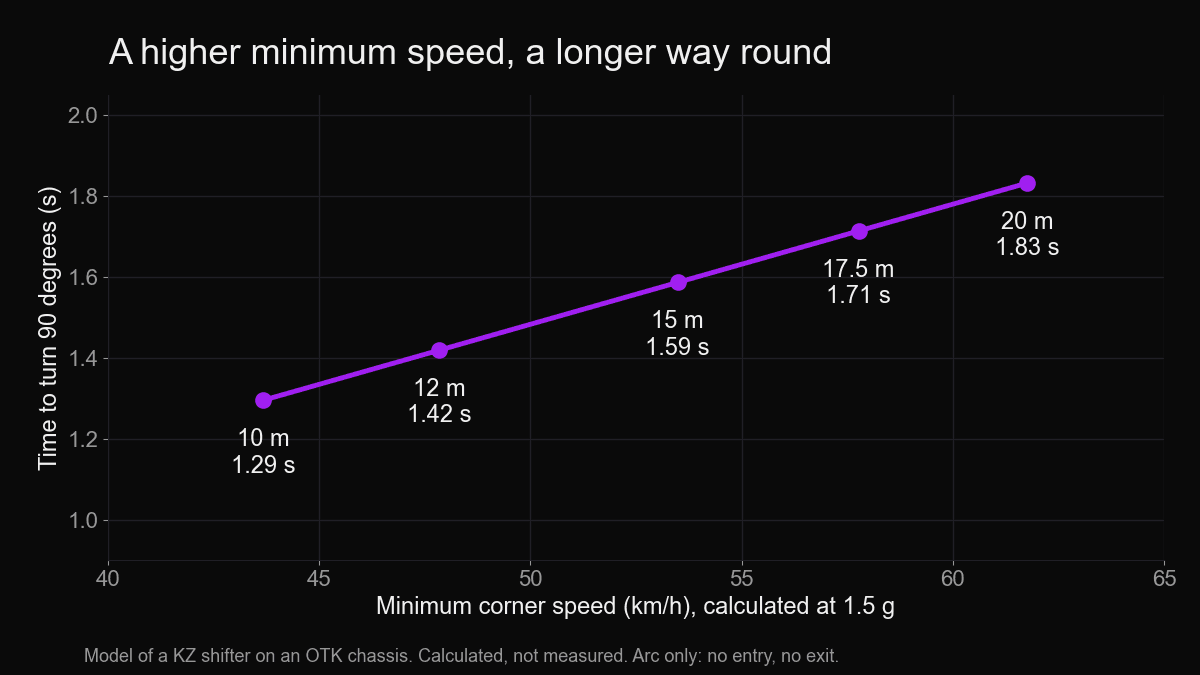
At 1.5 g a 10 m arc takes 1.29 s and a 20 m arc takes 1.83 s. The wide arc has a minimum speed 18 km/h higher and takes 0.54 s longer. Distance grows with the radius, and speed only grows with its square root, so the distance wins.
I put it this way in one recording: "the equation of time is distance divided by speed". The goal is the highest speed with the least distance. If your speed is the same and you are just making too many metres, you try a different line.
But that is an arc on its own, with nothing before it and nothing after it. A real corner joins a braking zone and a straight. A wide arc is also how you carry speed out onto that straight, and that part is in corner exit speed. I have said both things in different places. Open the arc on the entry and the exit and keep it tight in the middle. And when two corners go in opposite directions, like a chicane, the tighter line often pays even if the minimum speed drops. Which one wins depends on what comes after the corner.
The model also holds speed constant through the turn-in, so any speed you lose getting into the corner is not in these numbers. Treat the table as the shape of the trade, not a lap time.
What should you read next to minimum speed in your own data?
- Lateral g at the same point. With speed and lateral g you get the radius: speed in metres per second, squared, divided by lateral g times 9.81. Put the model's own 53.5 km/h and 1.5 g in and 15 m comes back. So a higher minimum at the same lateral g means a wider arc, not more grip.
- Where the minimum sits, and the shape around it. A round bottom and a sharp one are different corners at the same number. How to read a speed trace goes through the shapes, and rolling speed says why a kart wants speed through the middle.
- Speed 50 or 100 m after the corner. That is where the minimum pays or does not pay.
- Delta time. It is the only judge that counts metres and speed together. A higher minimum that does not show in delta time is a number, not time.
One more thing on the number itself. A 25 Hz GPS gives you one sample every 0.6 m at 53.5 km/h, and the minimum is the lowest sample, so it is a point on a curve and not the curve.
How to open the arc from the seat, with real Lonato numbers, is the technique side and I wrote it up on Senndit: minimum corner speed, what your telemetry is telling you.