1T vs 2T Loggers: What a Second Temperature Channel Tells You
1T means one temperature input, 2T means two. What the second channel actually buys you, who needs it, and the upgrade question answered honestly.
Every logger brand sells the same confusing pair. A 1T version, a 2T version, and a price gap between them.
The 1t vs 2t kart question is simpler than the catalogues make it. T means temperature input. A 1T logger reads one temperature sensor, a 2T reads two at the same time.
That's the entire difference, across every brand that uses the naming. Plain and simple.
The real question is what you'd do with a second temperature. So that's the question this article answers.
What the one channel does on a 1T
With one input, the choice makes itself. Water temperature on a water-cooled engine, head temperature on an air-cooled one.
That single channel covers the health-and-cooling job completely. You get the target, the curtain habit, and the session shapes from kart water temperature, or the air-cooled version of the story from CHT versus water temp.
What you don't get is the engine's mixture story. The cooling channel says how hot the engine is running. It can't say why.
What the second channel is really for
In practice, the second input has one overwhelming use: EGT.
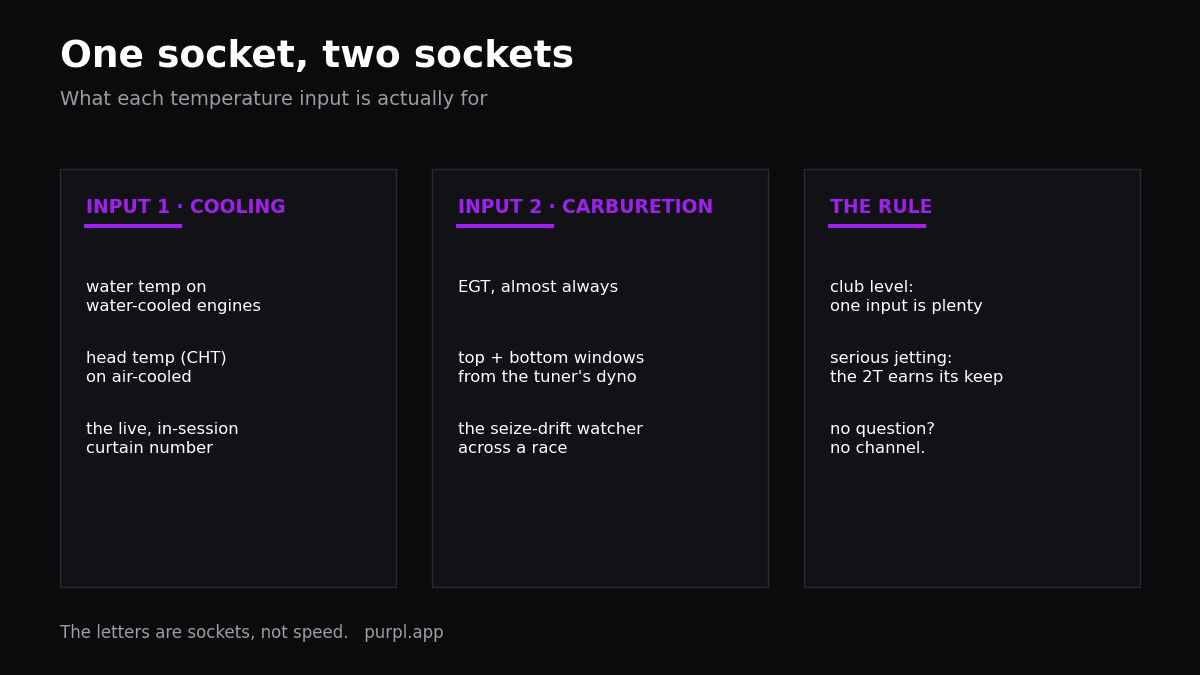
Water plus exhaust temperature is the classic 2T pairing on a two-stroke. The water channel guards the cooling system, the exhaust channel guards the carburetion, and together they cover the two ways a kart engine gets hurt.
One sensor watches the radiator's work. The other watches the jetting. Health and mixture.
That second story is the one that changes your tuning. The whole top-and-bottom reading method in the kart EGT guide only exists once you have the input to feed it. And the seize-risk drift across a race is invisible without it.
Air-cooled classes run the same logic with different sensors. Head temperature in the first slot, EGT in the second, same division of labour.
Who actually needs 2T
Borrow the club-versus-international rule from the sensor stack.
At club level, the trio is tyre pressure, water temp and RPM for the sprocket, and one temperature input covers that life completely; the money saved is seat time. Nobody loses a club final for lack of a second thermometer.
The 2T case starts the day carburetion becomes a managed variable. If you're jetting seriously, racing where seizures are a real budget line, or working with an engine tuner who names EGT windows, the math flips.
The second channel stops being an upgrade. It becomes the tool the conversation runs on.
A decent shortcut question: has anyone ever asked you what your EGT was? If yes, you're a 2T user already, just without the input. Simple test.
Still unsure? Run a hypothetical club Saturday with each box and watch where the decisions come from.
With a 1T, the day carries one heat job. Warm-up, glance at the water number, adjust the curtain, forget it until the next session, and every other call (sprocket, pressures, lines) comes from RPM and the speed trace.
Nothing about that day feels under-equipped. The questions being asked all have answers. The spare money went on tyres and track time.
Now give the same driver a 2T with an EGT probe fitted. The water routine doesn't change at all. What changes is the time between sessions, because the laptop now holds an exhaust trace, and the jetting chat runs on readings instead of plug colour and gut feel.
Same kart, same track, one extra story. And the order matters: the second channel only improved that Saturday because a carburetion question was already on the table. Give it to a driver who isn't asking one, and it's another line on a screen nobody opens.
No question, no channel.
The upgrade math, honestly
Three situations, three different answers.
Buying your first logger new? Take the 2T if the gap is small, because you're buying the option to grow and the channel costs less as a bundled input than as a later regret.
Buying used? A clean 1T at a good price beats a tired 2T. GPS and RPM quality matter more than the spare input, per the buying logic in kart data loggers explained.
The used market deserves a longer look, because that's where most first loggers come from. Sellers price the letters. Buyers should price the condition.
Check the GPS lock, the RPM lead and the connectors before you even think about sockets. Check the battery holds a charge too; data logger battery care covers what tired cells do to a race weekend. A second temperature socket fixes none of those problems.
Condition first. Letters second.
Already own a 1T and wondering: don't upgrade for the badge. Upgrade when a real jetting question is waiting for the answer, the same buy-the-sensor-after-the-question rule from kart sensors explained.
And remember the channel is only the socket. The probe, the reading habit and the tuner's targets are the actual purchase, and the catalogue never mentions those.
The probe is its own line on the bill. An EGT thermocouple, the fitting to mount it, and a wiring run that has to survive heat and vibration the whole way along the chassis. None of it ruinous, none of it free.
And the habit costs more than the hardware. A channel nobody opens after the session is dead weight, whatever it measures.
If the laptop routine isn't there yet, build it on one temperature first. A second number won't create the discipline; it just gives the missing habit more room to hide.
Reading two temperatures without drowning
Two channels means two jobs, and they're easier kept apart.
The cooling channel is a live, in-session number: glance, adjust the curtain, move on. The EGT channel is mostly a laptop number: top and bottom windows, logged per session, read as trends. Different rhythms, different screens.
The one moment they work together is diagnosis. Water creeping up while EGT climbs too points at mixture leaning; water up while EGT sits steady points at the cooling system.
The disagreement trick from the temperature comparison works for any two heat channels, this pair included.
Log both in the session sheet, colour-coded against their windows. Thirty seconds, and the weekend's heat story is one glance, the habit behind the whole karting telemetry method.
The confusion the catalogues created
A last word on why this question gets asked so much.
The 1T/2T naming spread across brands without anyone explaining it, so forums fill with drivers asking whether they bought the wrong box. Community threads like KartPulse's logger-choice discussion show the pattern weekly: the letter gets treated like a performance tier when it's just a socket count.
It's an easy mistake. Bigger letter, bigger price, surely a faster box. But a logger doesn't make speed; it records evidence, and the channels that hold the most evidence come standard on both versions.
It isn't a speed decision. A 1T logger with a driver who reads the speed trace beats a 2T gathering dust, every weekend of the year.
Buy the channels your questions need, plug in the probes properly per the installation guide, and let the catalogue letters mean exactly what they are. Sockets.
FAQ
What does 1T and 2T actually stand for?
One temperature input versus two. Nothing else differs by definition, though some brands bundle extras into the bigger model, so check the spec sheet for what changed beyond the socket before paying for letters.
The same logic runs through the rest of the spec-sheet alphabet, by the way. Letters describe inputs, not speed. A box that reads more things is only better when you'd actually read them.
Which two temperatures should a 2T run?
Water-cooled two-stroke: water plus EGT, the cooling story and the carburetion story side by side. Air-cooled: head temp plus EGT, same logic. Running two cooling sensors and no carburetion channel wastes the slot.
The discipline matters more than the wiring order. One number gets read live for cooling, one gets read on the laptop for jetting. Keep those two jobs separate and the pair stays useful.
Can I add EGT to a 1T logger?
Only by giving up your cooling channel, which is a bad trade on race day. Swapping probes between sessions for special tests works in a pinch; managing an engine on EGT alone with no cooling number doesn't. If the EGT question is real, the second input is the honest answer.
Price the move honestly before committing either way. By the time you've bought a probe and rewired the loom around one socket, the step up to a proper second input often looks smaller than the catalogue suggested.
Is 2T worth it for a cadet or junior?
Usually not yet. Cadet engines are managed by the team's tuner, and the young driver's data time is better spent on the speed trace and consistency numbers.
The second channel earns its place when the family starts owning the jetting decisions. It's a budget call, covered in beginner guides like the KartPulse cadet setup thread.
Alessio Lorandi started karting at six and won the 2013 CIK-FIA Karting World Championship. He raced through Formula 3, GP3 and Formula 2 before founding Purpl, an AI data coach for karting drivers.