EGT in Karting: Using Exhaust Temperature Data to Jet Right
EGT is the carburettor's thermometer. How to read kart exhaust temperature at the bottom and the top, the driving-style trap, and the seize-risk drift.
Every two-stroke karter lives between two fears. Too rich, and the engine is soft, dirty, slow. Too lean, and somewhere out there a seizure is waiting with your name on it.
The kart EGT sensor exists to manage exactly that trade. A probe in the exhaust reads the temperature of the burn, and the burn tells you where your carburetion really is, lap after lap, corner after corner.
It's the carburettor's thermometer, and at serious level it's not optional anymore. Here's how I read it, including the two traps that catch almost everyone.
What the probe actually measures
The sensor is a thermocouple sitting in the exhaust header, close to the cylinder. It reports the temperature of the gas leaving the engine, many times a second, straight into your logger.
The chemistry is simple enough to trust. A richer mixture burns cooler, because the extra fuel soaks up heat. A leaner mixture burns hotter, right up to the point where hot becomes dangerous.
Why does extra fuel cool the burn? Because fuel has to turn to vapour before it burns, and that change eats heat. Run lean and there's less fuel doing that job, so more of the heat of the burn stays in the gas on its way past the probe.
So EGT moves opposite to fuel. Temperatures climbing means mixture leaning, and your margin shrinking. That's the whole principle.
The skill is in which numbers you watch, and when you're allowed to believe them.
Reading kart EGT: two numbers, not one
The biggest beginner mistake here is reading one temperature. It's two.
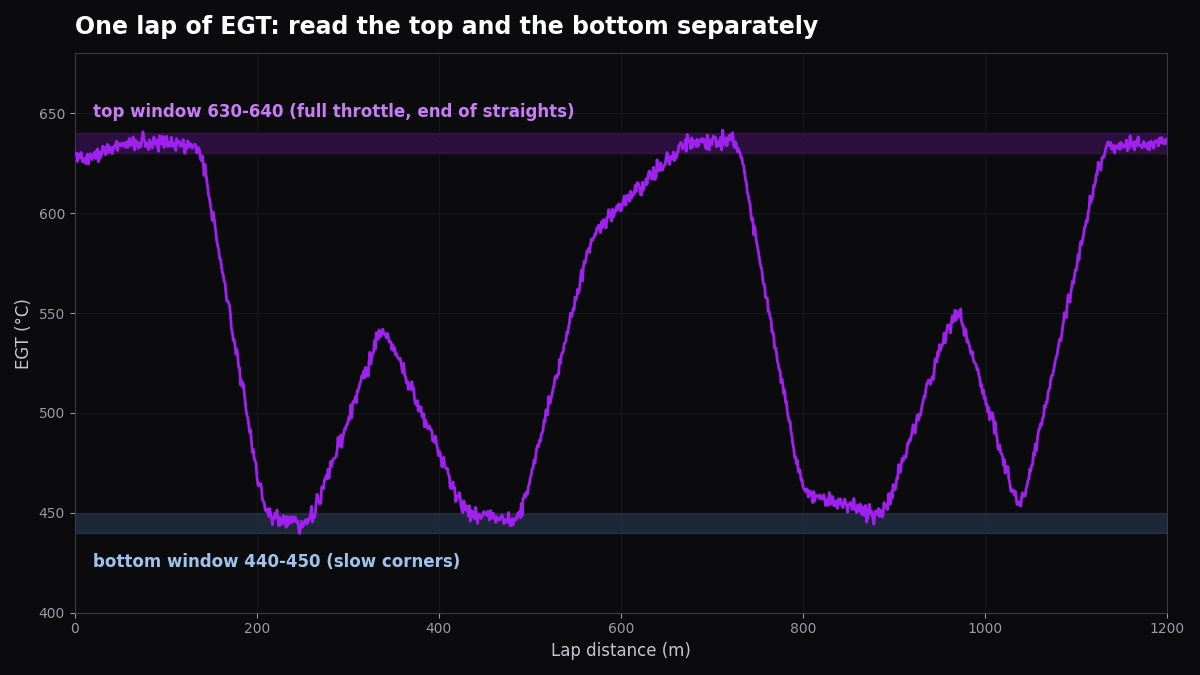
The maximum, reached at full throttle down the straights, describes your carburetion at the top of the rev range, and the minimum, in the slow corners, describes the bottom.
They answer different questions. They're tuned by different adjustments. And they need to be logged separately, never averaged.
The targets come from your engine tuner's dyno hours, and they're specific to your engine and fuel. To give you the shape of it with our numbers: a window of say 630 to 640 degrees at the top. Not so rich you lose power, not so lean you risk seizing.
And say 440 to 450 at the bottom; once the tuner names them, those values become the north star, exactly like the 50 degrees of water temperature.
Treat those as examples of the framing, not as your targets. Your tuner's numbers beat mine, every time, and the wider window idea is mapped in kart sensors explained.
Now make it practical. Say your tuner names the windows, and your straight-end maximum starts creeping above the top one. That's a lean warning at high revs, even if the bottom number is still sitting pretty.
Or say the bottom number sits low while the top is fine. That's a rich bottom end: dirty pickup off slow corners, nothing dangerous, just slow.
Two numbers. Two separate conversations with the carburettor.
The driving-style trap
Here's the trap that wastes the most carburettor adjustments in any paddock. By a distance.
EGT lines are heavily driving-style related. Two karts with identical carburetion will draw different EGT traces if the drivers pick up the throttle at different points. The burn follows the right foot as much as the fuel.
I've sat with drivers convinced their jetting was wrong because their EGT line split from their teammate's. Then I showed them. Wherever both karts went to throttle at the same moment, the temperatures matched exactly.
So the comparison rule is strict. Judge carburetion against another kart only where the throttle behaviour matches, ideally at the end of the straights where everyone is flat.
Mid-corner EGT differences are usually driving differences wearing a carburettor costume, and they're the same confusion filed under mistake seven in my list of data analysis mistakes.
The drift that seizes engines
Carburetion isn't a set-and-forget number across a race. It drifts, and the drift has a direction.
As laps go by and grip comes up, the driver naturally gets on the throttle earlier and harder. More throttle time means the mixture runs effectively leaner and leaner. In categories like OK and KZ2, that drift is exactly how engines get seized in the final third of a race.
The EGT trace shows it as a ceiling that creeps upward, lap after lap.
Which is why starting slightly rich is the classic race setup: you suffer a dirty first response early, and the engine cleans up as the race leans it. The sweet spot arrives mid-race instead of the danger zone arriving at the flag.
Start lean and the same drift works against you, with much worse failure modes. Rich is patient. Lean is not.
What does a healthy stint look like on screen? Peaks that sit inside the window and stay put, lap after lap, maybe edging up a touch as grip builds. Boring is good here.
An unhealthy stint is a staircase. Each lap's peak a little higher than the last, no flattening, and the minimum climbing with it. When the whole trace migrates upward together, blame the mixture, not the driving.
Watch the trend across the stint, not just the lap. A rising EGT ceiling is the engine telling you tomorrow's jetting, and the hardware levers live in jetting by the numbers.
The ear test still works
One old-school habit I refuse to retire, even with a perfect EGT trace on the dash.
You can hear a lean engine. The sound shifts, gets just a bit too loud and hard-edged, and that note told me more than once that the engine was struggling toward the edge of seizing.
The response is immediate and free. Richen the carburetion, or do the ancient karting move of putting a hand over the carb down the straight to force it richer for a moment.
The sensor confirms what the ear suspected, a few seconds later, in degrees. Use both. The ear is real-time and the probe is precise, and the combination is how two-stroke drivers survive hot afternoons.
Can you train the ear? Yes, and the safe way is to practice on days when you know the engine is rich. Learn the round, slightly flat note of a fat mixture on those safe days, so the hard edge of a lean one stands out the moment it appears.
Listen in the same place every lap, ideally the second half of the main straight. And use the ear in one direction only. A suspicious note earns a richer setting or a hand over the carb, never a leaner one.
Setup and comparison discipline
Three habits make the channel trustworthy.
First, mount the probe at the distance your engine builder specifies. Never compare absolute EGT numbers with a kart whose probe sits at a different distance. Placement changes the reading.
Second, log minimum and maximum separately in your session sheet, the routine from the sensors hub. Third, when something looks wrong, check the basics. A loose probe or tired connector draws drama better than any real problem, per installation discipline.
Here's my session routine for this channel. Glance at the dash max on the in-lap. Then write two numbers in the sheet before anyone touches the kart: the EGT maximum and the minimum.
That's it. Do it after every run, morning practice included. No exceptions.
The early numbers look harmless, but grip builds through the day, throttle time grows with it, and the same lean drift quietly works across the whole day too.
Cross-check the straight-end reading against revs while you're at it. EGT and RPM read together tell you whether the engine is healthy and pulling, the pairing I walk through in kart RPM data.
For the practical carburettor side, TKART's carburetion tools guide is solid. And the KartPulse EGT and carburetion thread shows real drivers working through real traces, useful calibration for what normal confusion looks like.
EGT or lambda?
Honest answer: I prefer lambda, because it measures the mixture directly instead of inferring it from heat, and the information is simply more accurate.
But EGT is cheaper, tougher, and everywhere, which is why it remains the standard tuning channel in most paddocks. Run EGT until your programme is serious enough to want the sharper tool, then read the lambda sensor guide before spending. Plenty of top tents run both and let them check each other.
FAQ
What should my kart EGT be?
Whatever your engine builder's dyno work says for your engine, fuel and pipe, read as separate top and bottom windows. Published numbers vary too much across classes and probe placements to borrow safely.
If you have no tuner numbers yet, log a known-good session and treat it as your baseline. Then judge every later session against that baseline. The trend is the information.
Why does my EGT differ from my teammate's with the same jetting?
Almost always driving style: different throttle pickup points produce different burns from identical carburettors. Compare only where you're both flat out.
If the numbers still differ at the end of the straight, check probe placement before touching a jet. Same engine, same fuel, same probe distance: only then do the absolute numbers earn a conversation.
Is a falling EGT at full throttle good news?
Usually the opposite of what it looks like. If peak temperatures sag while everything else is constant, don't celebrate. Suspect the reading or the engine: a tired probe, a connector, or combustion that's gone wrong.
Investigate before the next session, not after. Sensors fail far more often than engines, so start at the cheap end of the list.
Does EGT replace the water temperature channel?
No, they watch different systems. EGT guards the mixture, water temp guards the cooling, and a hot day can push both for different reasons.
The pairing, plus RPM, is the core two-stroke dashboard, as covered in the karting telemetry guide. Read them together at the end of each session, next to your lap times, and the engine has very few ways left to surprise you.
Alessio Lorandi started karting at six and won the 2013 CIK-FIA Karting World Championship. He raced through Formula 3, GP3 and Formula 2 before founding Purpl, an AI data coach for karting drivers.