Kart Water Temperature: What's Normal and What Your Data Says
Around 50°C is the north star, 56°C is lap time given away. Normal kart water temperature by class, the curtain habit, and overheating signatures in data.

Water temperature is the rare karting number with an actual target. Not a feeling, not a range of opinions. A number, on the dash, that you can hit or miss every single lap. Most drivers miss it.
For most water-cooled two-strokes that number sits around 50°C. Kart water temperature is the channel you manage live, lap by lap, with your own hand on the radiator curtain. Get it right and the engine gives everything it has. Sit at 56 and you've given lap time to charity.
Normal has a shape, chasing it has a method, and trouble has its own signature in the data.
What normal actually is
The engine community broadly agrees on this one, which is rare enough to enjoy.
Around 50°C is the working answer for water-cooled two-strokes. KZ engines like 48 to 52. Rotax names roughly 50 as the point where friction losses bottom out and mechanical efficiency peaks. Push past the mid-fifties and power starts falling, with real damage territory beyond that. TKART's radiator curtain guide collects the manufacturer numbers if you want them by engine.
Your engine builder's number beats any article's, including mine. But if nobody has given you one, 50 is the north star to chase until they do.
The curtain: temperature is a driving job
What surprises people coming from cars is that on a kart, the driver IS the thermostat. Literally.
The radiator curtain slides up and down, and adjusting it lap by lap, eyes flicking to the dash on the straight, is part of the job description. Curtain up, less airflow, temperature climbs. Curtain down, more cooling. Cold day, you'll run it high; summer final, probably fully open. It becomes automatic with seasons, the way shifting gears does, until you find yourself adjusting the curtain out of instinct the moment the air changes temperature in the afternoon.
Forget it and physics collects, with interest. A teammate of mine once left the curtain fully up on a summer day, and the engine reached about 100°C. The tuner was furious, and fair enough. The thing was about to melt, and every lap before the dash got noticed was slower than it needed to be.
Reading water temperature in the data
On the laptop, I read one number and three shapes.
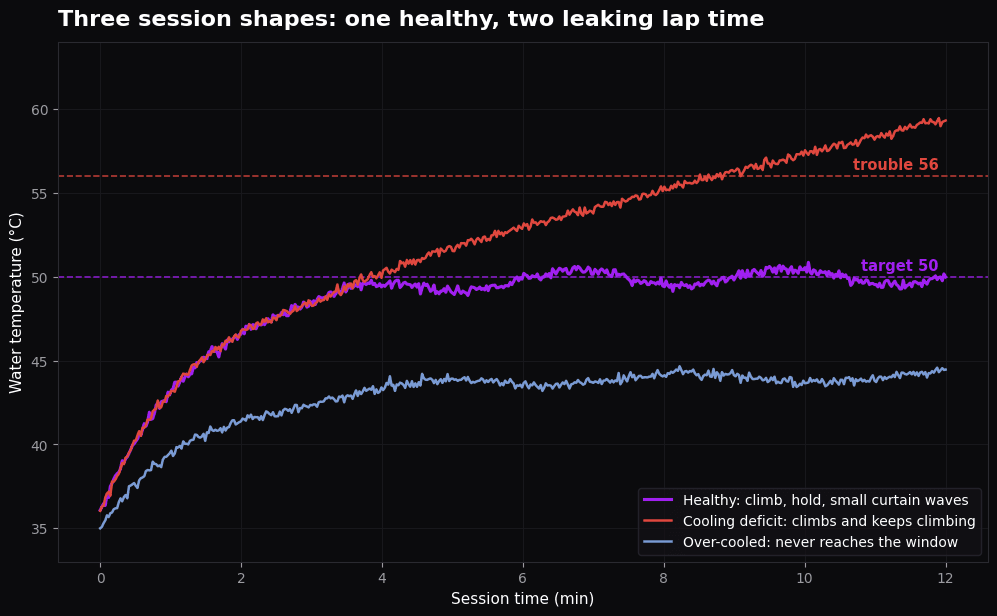
The number: average water temperature across the fastest lap. Minimum and maximum alone mislead, so if the lap swings between 50 and 52, log it as 51. That's the value that goes in the session sheet, next to pressures and EGT.
The shapes. A healthy session climbs briskly to target and holds flat, small waves where the curtain moved. That sawtooth isn't a problem, by the way. That's what a driver doing the job looks like. A line that climbs and keeps climbing is a cooling deficit: curtain, radiator angle, or a system needing attention. And a line that never reaches target is the sneaky one. An over-cooled engine runs below its efficiency window and drags lap time without ever triggering anyone's alarm.
Cold is a real cost, not a safety margin. Friction losses rise, carburetion reads get confusing, and winter mornings need the curtain doing real work. TKART's cooling system guide covers the hardware levers beyond the curtain.
When the temperature moves and it isn't the weather
Water temp also moves for racing reasons, and knowing them saves wrong conclusions.
Sit in a slipstream and the engine runs warmer with less cooling air. In summer races that's real: following too long has a thermal price on top of the tactical one. Lean carburetion runs hot, which is why a creeping water temp sometimes points at the jetting before the radiator. And a long first stint on a green track works the engine harder than the same laps on rubber.
So before blaming the cooling system, check the context channels: where you were on track, what the EGT was doing, what the day was doing. Temperature is a symptom channel. The cause is usually somewhere nearby.
The summer and winter playbooks
Two seasons, two fights with the same number.
Summer is a fight to stay cool: curtain fully open, kart out of slipstreams when you can, and an eye on the dash from the warm-up lap. On the worst days teams add cooling hardware, but for most of us the curtain and the line through traffic are the tools.
Winter is a fight to get warm at all. Curtain high, maybe tape on part of the radiator, and patience on the out lap while the number climbs. The trap is a first flying lap driven on a cold engine that won't pull, then a setup hunt for a problem that was just 38 on the dash.
Both fights are won the same way. Watch the number, move the curtain, log the result. Repeat.
When the sensor is the problem
Every so often the scary number is fiction. Check before you panic.
A sensor working loose in its well, a connector wicking water after a wet session, or a unit that simply drifted will all draw convincing nonsense. The tells: temperature jumping in steps rather than curves, readings that ignore the curtain entirely, or a value that disagrees with a heat gun at the radiator by ten degrees.
Placement matters too. A probe at the cylinder head exit reads hotter than one at the radiator return, so know which yours is before comparing numbers with the tent next door. Install discipline is covered in data logger installation, and the air-cooled classes' equivalent conversation in CHT versus water temp.
Three numbers to memorise
If you keep only three numbers from this whole article, keep these.
50, the working target for most water-cooled two-strokes. 56, the line where power is already leaking away and the day has started going wrong. And 100, the number my teammate's dash showed with the curtain forgotten, the number you never want to meet.
Everything else in this article is technique for staying near the first one.
What it does to the engine, in plain words
Why is the window so narrow? Two effects pulling in opposite directions.
Run too cold and the oil and metal sit below their happy range, friction goes up, and the engine wastes part of its own power fighting itself. Run too hot and the mixture leans out, power fades, and the margin to real damage starts shrinking fast.
The sweet spot near 50 is simply where both losses bottom out. That's why tuners chase it so hard, and why a few degrees either side is worth real lap time, not decoration on a dash.
None of that needs memorising. It just explains why the curtain habit pays.
The habit that makes the channel pay
Water temperature rewards exactly one routine, and it costs thirty seconds.
Every session: log the average from the fastest lap into your sheet, note the curtain position and the air temp beside it. Within a few weekends you own a private map: this engine, this radiator, wants this curtain at this weather. After that the dash glance becomes confirmation instead of discovery, and the full sheet system lives in the data starter sheet.
That's the whole channel. One target, one curtain, one logged number per session. The rest of the sensor family is mapped in kart sensors explained.
FAQ
What is a normal water temp for a kart?
Around 50°C for most water-cooled two-strokes, with KZ engines happiest at 48 to 52 and trouble starting in the mid-fifties. Always defer to your engine builder's target; the published numbers are starting points, not scripture. Plenty of tents tape the number to the wheel, and honestly, it works.
Why does my kart run cold even with the curtain up?
Winter air plus a generously sized radiator simply out-cools the engine. Beyond the curtain, the usual steps are partially masking the radiator or fitting a thermostatic valve where the class allows it. Running 10°C under target all day is lap time lost, so treat it as a real problem. Log the cold mornings too: they teach the curtain map faster than the easy days do.
Does water temperature affect lap time directly?
Yes, through engine efficiency. Too hot loses power outright and risks the engine; too cold raises friction losses and muddies carburetion. The window is narrow and the gains are real, which is why serious drivers manage it lap by lap instead of discovering it in the data afterwards.
Where should the water temp sensor be mounted?
Wherever your engine manual specifies, and consistently. Head-exit readings run hotter than radiator-return readings, so the location changes what "50" means. Pick one, calibrate against a heat gun occasionally, and never compare absolute numbers with a kart plumbed differently. When in doubt, trust the heat gun over the dash.
Alessio Lorandi started karting at six and won the 2013 CIK-FIA Karting World Championship. He raced through Formula 3, GP3 and Formula 2 before founding Purpl, an AI data coach for karting drivers.