How to Get Into Kart Racing: The Complete Starter Guide
From first rental session to your first championship: the ladder, the real costs, and the honest odds, from a karting world champion who climbed it.
Everyone in motorsport started somewhere. And almost everyone started here.
Karting is where you learn the fundamentals that never leave you. Braking, racecraft, the first crashes, the first wins.
I started at six years old. And the sport carried me to a world championship and into Formula 2. But the entry door I walked through is the same one available to you or your kid this weekend.
And it costs about as much as a cinema ticket.
This is the realistic map: the ladder, the money, the mistakes to skip. And the honest odds nobody puts in the brochure.
Step one: rental karts, and take them seriously
Your first sessions should be rental karts. And not just because they're cheap.
I'll admit something. If someone had told me in my racing years that rental karting could make you a better driver, I would have laughed.
I went rental karting on holidays, in Sardinia, once in Ibiza with my karting teammates and Mick Schumacher who raced against us back then. Later in the Netherlands with my F3 teammates Arjun Maini and Charles Leclerc, beating each other up for fun. Great memories, zero training intent.
I've changed my mind since. Specifically about indoor rental tracks. They're unforgiving in a way that builds precision.
Walls instead of run-off, narrow lanes, tight corners. Miss your line by half a metre indoors and you feel it immediately, where an outdoor circuit would forgive you.
For a beginner, that feedback loop is gold. Drive rentals until you're consistently at the front of public sessions. Racing strangers teaches you more racecraft than lapping alone ever will.
Step two: understand the ladder before you climb it
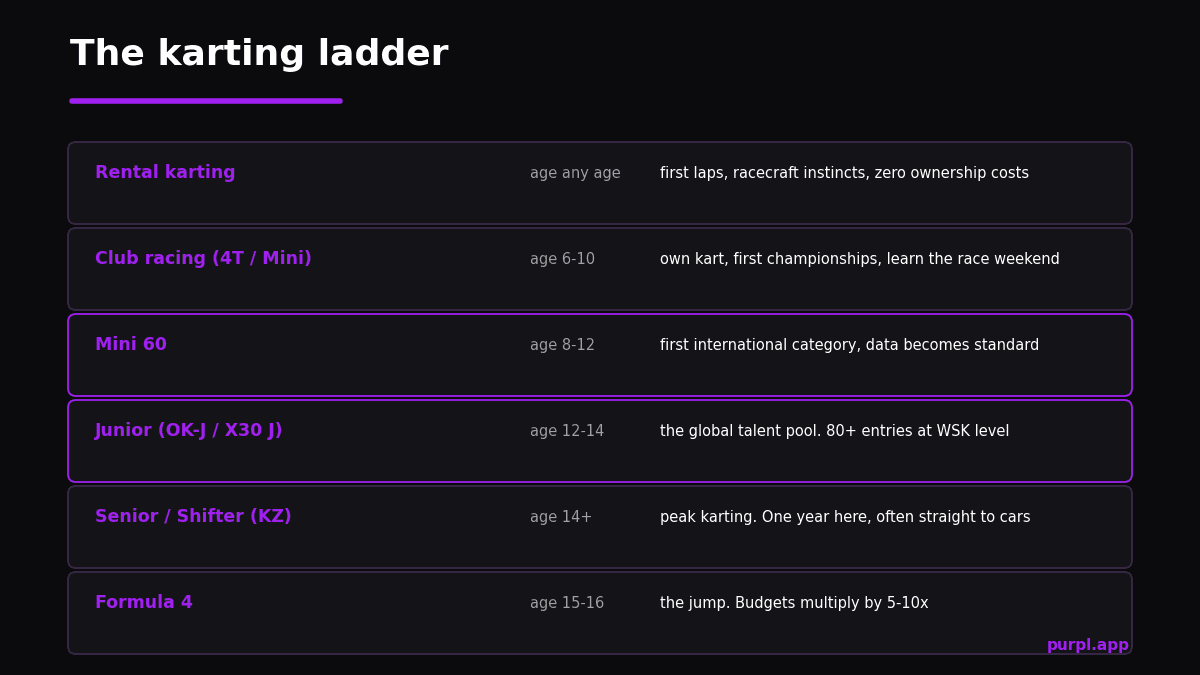
Competitive karting is organised by age and engine. Kids typically enter around 6-10 in club categories, move to Mini 60 between 8 and 12, Juniors from 12 to 14, then Seniors or Shifters.
The traditional path put a year in Seniors and a year in shifter karts before car racing at 16. These days many jump to Formula 4 at 15-16 directly, skipping that last shifter year.
Each step up costs meaningfully more. So the honest rule of the ladder is: results justify steps. Wins at one level are the argument for funding the next, unless your resources are unlimited, and for most families they are very much not.
The full category system is mapped in karting classes explained. That includes the 2-stroke vs 4-stroke split and what each class costs to run.
Adults: the ladder isn't only for kids. Club racing in 4-stroke classes and masters categories is thriving, cheaper than junior international karting by an order of magnitude. And the racing is genuinely hard.
Step three: the money conversation
Have it early. With real numbers. Rental sessions run €20-40.
A season of club racing with a used kart might be a few thousand euros. A serious national season runs into five figures, and the international scene, WSK, Euro Series, world championship, costs more per year than most families spend on a house deposit.
The complete breakdown with line items is in how much kart racing really costs. Read it before buying anything.
Two rules save beginners the most money. Buy used equipment. Karts hold value badly.
And beginners can't use the difference between a new chassis and a two-year-old one. So spend the savings on track time. Because seat time is the only purchase that always works.
Your first owned kart
When the rental phase ends, resist the showroom. A two-year-old chassis from a respected brand, bought from a club racer who's upgrading, is the correct first kart. And the difference between it and a new one is invisible to a beginner in every way except the invoice.
Budget for the unglamorous list too: trolley, basic tools, spare sprockets and chains, wet tyres on spare rims, and a used data logger. It costs less than one set of new tyres and pays back forever.
Engine choice is really class choice, decided by what actually races at your local club. Go watch a club race before buying anything and count entries per class.
The best class for a beginner is the one with the biggest grid at your home track. Full stop. Twenty mediocre rivals teach you more than three fast ones, and resale is easier in a popular class too.
Safety gear: a kart-homologated helmet, an abrasion-rated suit, gloves, and proper boots are non-negotiable. And a rib protector is the item beginners skip and regret first. Because karts don't have seat belts and ribs meet seat edges hard.
Buy the helmet new, always; everything else can be sensibly used.
A realistic first season
Here's a first-season plan that builds drivers instead of disappointments. Months one and two: practice days only, every second weekend if budget allows, each one with a goal, this is where the one-question habit from the data analysis method starts.
Months three to six: enter club races with zero result expectations; the goal is finishing races, learning procedures, starts, and traffic.
Second half of the season: pick one modest, measurable target, top ten in class, or qualifying within a defined gap of the front. And let the data measure progress toward it rather than the championship table, which mostly measures budget and experience at this stage.
What ruins first seasons, in order of frequency? Equipment-blaming (the data usually disagrees), parents who turn race day into exam day. Then skipping practice to spend the budget on more race entries.
And chasing setup changes before the driver is consistent enough to feel them, the trap explained in kart setup basics.
Step four: know the odds, then beat them
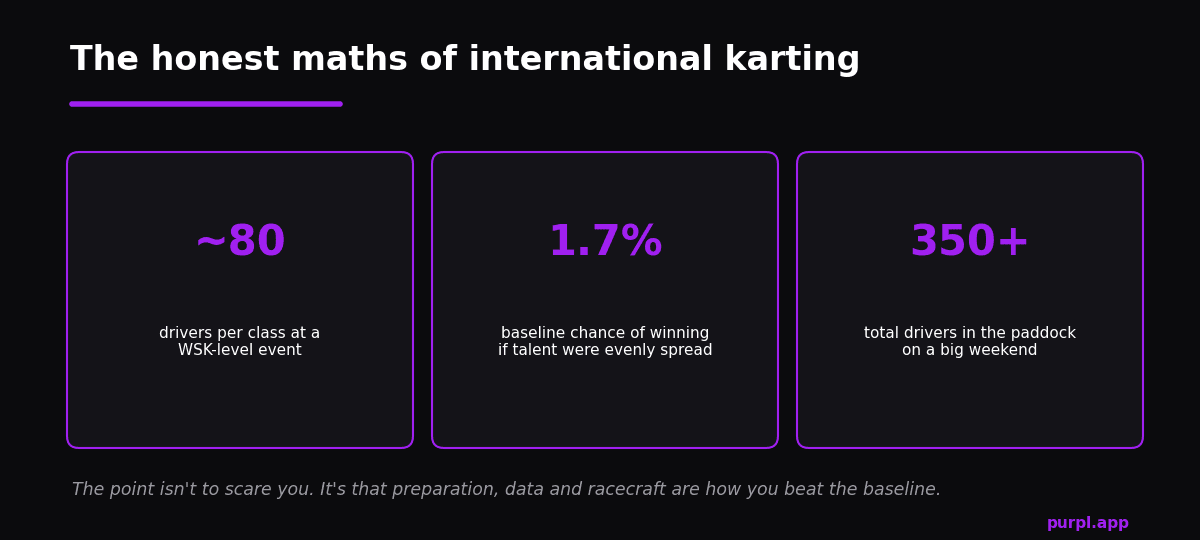
Here's the maths nobody hands out with the entry form. A club race might have 20-30 karts in your class. An international event is another planet.
WSK weekends start on Wednesday, you park ten minutes' walk from a paddock holding 350-plus drivers, and your class alone can field 80, at the peak years over a hundred. Eighty drivers means a baseline 1.7% chance of winning if ability were spread evenly.
The point of that number isn't discouragement, it's direction. Talent is real. But it's not the variable you control on a Tuesday.
Preparation is. Arriving with the track learned, the kart in the window, and your own data telling you where the next tenth is.
That's how the baseline gets beaten. And it's the entire reason this blog and Purpl exist.
What a race day actually looks like
Demystifying the first race removes half its stress. So here's the standard club Sunday. Arrive early, sign on, scrutineering checks your kart and gear.
A drivers' briefing covers flags and local rules, listen properly, the questions asked at briefings are answered in penalties later. Then the rhythm: a short practice or warm-up, qualifying that sets the grid, one or two heats, and a final.
Between sessions you'll have under an hour, which is exactly the window the twenty-minute data routine was designed for: download, one corner, one decision, tyres and fuel, breathe.
Expect three surprises. The pace of the day, club racing runs on a strict clock and being late to the grid is a self-inflicted penalty.
Standing starts or rolling starts that no practice day prepared you for, ask an experienced racer to talk you through the local procedure before your first one. And the noise of close racing: your first heat will feel chaotic, lap five of your third race it will feel like home.
Karting paddocks are also, despite the rivalries, absurdly helpful to newcomers who ask politely; the same culture lives online at KartPulse.
Fitness, age and other honest answers
Small habits with outsized returns, learned the hard way at international paddocks. Drink water all day, not just when thirsty, because dehydration shows up as slow hands and bad decisions in the afternoon finals long before you feel it.
Eat light at lunch on race days. And sleep before race weekends like it's training. Because it is.
Can you start at 30? Yes, and you'll have company in masters and club classes; the ladder above is for the junior pathway, not a visa requirement.
Is karting physical? More than it looks: necks, forearms and core take a beating, ribs especially, and basic conditioning improves both lap time and enjoyment within weeks.
Do you need a competition license? For organised racing, yes, a short course and a medical through your national federation, and clubs walk beginners through it routinely.
None of these are real barriers. The only real barrier is starting. That's what the rental session this week is for.
The beginner's shortcut list
Things I wish every newcomer knew on day one. Join a club and do a license course; in most countries the national federation lists accredited clubs, and internationally the sport runs under FIA Karting.
Get coaching early, before bad habits calcify; even three sessions change a driver's trajectory. Start logging data from your first owned kart, a used logger costs little and the habit, explained from zero in the karting telemetry guide, compounds for your entire career.
Learn the standard mistakes before making them all personally, I've catalogued them in beginner karting mistakes.
And parents of young drivers: your role is the most misunderstood job in the paddock. So read the parent's guide to junior karting before your first race weekend, not after it goes wrong.
For the practical questions that fill a first season, what to pack, how a race day runs, when to practice, the race weekend checklist covers the logistics.
One more honest answer while we're here. How long until you're competitive? With regular seat time and the data habit, expect to be racing mid-pack at club level within a season, and genuinely fighting at the front in your second.
Anyone promising faster is selling something.
Is it worth it?
I'm biased, and the answer is yes. Not because of Formula 1. Statistically that door opens for almost nobody, and you should hear that early too.
It's worth it because karting compresses lessons most people wait decades for. How to lose on Sunday and analyse it on Monday, how to perform when nervous. How to take responsibility for your own mistakes (your data makes them hard to outsource), how to work inside a small team.
Drivers who climb to cars carry those lessons up, the path described in from karting to cars.
The ones who stay in karting keep one of the best-kept secrets in sport: the racing at club level is better than almost anything you can buy for the money.
Start with a rental session this week. Everything else in this guide is optional until then.
Alessio Lorandi started karting at six and won the 2013 CIK-FIA Karting World Championship. He raced through Formula 3, GP3 and Formula 2 before founding Purpl, an AI data coach for karting drivers.