From Karting to Car Racing: How Data Skills Transfer Up the Ladder
What carries over from karting to car racing? Less of the feel than you think, almost all of the method. The honest map from a driver who climbed it.
There's a question every karting family lands on eventually. When the move from karting to car racing comes, what actually carries over?
Here's my honest answer. Less of the hardware feel than you think. Almost all of the method.
I climbed the whole thing, karts to Formula 3 at sixteen, then GP3, then Formula 2. The kart-specific tricks faded within a season. The way karting taught me to learn never left.
This one is for the parents and juniors looking up the motorsport ladder, wondering which skills are worth building early and which ones the next category throws away. The map follows.
The motorsport ladder as it runs today
The ladder is more standard than people expect. Mini 60 from around eight to twelve. Juniors from twelve to fourteen, then Seniors or shifter karts, then Formula 4.
The classic route was a year in Seniors, then shifters at fifteen or sixteen. These days plenty of drivers go from karting to Formula 4 at sixteen and skip the shifter year completely, a shortcut that was rare when I came up.
The car side is built to receive them. The FIA created Formula 4 in 2014 as the first step out of karting into single-seaters, and Formula Scout tracks every series on the climb from there.
Two rules hold on every rung. Each step up costs more than the one before. And a step up should be justified by results, not by a birthday.
That second rule protects families from the first one, because the motorsport ladder rewards patience at the cheap levels far more than it rewards haste toward the expensive ones. Paddocks everywhere hold the same story. A driver promoted on hope instead of results spends the season racing for survival, learning less at the most expensive level he's ever touched.
If you're still mapping the kart side of this, start with karting classes explained and what kart racing really costs, because the ladder reads differently once you've priced the rungs.
Then decide.
The data method transfers wholesale
Now the part that moves up the ladder without losing anything.
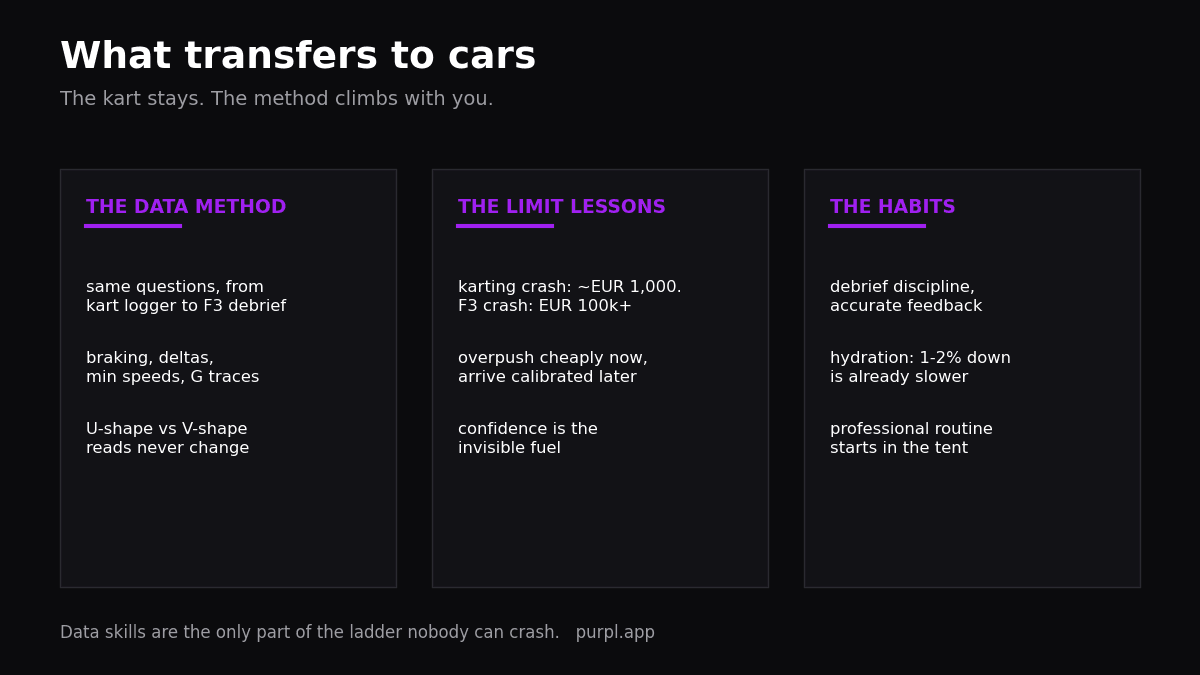
When I check a teammate's data, I feel like Sherlock Holmes. Braking first: who brakes later, who brakes more, who stops the kart more efficiently?
Then the speed trace with the delta under it. Where does the delta rise? Who carries the higher minimum speed, who reaches it earlier, who exits better, and why?
Is the corner U-shaped rolling speed, or a V-shaped stop-and-go? RPM and EGT next: which gears, which shift points, a short shift or the full gear? Then G force: the highest combined G on entry, who turns in earlier, the most lateral G, the strongest exit G.
Those are the exact questions an F3 engineering debrief runs on. They scale straight from karting telemetry to a professional data room.
Nobody needs a Formula 2 budget to practise any of this. The same investigation, run on a basic kart logger weekend after weekend, builds the same investigator an F3 engineer wants sitting beside him. That's the whole transfer.
The difference in cars is company. An engineer sits beside you and asks those questions with you, on a bigger PDF, across more channels, and with a salary attached to making sure you answer them honestly. A junior who already owns the questions walks into that room speaking the language, and the first expensive test day gets spent improving instead of translating.
Building that habit is the whole point of a proper kart data analysis routine. Start with the questions, then learn delta time properly, because every question on that list either starts at the delta or comes back to it.
The limit is cheaper to find in a kart
In karting, a bad crash costs maybe €1,000. An axle, a spindle, in a bad case a frame.
In F3 or F2, at over 280 km/h, one crash can bill €100,000 to €150,000. On a tight budget that's the difference between racing next season and stopping forever.
Plain and simple.
That asymmetry changes how you drive and how you learn. Karting is the one place on the ladder where you can overpush, find the real limit, and pay almost nothing for the lesson.
Run the same mistake through both budgets. A spin that clips a barrier in a kart is a story at dinner, while the same misjudgement in an F3 car can end the conversation about next season.
Cheap lessons compound.
I learned what that's worth at Pau in 2015, my first Formula 3 street race, at sixteen. Everything narrow, no grass, no gravel, nowhere cheap to get it wrong.
And in my head, the number. One small mistake there could cost my family up to €100,000 in the worst case.
Confidence is the invisible fuel. Without it you second-guess yourself, and you're slower.
Where does a full tank of it come from? From the karting years, where finding the limit cost €1,000 instead of €100,000. There's a whole piece on building karting confidence with data.
A year after that first attempt I came back and won the Pau Grand Prix. Same walls. Different driver.
Drivers who arrive in cars having never explored past the limit end up driving with a permanent safety margin they can't measure or even feel. And an unmeasured margin is lap time you never get back.
Modern teams prepare a street circuit like that in simulators for days before the cars run. How sim work fits a karting program is its own story, told in sim racing for karting drivers.
The professional habits start in karting
Car racing punishes indiscipline harder than karting does. The heat is worse and the physical load is higher.
In karting you're privileged. Dehydration is less severe than in a closed cockpit. But performance already drops at 1 to 2% dehydration, which is about half a litre of fluid.
So the professional habits start in karting, or they don't start at all.
The list reads boring on purpose. Drink before you're thirsty. Debrief every session in writing, the same evening.
Give feedback in corners and numbers, not in moods. None of it needs talent. All of it compounds.
A fourteen-year-old who writes three honest lines after every session is doing, in miniature, exactly what a Formula 2 driver does with a room full of engineers. Smaller stage. Same job.
A driver who lands in Formula 4 with those habits installed doesn't burn an expensive first season learning them. That season gets spent on speed instead.
What doesn't survive the trip
Now the honest section, because the aspirational stuff is useless without it.
A kart has no suspension and no differential. A big share of kart technique exists purely to manage those two missing parts.
The braking style that keeps a solid rear axle from locking. The way the inside rear lifts through a corner. Cars un-teach some of that within a few test days, because suspension and a diff solve the problems the technique existed for.
So no, the muscle memory is not the asset. The learning method is.
And that should comfort anyone budgeting this sport, because muscle memory gets rebuilt at every rung anyway, while a method built once keeps paying all the way up.
The feel changes at every rung and the data questions never do. That holds to the very top; the channels in F1 telemetry versus karting are far richer, and the questions underneath stay the same.
Pack accordingly.
The part of karting to car racing nobody can crash
Price the ladder honestly. Engines, tyres, entries, travel, coaching, and a calendar that crosses borders more often every year, with every rung multiplying the one below it.
Now price the data method. A logger, a laptop, and the discipline to ask the same Sherlock questions after every single session, whether the day went well or fell apart. That's the whole shopping list.
Data skills are the cheapest thing on the whole ladder to build. And the only thing nobody can crash.
Every other advantage on this ladder is rented. The engine that's strong this year, the team that's sharp this season, the budget that lives while a sponsor stays happy: rented, all of it.
The method is owned. The method you built reading kart telemetry gets into every car with you, for free, for the rest of your career.
That belief is most of why Purpl exists. If you're at the start of this road, begin with the karting telemetry guide and build the habit while crashing is still cheap.
FAQ
When should a karting driver move to cars?
When results justify it, not when a birthday arrives. Each step up the ladder costs more, so it should be earned at the level below.
The common move today is from karting to Formula 4 at around sixteen, often skipping the shifter year that used to sit between.
Does karting experience help in car racing?
Nearly every professional single-seater driver on the modern grids started in karting, and that's not nostalgia talking, it's the economics of learning. Racecraft, limit-finding and the data method all build there, at a tiny fraction of what the same lessons would cost in a car.
What fades is the kart-specific feel, the technique shaped by no suspension and no diff. What stays is the way you learned, and that's the part that wins later.
How much does Formula 4 cost?
It depends on the championship, the team, and how much testing the program includes, so treat any single published figure with suspicion. The reliable rule is that car budgets multiply karting budgets.
Price the kart side first with the real cost of kart racing, then ask two or three F4 teams for current quotes. Numbers age fast in this sport. Quotes don't lie.
Is the shifter year still worth it before Formula 4?
The traditional path said yes, a season in Seniors and then shifters at fifteen or sixteen. The modern calendar often says no, with drivers stepping into F4 at sixteen directly.
Neither answer is wrong on its own. Judge it the way every step should be judged, by whether results at the current level have earned the spend at the next one.
Alessio Lorandi started karting at six and won the 2013 CIK-FIA Karting World Championship. He raced through Formula 3, GP3 and Formula 2 before founding Purpl, an AI data coach for karting drivers.