F1 Telemetry Explained: Same Science as Karting, Different Budget
F1 telemetry explained by a driver who lived both ends: F2 data rooms and karting tents. Hundreds of channels, one logger, the same six questions.
Watch an F1 weekend and the telemetry side looks like another universe. Hundreds of channels. Walls of engineers in matching shirts, with more of them back at the factory.
I've raced both ends of that spectrum. Kart loggers as a kid in the WSK paddocks, then the briefing rooms of F3, GP3 and Formula 2, one rung below the top of the pyramid. So here is F1 telemetry explained by someone who climbed that ladder: same science, scaled by budget.
The screens get bigger. The questions never change. Hold that thought.
The F1 side, in honest numbers
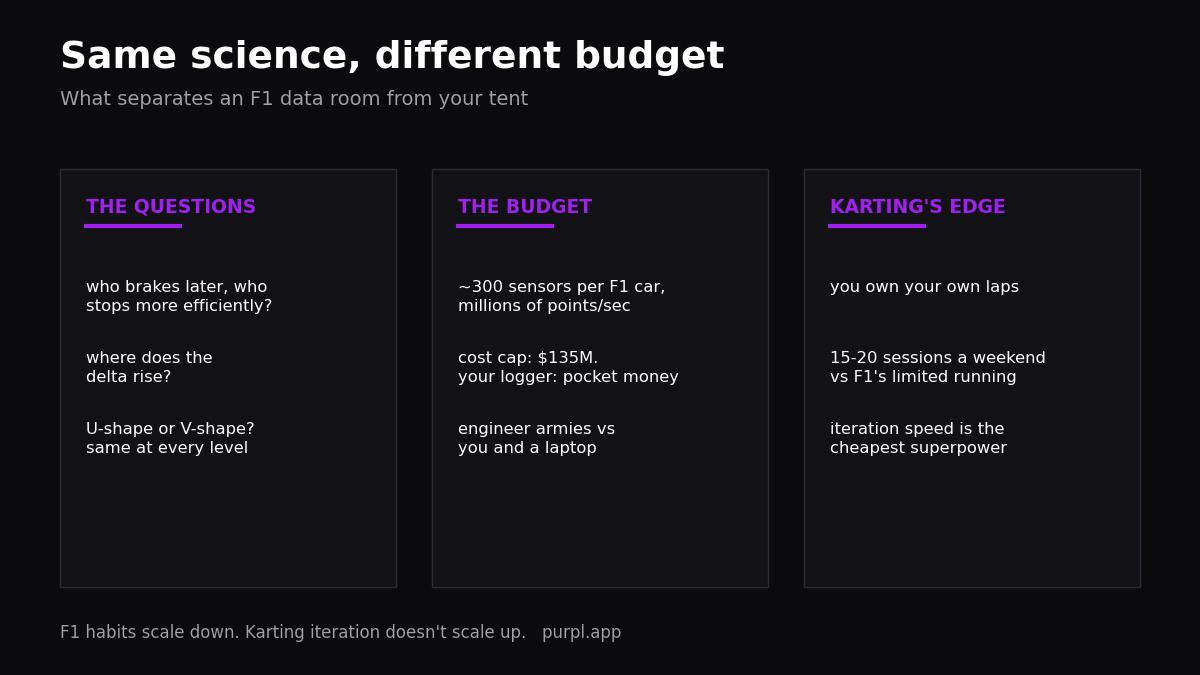
Start with what's verified. A modern F1 car carries around 300 sensors. F1's own technology page with AWS puts the output above 1.1 million data points per second, streamed live from car to pit.
From the pit wall it flows on to the factory, where dedicated groups for tyres, power unit, aero and strategy read it the moment it lands. Whole careers spent on one driver's traces.
"Live" means exactly that, by the way. A driver gets halfway through reporting a problem on the radio and the garage has usually already watched it happen in the data. That's the bandwidth money buys.
Those teams feel like mini NASA centres. Sophisticated machinery everywhere, and engineers who genuinely know what to do with it.
For years, money was the only limit. Red Bull, Mercedes and Ferrari ran budgets north of $400 million a year, by some reports. Then the sport stepped in, and by 2023 the cost cap sat at $135 million.
The yearly figures are in F1's own cost cap explainer, and the rulebook behind them is the FIA's Financial Regulations. Remember that last number. A capped team is the cheap version of F1.
The karting side of the same coin
Now the other end of the ladder. One logger, one GPS antenna, a display on the steering wheel. The whole "data department" fits in a backpack.
The channel list grows with the level. Club karting needs tyre pressures, water temperature and RPM, and that's genuinely enough to start improving.
International karting adds tyre temps, brake temps, exhaust gas temperature and lambda, plus engine head temps. Between EGT and lambda I prefer lambda, because it reads the mixture itself instead of a side effect. The full stack is mapped in kart sensors explained.
Karting's technology asks far less than F1's. But the scientific approach has taken over at the top of the sport anyway. Performance is the new north star, and the laptop has earned its place in the tent.
A kart also wears its data on its sleeve. No suspension to hide behind, no driver aids, so cause and effect sit closer together than in any car category. The files are honest.
And the budget comparison is the punchline. A complete karting data setup is pocket money against a space program. Plain and simple.
The science you run on it is the same.
Starting from zero? The karting telemetry guide is the foundation piece.
F1 telemetry explained in six questions
Here's the part the broadcasts never show you. Strip away the sensor count and the mission-control lighting, and those engineers are working through the exact list you should be working through in a karting tent.
Who brakes later? Who stops the car more efficiently? Where does the delta rise?
Who carries more minimum speed? Is the corner a U shape or a V shape? Who gets back to throttle earlier and exits better?
That's it. That's the science. I ran that same routine, Sherlock hat on, against my teammates' files in karting tents and then against my teammates' files in Formula 2 engineering rooms.
The room changed. The screens grew. The six questions never moved an inch.
Watch qualifying with that list in your head and the graphics stop being wallpaper, because the speed traces they flash between runs are answering questions one and four. Nothing more exotic than that.
The delta trace is the spine of it in both worlds. Reading it is a learnable skill, and I've broken it down in delta time telemetry and the overlay analysis method.
Neither world was born this way, either. Before telemetry arrived, drivers got split times and their mechanic's opinions, and even onboard cameras only became a normal tool around 2010 or 2011. Karting lived that history later than F1 did.
The most loaded sensor is the driver
One thing fans underestimate badly. Every trace on every screen comes out of a body under load. Mine included.
GP3 and Formula 2 cars have no power steering, unlike F1. In maximum-downforce corners at Hungaroring, Silverstone or Zandvoort, the wheel gets heavy enough that a steering trace doubles as a strength chart.
I felt it in GP3 at Malaysia in 2016 and again through F2, where a race can pull 2 to 2.5 litres of fluid out of you. F1 drivers lose up to 3 litres, with roughly a litre available to drink in the car.
Karting is the same story at a smaller scale. Raw steering, no assistance, finals that leave your forearms pumped solid. So when the delta rises three laps from the flag, weekend after weekend, sometimes the answer isn't setup or tyres at all.
It's the human. At every level, the data is measuring a person under load, and good analysis never forgets that.
What karting has that F1 doesn't
Now the part that should make the karting paddock feel rich. Three advantages, and they all favour the kid in the tent.
You own your laps. An F1 driver's data belongs to the team, and the day he leaves for a rival, every lap he ever drove stays behind on the servers. Your kart files are yours for life, which is the whole argument of racing data ownership.
Iteration speed. F1 gets a few tightly limited practice hours under a near-total testing ban, while one karting weekend can hand you fifteen or twenty full sessions. You can test an idea before lunch and its correction after.
The data-to-seat-time ratio. Every kart session comes with a file you can read within the hour, a change you can make in the tent, and a track waiting to grade it. That loop is the entire data analysis routine, and it compounds week after week at pocket-money cost.
An F1 driver would trade a lot for twenty sessions of free experimenting in one weekend. You get it for the price of an entry fee. Use it.
The F1 habits worth stealing
Traffic flows the other way too. Three habits from the big paddocks translate straight down to karting.
Reference comparisons. An F1 engineer never reads a lap on its own; everything sits against a reference, usually the teammate. Karting deserves the same discipline, every session, no exceptions.
Channel discipline. Even with hundreds of channels on tap, the first read is always the same few: speed, delta, then driver inputs. A fixed reading order beats more data, at every level.
The structured debrief. Every F1 session ends with the same agenda: what happened, why, what changes next. The karting version takes ten minutes, and the karting debrief template gives you the exact sheet.
Steal all three.
And if your plan is the ladder itself, these habits are the most portable thing you own. The driving changes on the way up; the data culture doesn't. I've covered that jump in karting to car racing.
Karting's tools are closing the gap faster than most people think, too. That story has its own article: the future of karting telemetry.
FAQ
What telemetry do F1 teams use?
Every car runs standard-specification logging electronics, and each team layers its own sensors and analysis software on top. The data streams live from the car to the pit wall and on to the factory operations rooms, per F1's published technology material.
The exact software stacks are secret. The reading method isn't, and it's the same one you can run on a kart file tonight.
How many sensors does an F1 car have?
Around 300 per car, generating more than 1.1 million data points every second, according to the F1 and AWS technology page linked above. The exact count varies by car, by weekend and by what the team is testing, so treat 300 as an order of magnitude rather than a spec sheet.
A kart logger reads perhaps a dozen channels. That gap sounds enormous until you notice both ends feed the same six questions.
Can karting telemetry teach F1-level skills?
The analysis skills, yes. Delta reading, braking comparison, minimum speed, corner shape: those questions are identical at every level, so the habit transfers all the way up.
What karting can't teach is downforce, tyre management at 300 km/h, or working with a room full of engineers. But drivers who arrive in cars already fluent in data start with a genuine head start.
What does F1 telemetry cost?
Honestly, nobody outside the teams knows, because it's never itemised in public. The scale shows up in the budget instead. Team spending is capped at around $135 million a year, and before the cap the biggest names ran north of $400 million, by some reports.
Your complete karting data setup is a rounding error against either number. Same science, different budget. That's the whole article in one line.
Alessio Lorandi started karting at six and won the 2013 CIK-FIA Karting World Championship. He raced through Formula 3, GP3 and Formula 2 before founding Purpl, an AI data coach for karting drivers.