The Future of Karting Telemetry: From Data Loggers to AI Copilots
Where karting data is going next, from a driver who lived the arc from dash times to AI coaching. The visible directions as of 2026, and what won't change.
Where is karting data going next? I think about that question every day, because I'm building tools in exactly this space. That's my bias, declared upfront.
It's also my vantage point. My career ran the whole arc: split times on a dash as a kid, a full sensor stack at world championship level, F2 data systems after that.
So here's my read on the future of telemetry in karting, written in mid-2026. Some of it is already visible on track. Some of it is opinion, and I'll tell you which is which.
If the basics are still new to you, start with the karting telemetry guide. This piece is about where all of it goes.
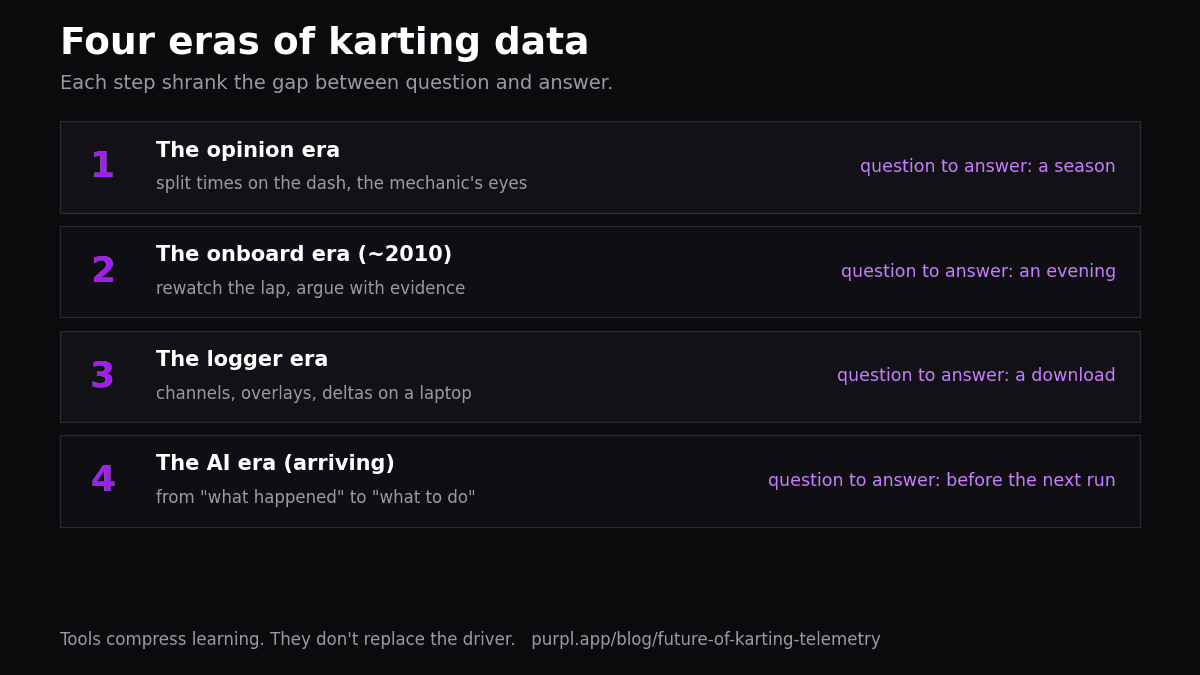
Four eras, one direction
Before telemetry existed, drivers relied on split times on the dash and their mechanics' opinions. That was the whole toolkit. Your lap lived in two memories, yours and his.
Then came onboard cameras. They only really spread through the paddocks around 2010 and 2011, and suddenly you could rewatch a lap instead of debating it.
Loggers came next. GPS, speed and RPM on every kart, downloadable in the time it takes your mechanic to pull the chain off; the hardware story is in kart data loggers explained. And the analysis era followed: overlays, deltas, theoretical laps.
Data replaced opinion with certainty. That's the whole history of telemetry in one sentence.
Notice what each era actually did. It compressed the time between a question and its answer.
"Why am I slow in turn four?" once took a season of guessing. Then a weekend of video. Now it takes one download and an overlay.
Hold onto that pattern. It predicts everything that comes next.
Where things stand in 2026
Ask a paddock whether karting feels more like art or science, and most people still answer "art". A few years ago I'd have said the same. At the top level, that answer has flipped.
Performance is the new north star. The "artistic" way of tuning a kart is hit or miss, and a scientific approach is what actually wins now.
And the margins explain why. Two or three tenths are a day and night difference in karting, because most tracks run under a minute and the gaps between whole rows of the grid stay tiny.
Formula 1 shows the far end of that road. Every F1 team feels like a mini NASA centre. The sport needed a budget cap (135 million in 2023) because Red Bull, Mercedes and Ferrari could spend up to $400 million a year.
The public numbers back the NASA joke up. As of 2026, AWS's F1 technology page lists around 300 sensors on every car, generating 1.1 million telemetry data points per second from car to pit wall. The full comparison between those worlds is in F1 telemetry vs karting.
Karting's technology is far less demanding, thankfully. But competition keeps rising, and rising competition forces teams to chase every performance lever they can find.
Same direction, smaller wallet.
What does that chase look like in channels? At club level, tyre pressure, water temperature and RPM are enough. Genuinely enough; that little stack wins club races.
At international level the bar sits much higher. Tyre temps, brake temps, exhaust gas temperature, lambda, engine head temps and more, the full stack from kart sensors explained.
One preference of mine inside that list: lambda over EGT, because it gives more accurate information about the carburation. The case for it is in the kart lambda sensor guide.
That's the present. A sport that quietly went from art to science in one generation.
The visible directions for the future of telemetry
Now the forecast part. These are my opinions, formed from racing, coaching and building software for this exact problem. Treat them as a builder's bets, not a federation press release.
Five bets, then.
Sensors get cheaper and denser. The channel list that needed a factory budget ten years ago already fits a serious privateer's wallet. I expect the international stack to become the normal stack, the same way GPS did.
Tyre temperatures on all four corners, brake temps, a lambda probe in the exhaust: all of it was works-team luxury once, and all of it gets cheaper every year. Nothing radical in that prediction. Price curves in electronics only move one way.
Analysis moves from "what happened" to "what to do". This is the big one, in my view.
A logger tells you that you lost a tenth into turn three. A coach tells you how to take it back. Software is crossing that line right now, and I've written about what an AI racing coach actually does.
Sim racing got there first. It's already real with tools like Trophi.ai, where a live AI engineer gives you real-time coaching tips from the live telemetry it's analysing. Mind boggling.
I can only imagine what AI will do in relation to data analysis and video comparisons.
No one is bringing back the 80s.
And the sim-to-kart pipeline already runs both ways, which is part of why sim racing for karting drivers keeps growing as a training tool.
Video and data merge into one screen. The ability to rewatch and analyse every single session in an objective way is the real value that data and video comparisons bring.
Today that pairing is still a manual chore for most drivers, fiddling with file timestamps at the laptop, the routine from sync video with telemetry. My bet, and it's only a bet, is that within a few seasons the merged view becomes the default, not a premium feature. One timeline, both sources, no arguments.
Real-time feedback trickles down. F1 engineers already coach from live data between sessions and during races, and sim platforms now coach you mid-lap. Karting sits between those two worlds, and the technical gap is closing.
One honest caveat here. Racing is regulated, and in-race driver aids can be restricted depending on your series' sporting rules. Whether live coaching ever reaches an actual kart race is a question for bodies like FIA Karting and national federations, not for software people.
Practice days carry no such limits. That's where real-time tools will land first, on the dash and in your debrief, minutes after the run.
What might it look like at a kart track? A dash that flags water temperature drifting out of its window, or a note on the cool-down lap of a private test naming the corner that bleeds time.
None of that needs new physics. It needs software, and a careful read of the rulebook.
Data ownership becomes a fight worth watching. As the tools get smarter, your laps become valuable training material, and the question of who owns them, and whether you can take them elsewhere, stops being academic.
The stakes are laid out in racing data ownership. Watch that one quietly. It may end up mattering more than any sensor.
What won't change
Here's the anchor under all the futurism. The driver still has to brake later. The kart still has to be in its window.
No AI brakes for you. No dashboard finds you three tenths of commitment through a fast corner. Tools compress learning; they don't replace it.
Plain and simple.
Every era so far shortened the road from question to answer, and the next one will shorten it again, but the driving itself never once got outsourced along the way. The drivers who did the work won before telemetry, and they still win with it.
My 2013 world title came from laps and obsession first. Data second. I'd expect the same ranking to hold in 2036.
For transparency: I'm betting my own time on this future with Purpl (purpl.app), an AI data coach for karting drivers. Weigh my predictions with that in mind.
But the loop that built every fast driver survives every era. Drive, download, compare, repeat.
FAQ
What is the future of telemetry in karting?
Cheaper and denser sensors, analysis that recommends instead of just describing, and video fused with data as the default view. That's the direction visible as of 2026. The timing is opinion; the direction isn't.
Expect club drivers to run channel lists that would have looked international-level a decade ago, at prices a family budget can stand. The hardware race is mostly settled. The software race is just starting.
Will AI replace race engineers and data coaches?
My honest view, as someone building AI tools: no. The job shifts instead, with AI handling the "what happened" so humans can spend their time on the "what do we risk".
The same shift happened when loggers arrived. Mechanics didn't disappear; the guessing did. Good engineers get faster, not redundant.
Is real-time AI coaching legal in karting races?
It depends on your series and your national federation, so read the sporting regulations that actually cover your races before assuming anything about live coaching. Radio coaching of the F1 kind has generally not been part of karting, and any in-race driver aid can fall under series rules.
Practice and testing are a different story. Between-session analysis is restricted nowhere, and that's where most of the coaching value lives today anyway.
Do I need to wait for AI tools before learning data?
No, the opposite. Every future tool still feeds on the same basics it always has: clean laps, honest comparisons, one change at a time, written down where you can find it. Drivers who read a speed trace today will simply ask better questions of whatever arrives tomorrow.
The skill transfers. The software changes around it.
Alessio Lorandi started karting at six and won the 2013 CIK-FIA Karting World Championship. He raced through Formula 3, GP3 and Formula 2 before founding Purpl, an AI data coach for karting drivers.