AI Coaching in Motorsport: How an AI Racing Coach Actually Works
An AI racing coach automates what a good data engineer does: braking, minimum speed, exits, gears. What the tech actually does, and what it can't.
"AI racing coach" stopped being science fiction somewhere in the last few years. The phrase is on product pages, in sim racing menus, across F1 broadcasts, and in the mouths of dads at karting tracks who want to know if it's real.
Most people using it can't tell you what the software actually does.
I can have a go. The human version of the job shaped my whole career. I won the karting World Championship in 2013, then raced F3, GP3 and F2, and at every step an engineer turned my data into instructions.
So this is the honest version of the term. What the technology really does, what it does better than a person, and what it can't touch. No hype in either direction.
Coaching by data is a list of questions
Strip away the branding and every data coach, human or artificial, does the same job. It holds your lap against a reference and answers one question. Where does the time go?
That's it. That's the whole job.
When I check a teammate's data, I feel like Sherlock Holmes, trying to unveil what's costing me time against him. That's the right energy. This is an investigation, not a browse.
Braking first. Who brakes later? Who brakes more, and who stops the kart more efficiently?
Then the speed trace, with delta time alongside. Where does the delta rise? Who carries a higher minimum speed, who reaches it earlier, who picks up the better exit?
And when he's faster through a corner, what shape is his speed valley? A U, rolling speed, or a V, stop and go?
Then RPM and EGT for the engine questions: which gears, which shift points, short shift or full pull. Then G force. Combined G on entry, the timing of turn-in, the lateral peak, what the exit G does.
Then the lines, in the corners where I'm losing: how the entry looks, how much track gets used, where the apex sits, how much exit kerb he takes. And with video on top, the steering inputs and the way his chassis behaves against mine.
One could write an entire book about all of the things one could check.
And that's exactly the problem. No human has the hours to ask every question, of every lap, for every session of a race weekend that produces ten of them between Friday and the final. So the questions go unasked, and the answers sit in the file.
That list is the heart of this article, so read it twice. It's the method every AI coaching tool is trying to automate. Nothing mystical, just a very good set of questions asked corner by corner, with a number attached to every answer.
You can run the whole thing by hand today. The walkthrough lives in my lap overlay method and in delta time telemetry. Learn it manually first and you'll judge every tool that claims to automate it far better.
Split times, opinions, onboards, certainty
This category didn't appear from nowhere. It's the latest step in a sequence that started with a stopwatch, and every single step removed a bias or a bottleneck. Watch the pattern.
Before telemetry existed, drivers relied on split times on the dash and their mechanics' opinions. Onboard cameras only became common around 2010 and 2011, so for decades you couldn't even rewatch your own laps.
And opinions carry a failure mode. A good mechanic's feedback can be biased by his beliefs, or by a single mistake. You miss one apex by a metre and you're told to "brake earlier", when every other lap of the session you were braking too early.
Data killed that argument. Download the file and you know with certainty.
Imagine Max Verstappen's race engineer, Giampiero Lambiase, telling Max how to improve purely by feeling, from watching trackside. Or tuning the car that way. No chance, right?
Karting can't be compared to Formula 1. But teams and drivers will have to step up to this more and more over the coming years.
Each step shortened the gap between driving and knowing. Splits gave you the what, video the where, telemetry the why. Plain and simple.
AI is the next compression step. The file always held the answers; the bottleneck was the evenings needed to extract them. If loggers are new territory, start with the karting telemetry guide and come back.
How an AI racing coach works in practice
What follows is the category in general, not a review of any single product. Under the marketing, these tools run one loop.
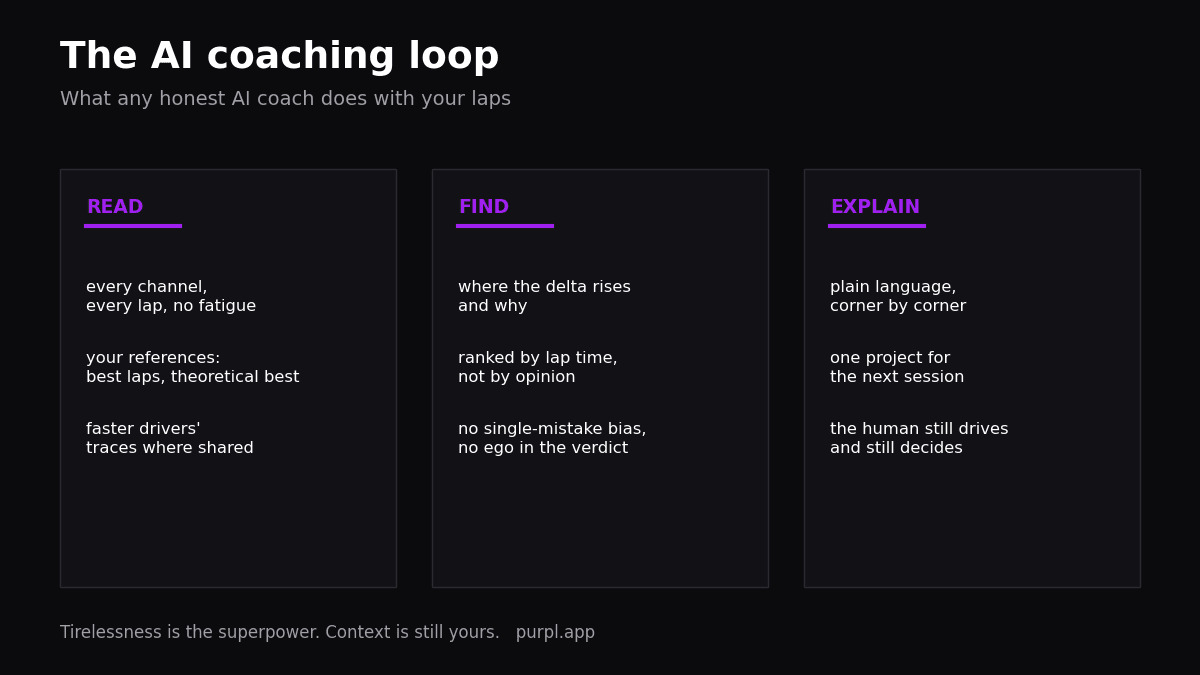
Ingest. The software reads your telemetry channels: speed, RPM, G force, temperatures, whatever the logger records, from a basic GPS unit to a full sensor stack. Nothing exotic.
Compare. It holds your lap against references. Your best lap, a theoretical best stitched from your fastest sectors, or a faster driver's file where one exists, because a comparison is only as smart as its reference.
Locate and rank. It runs the delta question on every corner of every lap, then sorts the losses by size. The biggest loss becomes the first conversation.
Explain. This is the line between analysis software and coaching. A coach tells you what to change before the next session, in words a fifteen-year-old and his dad can act on without a graph being opened.
The other split worth understanding is real-time against post-session.
Real-time AI coaching already exists in sim racing. Tools like Trophi.ai put a live AI engineer alongside you, giving coaching tips off the live telemetry while you lap. Mind boggling.
Sims got there first for a boring reason: the data link is perfect and instant. A real kart has no live feed to your ear, so on track the work happens after the session, exactly where a human engineer does it. That's no downgrade, because the debrief is where lap time has always been found.
If you train on a rig anyway, the crossover between sim habits and kart habits is mapped in sim racing for karting.
At the top of the sport, none of this is futuristic. An F1 car carries around 300 sensors producing more than 1.1 million data points per second. The sport runs machine learning across that flood with AWS because no human can read it raw.
I can only imagine what AI will do in relation to data analysis as well as video comparisons. The competition keeps rising at every level, and nobody is bringing back the 80s.
What the machine does better, and what it doesn't
The honest scorecard, machine first.
An AI coach is tireless. It reads every lap of every session, every channel, including the sessions a human never opens because the weekend ran out of evenings.
It never gets bored, either. Lap forty of a test day gets the same attention as lap one, which is more than most drivers can say about their own debriefs at eight in the evening.
It has no ego and no stake in yesterday's argument. And it doesn't carry the single-mistake bias from the mechanic era. It weighs your missed apex against every other lap before saying a word, so one error never becomes a theory.
Humans keep the other half. A good coach knows you slept badly, knows the grip walked away after the rain, knows when a driver needs pushing and when he needs leaving alone.
And when the numbers say one thing while the driver's face says another, only the human in the awning notices. That gap matters more in karting than anywhere, because so much of the grid is still made of kids.
Software reads the data. It doesn't read the driver. Confidence, pressure, the chat that rescues a bad day: that's human territory, and I expect it stays human for a long time.
Software can't do that. Yet.
So the realistic future is a division of labour, not a replacement. I take that question further in AI versus human coaching, and the mental side has its own piece in confidence and data.
Three questions for any AI coaching tool
The label is young enough that it gets stuck on very different products. Three questions cut through most of the noise. Ask all three.
Does it read your actual data? A tool that ingests your laps and talks about your corners is coaching. A library of generic track tips with a subscription attached is content.
Does it explain, or just score? A rating out of 100 gives you nothing to do on the next out lap. Useful output names the corner, the cause, and the change.
Does it respect your data? Your telemetry is yours, so check what a tool stores, what it shares with anyone else, and what leaves with you on the day you quit. The full argument is in who owns your racing data.
And one piece of coaching no tool changes. Automation buys you speed, not magic. The drivers who improve still change one thing per session and test it on track, the backbone of the whole data analysis routine.
Where I land
Opinion, stated plainly so you can disagree with it. The analysis half of coaching, the question list and the corner verdicts, will be automated for everyone within a few years, karting included. The judgment half won't be.
What that does to the sport over a decade is its own discussion, and it lives in the future of karting telemetry.
One disclosure before the questions, so you can weigh everything above. I'm building Purpl, an AI data coach for karting drivers, at purpl.app. That's my stake in this category, on the record; the arguments here stand or fall on their own.
FAQ
What is an AI racing coach?
Software that reads your telemetry, compares it against a reference lap, and explains where you lose time and why, in plain language. It automates the method a human data engineer applies by hand. The better ones output instructions, not just charts.
The term covers real-time tools, currently a sim racing thing, and post-session tools that work from downloaded files. Both count; they just sit at different points of your week.
Can AI replace a racing coach?
It can take over a big chunk of the analysis work: scanning every lap, finding the losses, ranking them. It can't read confidence, manage pressure, or know the track changed after the file was logged.
Think of it as a tireless junior engineer with a human keeping the context. Replacement is the wrong frame; division of labour is the right one.
Does AI coaching work for karting?
The method transfers directly, because karting data asks the same questions as any category: braking, minimum speed, exits, gears. Karts log fewer channels than an F1 car, which makes the job simpler, not weaker.
The practical shape is post-session. Drive, download, let the analysis run, pick one change. Real-time tips in your ear remain a sim feature for now.
Alessio Lorandi started karting at six and won the 2013 CIK-FIA Karting World Championship. He raced through Formula 3, GP3 and Formula 2 before founding Purpl, an AI data coach for karting drivers.