Sim Racing for Karting Drivers: What Transfers and What Doesn't
Sim rigs promise lap time. Some of it is real. I prepared Pau and Macau in team simulators, so here's what transfers to karting and what never will.
Every karting kid asks for a sim rig eventually. And every parent wants a straight answer before the wheel-and-pedals money leaves the account.
Does sim racing for karting actually work? Partly. And the parts that work aren't the ones most people expect.
I've driven both ends of this question. The toy simulator as a kid, where I mostly hit walls, and the professional team simulators later, preparing Pau and Macau.
So this is the straight answer. What transfers, what half-transfers, and what never will.
The professional proof
Start with the embarrassing part.
As a kid on my home simulator I crashed into walls constantly. Street circuits were the worst offenders.
Honestly, "crashed" is generous. Half the time I was using the walls as support, leaning on them mid-corner to carry more speed.
Not a technique with a future.
Years later I got the grown-up version at Van Amersfoort Racing, Carlin and Trident. Before my first Pau Grand Prix and my first Macau Grand Prix, I spent about five days in the simulator for each, around 150 laps a day.
Same exercise, better toys.
The work wasn't racing anyone. It was precision, consistency and spatial awareness, the same three jobs on every lap of every run, day after day, until the times came down.
My engineer kept telling me on the radio to get closer to the walls, through all three phases of the corner. I thought I was already close.
I wasn't.
Then we reviewed the onboards and he was right. There were still about 15 centimetres of track sitting unused. So I forced that gap closed, session after session, centimetre by centimetre, until nobody on the radio had to mention walls anymore.
The results came on the real streets: P7 and then P5 at the Macau GP F3 World Cup. And in 2016, on my second attempt, I won the Pau Grand Prix from a pole set in the rain, leading flag to flag ahead of Stroll and Russell.
That's what a simulator is for. Not pretend racing. Specific preparation for a real target, measured in laps and centimetres.
What sim racing for karting actually trains
The Pau story isn't really about Formula 3. It's about what a simulator can train, and the list holds in karting too.
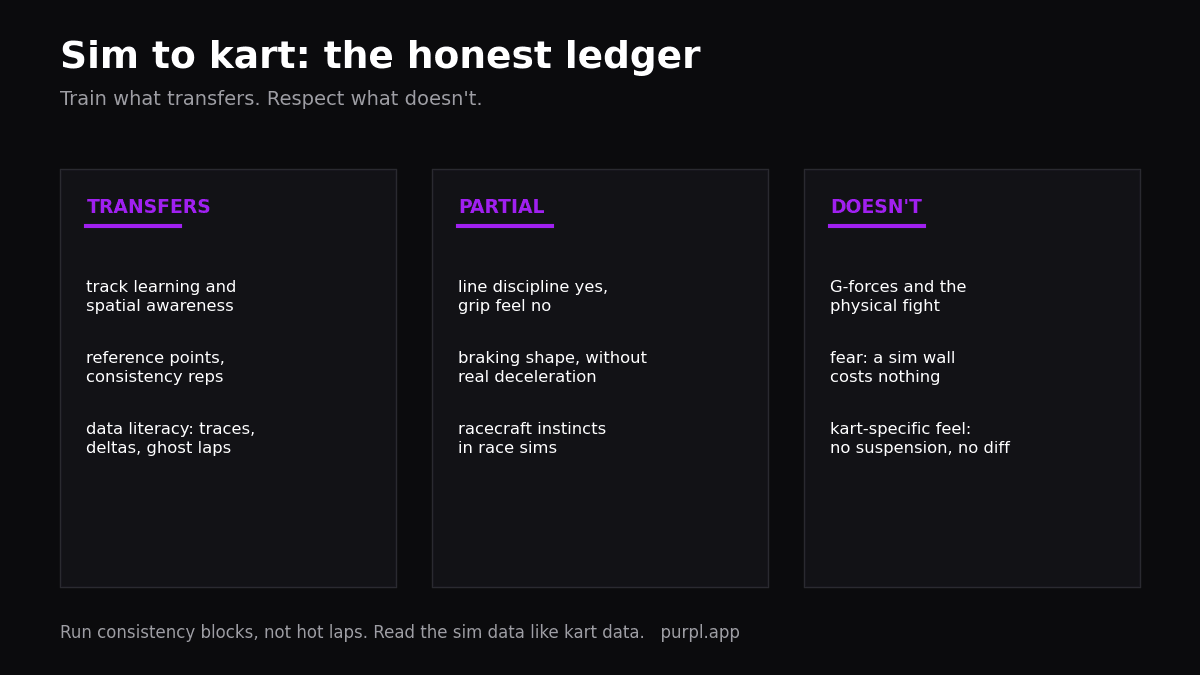
Track learning and spatial awareness. A circuit learned on screen arrives in your head before you arrive at the gate, the layout, the corner sequence, where the references sit. Converting that into real laps is covered in learning a new kart track.
Reference-point discipline. Sims reward drivers who brake at a marker and turn at a marker, because the screen gives you little else to trust. That habit transfers straight across to asphalt.
Consistency reps. Sim laps are free, so ten-lap blocks judged on spread rather than the single best time become affordable in a way real track time never is. Spread first, speed later.
Racecraft instincts. Online racing serves you starts, defences and gap judgements every ten minutes. The consequences are fake, the decision reps are real.
And the centre of it all, data literacy. Every serious platform shows you telemetry from day one. Speed traces, brake traces, deltas against a ghost lap.
A kid who reads sim telemetry already half-knows kart telemetry. The delta channel works exactly the same way, and the reading order in my karting telemetry guide carries over to a kart logger almost line for line.
Sim racing raised a generation that treats data as normal, kids who compare ghost laps before breakfast and argue about brake traces in Discord all evening. Plenty of karting paddocks are still catching up to that. A sim-raised driver walks in ahead.
What only half-transfers
Braking is the honest example. A sim teaches you where to brake and how to shape the release, and that part carries.
The force doesn't. A static rig never decelerates, so the body never learns what a real stop feels like through the chest and arms, or how the rear goes light on release. Kart braking is a physical skill as much as a timing skill.
The racing line splits the same way. Line discipline transfers, and the logic in the racing line is identical on screen and on asphalt.
Grip feel doesn't, because a sim reports grip through a speaker and a wheel motor, and a kart reports it through your hands and ribs. Half the channel is missing. You drive on the half you have.
What doesn't transfer at all
Three things. Pretending otherwise wastes money.
The physical fight. A kart has no power steering, and the cornering load works your arms, neck and ribs all day. No home rig reproduces that, which is why sim-fit and kart-fit are different kinds of fit.
Fear and consequence. A wall in the sim costs a reset button. A bad crash in a real kart costs somewhere around €1,000 in parts, plus whatever it takes from your confidence.
The sim charges nothing. That's exactly the problem.
The last ten percent of a fast lap lives where mistakes have a price. Bravery practised for free is only a rough draft of the real thing.
Kart behaviour itself. A kart has no suspension and no differential. It turns by lifting the inside rear wheel, the jacking effect, and most sims model that behaviour poorly.
Sim karts exist on a few platforms, to be fair. But the ecosystem is thin next to the car side, and the handling rarely convinces people who drive the real thing. Use a car sim for the transferable skills and leave kart feel to the kart.
How to use a sim as a karting driver
Good karting simulator training is a short list of jobs run with intent. Four of them, in order of value.
Learn the calendar's tracks. If your next circuit exists on a platform, run it until the corner sequence is automatic, because geography is the one thing you can solve from home. Then spend the real sessions on grip and references instead.
Run consistency blocks, not hot laps. Leaderboard chasing teaches over-driving. Set ten-lap blocks and judge them on the spread, the same exercise lap time analysis runs with real data.
Read the telemetry after every block. Worst corner first, one change, run again. It's the same loop as the kart data routine, just with free laps, and the habit is the actual product here.
Platforms matter less than people argue. iRacing, Assetto Corsa and the rest all expose proper telemetry, and the traces beat the brand. Habits over hardware.
Watch the AI corner of the sim world. AI coaching is already arriving in sim racing with tools like Trophi.ai, where a live AI engineer gives you real-time tips from live telemetry.
That's a preview of where coaching is going, karting included. I've laid out that argument in the AI racing coach piece.
One more pointer, the cheap one. The best real-world supplement isn't a better rig, it's a rental kart, which trains everything the rig skips. Getting into kart racing maps that route.
The honest verdict
A simulator is a supplement with a real job. Tracks, references, consistency, data habits. It's not a replacement for seat time, and no rig budget changes that.
No more, no less.
Both extremes get this wrong. The paddock veteran who calls sims video games is throwing away free track learning, free consistency work and a cheap data education. The sim-first parent skips the one thing that actually builds kart drivers, which is karts.
And if cars are the long-term plan, simulator fluency stops being optional anyway. Professional teams prepare in them as a matter of course, for street races and ordinary rounds alike, as the step from karting to car racing makes obvious.
Better to arrive already speaking the language.
FAQ
Does sim racing help with real karting?
Yes, for specific jobs: track learning, reference discipline, consistency reps and data habits. No, for grip feel, braking force and the physical fight of a kart.
Treat the sim as a supplement and it earns its money. Treat it as a substitute for seat time and it quietly builds habits that the first real session, with its heat and grip and consequence, will have to undo.
What is the best sim for karting practice?
Pick on criteria, not brands. You want accurate versions of the tracks you actually race, telemetry you can read after each run, and organised online racing for racecraft reps.
Hardware follows the same logic. A solid wheel mount and consistent pedals do more for training value than triple screens or motion platforms ever will.
How many hours of sim practice does a karting driver need?
There's no magic number, and structure beats volume. A short block with one goal, one corner or one consistency target, is worth more than an evening of aimless hot-lapping.
For scale, my professional event preparation was about five days per circuit at around 150 laps a day, aimed at one race. That intensity only makes sense with a specific target on the calendar.
Can you learn to race on a simulator?
You can learn a real share of the craft: lines, references, racecraft decisions, data reading. The physical skills and the consequence judgement still come from real karts, and racing licences are still earned on real circuits.
Use both and the order takes care of itself. Cheap reps on the rig, real development in the seat.
Alessio Lorandi started karting at six and won the 2013 CIK-FIA Karting World Championship. He raced through Formula 3, GP3 and Formula 2 before founding Purpl, an AI data coach for karting drivers.