Karting Classes Explained: From Cadet to KZ (and 2-Stroke vs 4-Stroke)
Every kart racing class on one page with current names: Mini, OK-Junior, OK, KZ, X30, Rotax, LO206. Ages, engines, and the 2-stroke vs 4-stroke answer.
OK, OKJ, KZ2, X30, DD2, LO206. The first wall in karting isn't a corner, it's the alphabet.
Every newcomer hits it. You decide to go racing, you open a club calendar, and a code sheet stares back with no key, no ages, and no hint of what it costs.
So here it is, karting classes explained on one page. Current names, real ages, engine sizes, and who each class is actually for.
And one reason to trust the names in this version. The class I won the World Championship in doesn't exist anymore, at least not under that name. Karting renames its classes, and half the internet still uses the old labels.
If you're starting from zero, the wider route is in how to get into kart racing. This page is the class map that goes with it.
Karting classes explained by age
Kart racing classes sort by age first and engine second. Four rungs. Cadet, Junior, Senior, Gearbox.
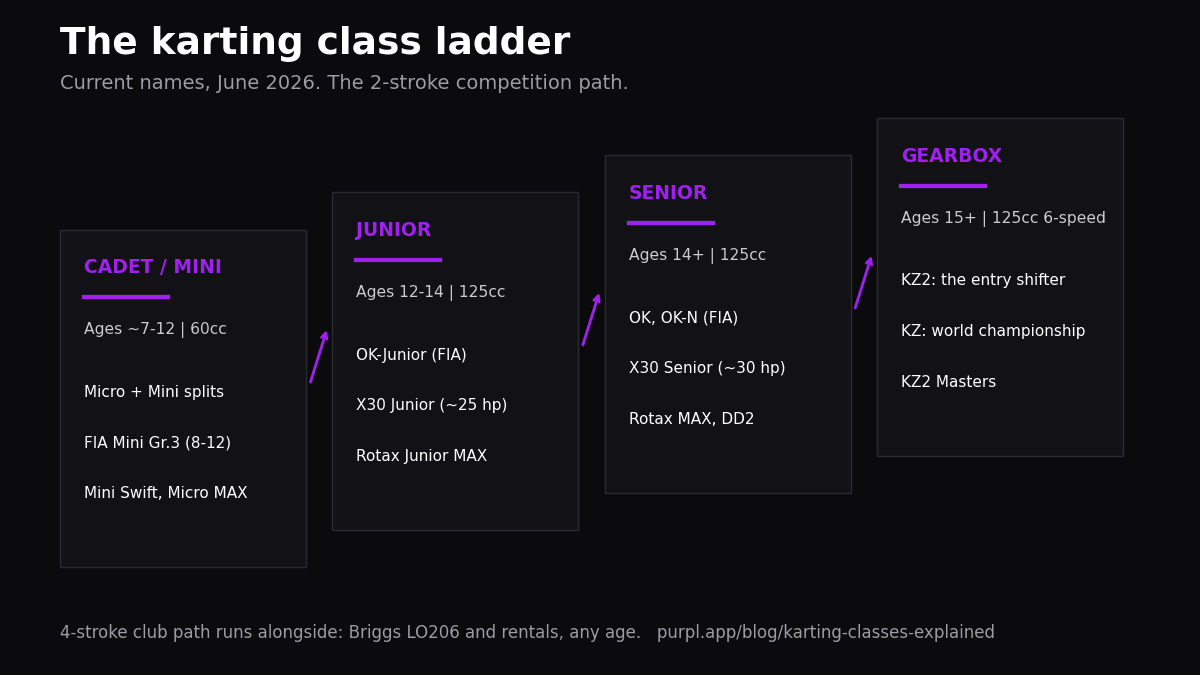
Cadet, roughly 7 to 12. The 60cc rung. Internationally the FIA runs Mini Gr.3 for ages 8 to 12, split into Under 10 and Over 10 groups.
Most countries split the same span their own way: Micro from about 7 to 10, then Mini to 12. In the US the IAME versions are called Micro Swift and Mini Swift, 60cc again. Different stickers, same rung.
These karts keep getting tamed, on purpose. New Mini technical regulations came into force on 1 January 2026, written to cut performance in the name of safety.
Good. The drivers are eight.
Junior, 12 to 14. The international class is OK-Junior, a 125cc direct-drive two-stroke. Direct drive means one gear and no shifting, so you carry speed with your hands and your lines, not a gearbox.
The one-make world mirrors the rung with X30 Junior and Junior Rotax, same ages on friendlier budgets, and most national federations add a junior class of their own on top.
Senior, 14 and up. OK is the FIA's flagship direct-drive class, the one that crowns a World Champion every year. OK-N is the calmer national-level version of the same recipe, also from 14, built for federations to run at home, and it has a junior variant of its own.
Gearbox, the top rung. KZ and KZ2 carry a 125cc engine with a six-speed box and launch from standing starts, while the rest of European karting starts rolling. Same engine spec in both; KZ is the world championship class with freer chassis and brake rules, KZ2 is where you enter.
KZ2 Masters exists for older drivers who still want the fight. And six gears means gearing homework at every track, every weekend, which is why shifter drivers obsess over gear ratios the way direct-drive drivers obsess over carburettors.
Now the renaming story, because it decides whether old advice confuses you. In 2013 I won the CIK-FIA World Championship in a class called KF-Junior. That exact class is called OK-Junior today; KF-Junior and KF became OK-Junior and OK in 2016.
Same rung, same ages, new badge. So when a 2014 forum thread says KF and a 2026 entry list says OK, they mean the same step of the ladder.
Go back further and the alphabet gets worse, Formula A, ICA, the 100cc era, which is why this page sticks to the names you'll see on a current entry list.
The path through the rungs hasn't changed, though. Start in Mini 60 between 8 and 12, move to Juniors from 12 to 14, then pick Seniors or Shifters. The classic route was a year in Seniors, then shifters at 15 or 16, then Formula 4.
These days many drivers move to F4 at 16 and skip the shifter year. Fine. But each step up costs more than the last, so a step should be justified by results, not by birthdays.
2-stroke vs 4-stroke, settled
One question sits behind half the searches that reach this page. In the 2 stroke vs 4 stroke kart debate, which one is "real" karting?
Both are. They're different tools. For different jobs.
Four-stroke karts are the budget workhorses. The engines are sealed and barely need maintenance, which is why rental fleets are almost entirely 4-stroke or electric.
The clearest example is the Briggs & Stratton 206, a factory-sealed 4-stroke of around 9 hp that dominates North American club racing. You buy it, you race it, you never open it. Running costs stay small because the rules keep the engine stock.
Two-strokes are the competition ladder. Everything from Mini 60 to KZ runs them, because a 125cc two-stroke makes far more power per kilo than any four-stroke its size.
The bill for that power is maintenance. Two-strokes want rebuilds, jetting attention and fresh parts on a schedule. The faster the class, the shorter the schedule.
Neither side is wrong, because they're answering different questions: one engine is built for the lowest cost per lap, the other for the most speed per kilogram. No club treasurer has ever confused the two.
So the confusion resolves into one line. Four-stroke means cheap and sealed but slower, the club and rental world. Two-stroke means the racing ladder, with more speed, more money and more wrenching.
That's the whole debate.
Three ecosystems, one decision
Zoom out and all the kart categories on this page collapse into three worlds. Pick the world first. The class mostly picks itself.
The FIA ladder. OK-Junior, OK, OK-N and the KZ classes, the structure laid out on the official FIA Karting categories page.
This is the international route, the one that feeds single-seaters. It's also the most expensive world by a distance, with factory teams and open competition between engine builders.
Speed costs. Here, it costs most.
If the goal is cars, this is the proving ground, and karting to car racing covers the exit. Budget honestly before you point at it. I've put real numbers in what kart racing costs.
The one-make ladders. One engine brand, sealed and equal, from cadet to senior. The two big families are IAME's X30 range and the Rotax MAX range, which runs Micro, Mini, Junior, Senior and the two-speed DD2.
Parity is the whole sales pitch: everyone bolts on the same sealed engine, so the results sheet says more about the driver and a little less about the wallet.
Both families are 125cc TaG packages, water-cooled with electric starters. TaG means touch-and-go: press a button and the engine lives. No push start, no drama for a parent-mechanic crew.
For scale, X30 Junior gives around 25 hp from age 12, X30 Senior around 30 hp. Modest numbers on paper. Then you remember the whole kart weighs less than the driver's dad.
The 4-stroke club world. The 206 paddocks, plus every rental and indoor track on the planet. It's the cheapest real racing there is, and the easiest to find.
Don't sneer at the rental rung either. Rental karts cost a fraction of professional karting; a 30-minute indoor session runs around 40 euros, which makes weekday practice genuinely affordable. Take your full safety kit when you go, because rental helmets are nobody's friend.
Choosing between the three worlds is budget first, geography second, goals third. In that order. Ambition doesn't pay entry fees.
International dreams point at the FIA ladder, eventually. Almost everyone else gets more racing per euro from a one-make class or a 206 grid, and plenty of strong careers have started on both before stepping across.
The class that matters is the one near you
Most class guides skip this. You don't choose from the whole menu, you choose from what actually races within an hour or two of home.
The standard paddock advice holds here: the best class is the one with a full grid at your nearest club, whatever the sticker on the engine cover says. Twenty karts in the "wrong" class teach more than three karts in the right one.
I'll commit to the stronger version. A full grid of slower karts beats a thin grid of faster ones at any age, because racecraft only grows in traffic. Nobody learns defending from a stopwatch.
So do the unglamorous homework. Pull up your national federation's calendar, or last season's entry lists at the two nearest clubs. Count entries per class, not logos on the poster.
Grids don't lie.
Distance matters more than it looks on a map. Forty entries two hours away can beat twelve entries ten minutes from home, but only if the travel survives a full season of early Sundays.
Match age first, then budget, then ambition. Picking in that order avoids several of the classic beginner karting mistakes before you've turned a lap.
And whichever class wins, the driving transfers, because every braking reference and every line learned in a 9 hp four-stroke still counts when the power doubles. So does the data habit, which is where the karting telemetry guide comes in once the class question is settled.
FAQ
What karting class should my child start in?
By age: national Micro or cadet around 7 to 10, Mini from about 10, all on 60cc engines. Before committing, a stretch of rental karting tells you whether the interest survives a cold morning.
Then pick whichever cadet class has the fullest local grid. The parents' guide to junior karting walks through the first season properly.
What is the difference between KZ and OK?
Gears. A KZ kart carries a 125cc engine with a six-speed gearbox and launches from a standing start. OK karts are 125cc direct drive, one gear, rolling starts.
Within the gearbox world, KZ and KZ2 share an engine spec. KZ is the world championship class with freer chassis and brake rules; KZ2 is the entry point, with KZ2 Masters for older drivers.
Are 4-stroke karts good for beginners?
Very. Sealed engines, low running costs and big club grids make a class like the Briggs 206 the cheapest real racing available. The karts are slower; the racing isn't.
The trade-off only appears if you target the 2-stroke ladder later, because the power step is real. Plan the switch instead of fearing it.
What age can kids start karting?
Rental tracks take kids once they fit the seat and reach the pedals, often around 6 or 7. Racing licences start around 7 to 8 in national Micro or cadet classes, and the FIA's international Mini Gr.3 runs from 8 to 12.
I started at six. Starting later closes fewer doors than parents fear, though; the Junior classes at 12 reshuffle the field anyway.
Alessio Lorandi started karting at six and won the 2013 CIK-FIA Karting World Championship. He raced through Formula 3, GP3 and Formula 2 before founding Purpl, an AI data coach for karting drivers.