A Parent's Guide to Junior Karting and Data Coaching
A junior karting guide for parents: what helps, what hurts, what it honestly costs, and how data coaching turns tense race weekends into steady progress.

Your kid wants to race. And now you're standing in your first paddock, coffee going cold, pretending you know what a sprocket does. Welcome.
Nobody hands you a junior karting guide at the gate. The paddock will teach you tyre pressures soon enough. What it won't teach you is the part that decides whether your kid grows here: what you say, when you stay quiet, and what you measure.
I grew up inside this pressure system. I started at six, won the World Championship in 2013, and felt from the seat what tent talk does once the visor closes.
So this one is for you, the parent: what helps, what hurts, what it honestly costs, and how data changes the conversation.
No judgment anywhere in it. Every trap below gets walked into out of love, by warm and well-meaning families, in every paddock, every single weekend, including families who read guides like this one.
The junior karting guide basics: classes, costs, kit
The practical layer first, kept short.
Kids kart racing starts younger than most parents expect. In the UK, competition can begin from a child's sixth birthday in the Bambino class, per Motorsport UK's getting started guide.
From there the ladder climbs by age and engine, all the way up to the world finals run by FIA Karting. The full map, class by class, is in karting classes explained.
Don't memorise the alphabet soup yet. Two questions cover year one: which class fits their age, and which local club runs it well. That's enough.
You don't need to buy a kart in week one. Rental sessions answer the only question that matters at the start: is the spark real. The route from rental laps to a first owned kart is mapped in how to get into kart racing.
Patience here is cheap. A few months of rental laps cost less than an impulse-bought kart nobody ends up using. The kart can wait.
When you do buy gear, one rule. Safety equipment that doesn't fit right is a real distraction on track: a tight rib protector, loose gloves, an oversized helmet. You're the one buying it, so buy fit, not growth-room.
Fit beats brand. Every time.
And the first-season mistakes are predictable, which is good news, because predictable means avoidable. The list is in beginner karting mistakes.
The three traps, and what they do inside the helmet
Now the heart of this guide. Three habits show up in almost every awning, and all three come from love. That's exactly why they're hard to spot.
The mechanism behind them is the same. Parents and coaches set high expectations, to impress a top team, to win a championship, sometimes for financial reasons, since results can mean better rates from top teams. The pressure builds anxiety and shifts the kid's focus from performing to pleasing others.
Nobody does this on purpose. So no guilt here, just the three shapes it takes, and a cheap swap for each one.
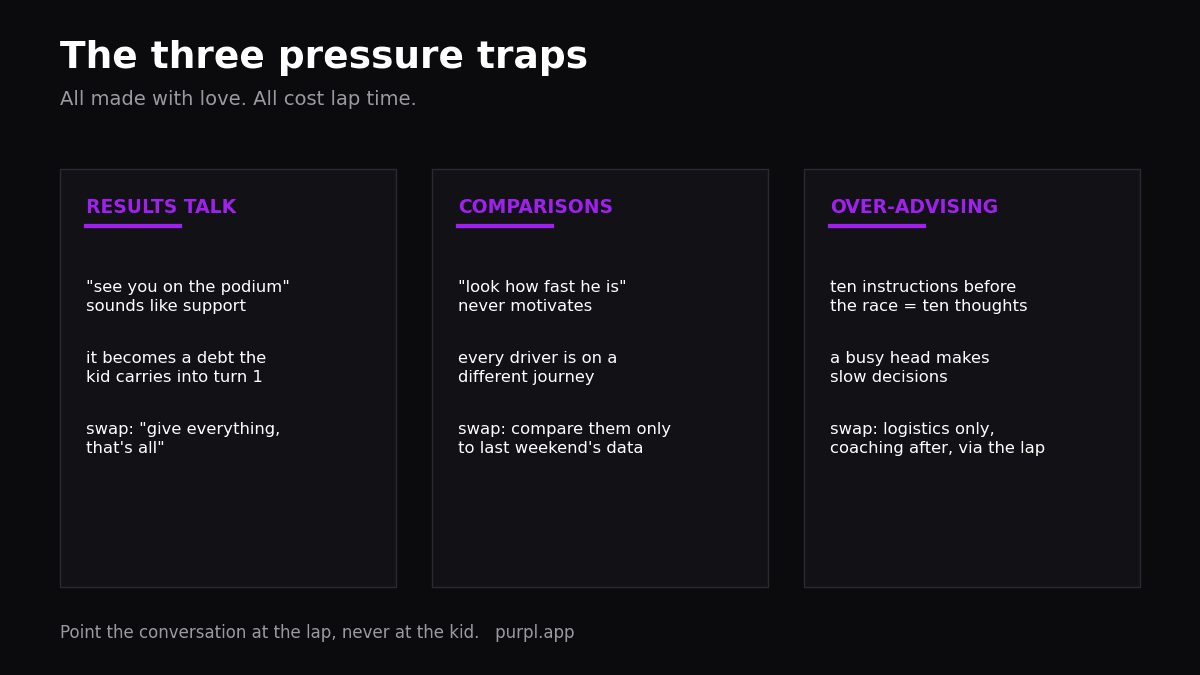
Trap one: results talk before the race
“Let's get a top 5.” “See you on the podium.” Or the worst one, “The win is yours.”
Those words are well meant. They're also useless, even damaging. When the result drifts away halfway through the race, the frustration arrives right inside the helmet, mid-job.
I heard all of them across my career. So I learned to set no expectations at all and tell myself one thing instead: “I'm just gonna give everything I have.”
Steal that mantra. Hand it to your kid, word for word.
Then make your own pre-race speech boring on purpose. Helmet ready, water in the bag, see you after.
Trap two: comparing them to other kids
Comparisons to other drivers are among the worst things you can do. Every driver is on a different path, carrying more or less experience than the kid parked in the next tent.
Social media pours fuel on this one, because scrolling other drivers' posts pulls focus from the real off-track work, the telemetry, the onboard videos, the setup talk. And it builds unreasonable expectations, with frustration following close behind.
The swap costs nothing. Compare your kid to your kid from last month: laps done, spread tightened, one corner fixed. Same ambition, pointed at something they control.
The numbers don't care what the kid in the next tent did. That's the point.
Trap three: coaching them onto the grid
A kid who gets scolded or over-advised just before a race carries every word into the seat. Too many subconscious thoughts run during the race, and they slow decision-making exactly when it needs to be fastest.
The last-minute advice feels like help from outside the helmet. Inside, it's weight.
The fix is a rule, not a talent. Before sessions, logistics only: grid time, visor, drink. Every observation waits for the download, when there's a screen to point at and time to think.
Say less, say it later. That's the whole swap.
What your kid actually needs from you
Strip it back and the list is short. Consistent logistics. Kit that fits, food, sleep, and one adult in their corner who isn't measuring them.
Be that adult. It's the quietest job in the paddock, and the only one nobody else can do. Mechanics will come and go, engines will get blamed, and results will matter less someday than anyone in the awning believes, but one calm adult is remembered for life.
They'll also need your calm after mistakes, because mistakes have a long tail. One early spin can poison a whole session unless the driver learns to let it go, and the earlier it's released, the sooner the quick laps come back.
Your face at the fence is part of that mechanism. Treat the spin as information and letting go gets easier; treat it as a disaster and the next mistake gets heavier.
The data way out of the pressure trap
Here's the quiet gift of data coaching for parents: it gives everyone something neutral to look at. The conversation lands on the lap, not on the kid.
No verdicts. Just a lap, a number, and a plan.
Progress turns measurable in ways no ranking can argue with, like the consistency spread across a run. One project per session keeps the stakes small. And the debrief becomes two calm questions on a debrief sheet instead of a verdict.
That's the short version, on purpose. The full method, with the three tent rules for parents, lives in using data to build confidence. If telemetry itself is new territory, start with the karting telemetry guide.
The wider youth-sport world points the same way. The Positive Coaching Alliance has been teaching this balance to sports parents since 1998, and karting is no exception.
The family decision nobody warns you about
Past a certain level, junior karting stops being a hobby with a schedule and becomes a family project. It's better to see that early, with eyes open, because the families who struggle are the ones who slid into it one upgrade at a time, without deciding.
The kids who make it to the very top tend to have three things arranged. Full school flexibility, so track time doesn't fight the timetable. Enough budget for the whole racing program plus extra track time, and someone who can take them to the track when the parents can't.
Read that as information, not as a bar you have to clear. It describes the all-in route, the one pointed at Formula 1, and almost nobody needs to be on it.
And there's no shame at club level. None.
The honest move is choosing your level on purpose. A club season is a complete sport in its own right, and most of the learning happens there at a fraction of the price. The level-by-level numbers are in the cost of kart racing.
If cars are the long-term dream, the ladder beyond karting has its own price tags, mapped in from karting to car racing. Whatever you choose, choose it out loud. A budget decided at the kitchen table beats one that drifts upward in the paddock.
FAQ
What age can my child start karting?
First rental laps often happen around five or six, and UK Bambino competition can start from the sixth birthday. I did my own first laps at six. Starting at eight or ten works too, because the ladder has entry points at every age.
Let rental sessions answer the readiness question for you. A kid who keeps asking to go back, unprompted, has answered it.
How do I support my child in karting without pressuring them?
Own the things they can't: logistics, kit that fits, food and sleep. Keep pre-race talk practical, keep results talk out of the car, and compare them only to themselves from a month ago.
Then give the ambition somewhere safe to live. One project per session and a simple debrief sheet let a kid chase improvement hard without anyone mentioning the championship.
And smile on the bad days. They're watching your face more than the timing screen. Especially then.
Is karting safe for kids?
It's motorsport, so respect the risk rather than dismiss it. That said, entry classes are built around small engines and low speeds, modern karts carry full bodywork, and official events run kart checks with marshals on post.
The gear list covers an approved helmet, a suit, gloves and rib protection, bought to fit the child they are now. Your two levers as a parent are gear that genuinely fits and a well-run club, and both get chosen before the engine ever starts.
How much does junior karting cost?
It depends entirely on the level, and the spread between club racing and the international scene is enormous. The honest level-by-level breakdown, rental laps to world championship, is in the cost of kart racing guide.
Decide the level first, then the budget, then say both out loud at home, ideally before the season starts and definitely before the trailer does. The expensive mistake isn't picking a modest level; it's never deciding at all.
Alessio Lorandi started karting at six and won the 2013 CIK-FIA Karting World Championship. He raced through Formula 3, GP3 and Formula 2 before founding Purpl, an AI data coach for karting drivers.